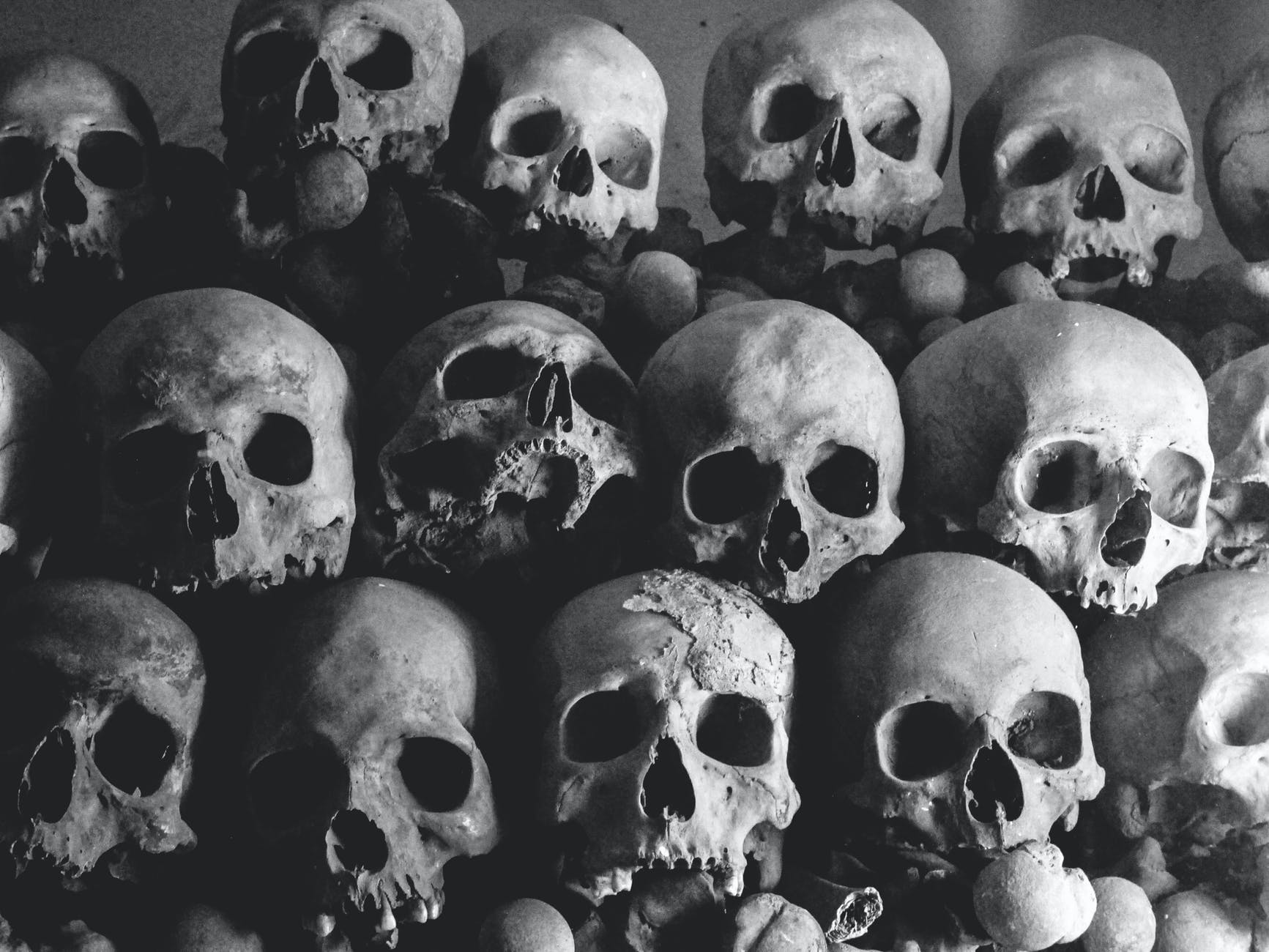
A Jomon woman from 8,300 years ago and a Yayoi man from 2,300 years ago were sequenced at 67- and 46-fold coverage, revealing divergent demographic histories and an unexpected shared trait.
Ancient DNA is usually read badly. Degradation and contamination mean most ancient genomes are sequenced at low coverage — each position in the genome seen once or twice, if at all — which is enough to place an individual on a population tree and not much more. Questions about how populations changed in size, or about variation in the number of copies a person carried of a particular gene, need better data.
A study in the Proceedings of the National Academy of Sciences from Kanazawa University reports two Japanese ancient genomes at unusually high coverage, and uses them to ask those harder questions.
The research teams were led by Koji Ishiya of Kanazawa University.
Two people, eight thousand years apart
The individuals are IY1, a woman from the Initial Jomon period who lived about 8,300 years ago, and DO, a man from the Middle Yayoi period who lived about 2,300 years ago. IY1’s genome was sequenced to roughly 67-fold coverage and DO’s to roughly 46-fold.
Those numbers are the methodological point. Coverage of 67-fold means each position was read on average 67 times, which is better than many modern human genomes and extraordinary for a sample eight millennia old. At that depth a genotype can be called confidently at nearly every position, including the structural variation and copy-number differences that low-coverage data cannot resolve.
The two periods they span are the central division in Japanese prehistory. The Jomon were hunter-gatherers, foragers and potters who occupied the archipelago for over ten thousand years; the Yayoi period begins with the arrival of wet-rice agriculture and of people from the Asian mainland, and present-day Japanese ancestry is generally modelled as a mixture of these two sources, with a third component added in more recent work.
Where each one sits
IY1 clustered with previously studied Jomon individuals, supporting an early-diverging Jomon-related lineage that contributed to present-day Japanese.
DO was genetically closer to present-day mainland Japanese and carried Northeast Asian ancestry components. Mixture models for the Yayoi pointed to contributions from groups linked to the Amur River region, Inner Mongolia and Shandong.
The study’s own treatment of those three is worth preserving carefully: they are used as genetic proxies rather than as direct ancestors. That distinction is the difference between a defensible claim and an overreach. Ancient-DNA mixture modelling works by finding which available reference populations best reconstruct a target’s ancestry, and the available references are whoever happens to have been sequenced — so naming the Amur region says the Yayoi component resembles people from there, not that anyone migrated from there.
Two different population histories
The high coverage is what makes the demographic reconstruction possible, and it produced a contrast.
Both ancestral populations declined around the Last Glacial Maximum, roughly 20,000 years ago, which is unsurprising — the coldest phase of the last ice age contracted habitable range for human populations across the northern hemisphere.
Afterwards they diverged. The Yayoi-related lineage grew gradually, possibly beginning that growth on the Eurasian continent before migrating to the archipelago, while the Jomon-related lineage stayed comparatively stable.
A stable population over thousands of years is itself a finding about the Jomon. Sustained demographic equilibrium suggests a subsistence system operating near the capacity of its environment without the expansion that agriculture typically drives — which fits the archaeology of a forager society that persisted for ten millennia without adopting farming.
The amylase result
The finding the authors single out concerns a gene for digesting starch. Both individuals had relatively high amylase gene copy numbers.
Amylase is the enzyme that breaks starch into sugars, and humans carry variable numbers of copies of its genes — more copies, more enzyme. The textbook interpretation has been that high copy numbers were selected for in populations that adopted starch-rich agricultural diets, making copy number a signature of farming.
A Jomon forager from 8,300 years ago with a high copy number does not fit that story.
“High-coverage ancient genomes allow us to investigate much more than broad population relationships,” Ishiya said. “They provide information about demographic history and complex genetic variation that is often inaccessible in low-coverage data.”
“We were particularly interested to find a relatively high amylase gene copy number in an Initial Jomon individual,” he said, “because it suggests that the relationship between plant-food use and human genetic variation may have a deeper and more regionally diverse history than previously recognized.”
There is a plausible mechanism, and the Jomon case supplies it. Foragers in temperate Japan had access to a great deal of starch without farming: acorns, chestnuts, and starchy roots and tubers, all of which appear in Jomon archaeological deposits alongside storage pits and grinding equipment. A diet heavy in wild starch would exert the same selective pressure as a diet heavy in cultivated starch.
What two genomes can and cannot settle
The sample size is the governing limitation, and it is two.
Copy number varies substantially between individuals within any population, so a high value in one Jomon person establishes that high copy numbers existed among the Jomon — which is a real and interesting fact — and says nothing reliable about the Jomon average or about whether selection had acted. Distinguishing a selected population-wide shift from one individual at the upper end of a normal distribution requires many genomes, not one.
The demographic reconstructions carry their own assumptions. Methods that infer past population size from a single genome read patterns in how genetic variation is distributed along chromosomes, and they depend on assumed mutation and recombination rates and on the absence of population structure that the model does not include. They are informative about broad trajectories and not precise about magnitudes or dates.
The release names no authors besides Ishiya and gives no author list, and it contains no conflicts of interest statement.
The paper was published on 23 July 2026, and was funded by a long list of MEXT and JSPS KAKENHI grants, the Mishima Kaiun Memorial Foundation, the JSPS Program for Forming Japan’s Peak Research Universities, and the TRiSTAR programme.
Notes
- “High-coverage ancient genomes reveal divergent population histories and prehistoric starch-related genetic variation in Japan.” Proceedings of the National Academy of Sciences, 2026. DOI: 10.1073/pnas.2606162123.
- Kanazawa University. “High-coverage ancient genomes reveal prehistoric population histories of Japan.” EurekAlert!, 6 August 2026. https://www.eurekalert.org/news-releases/1139263.
Photo by Felipe Hueb on Pexels.com



Leave a Reply