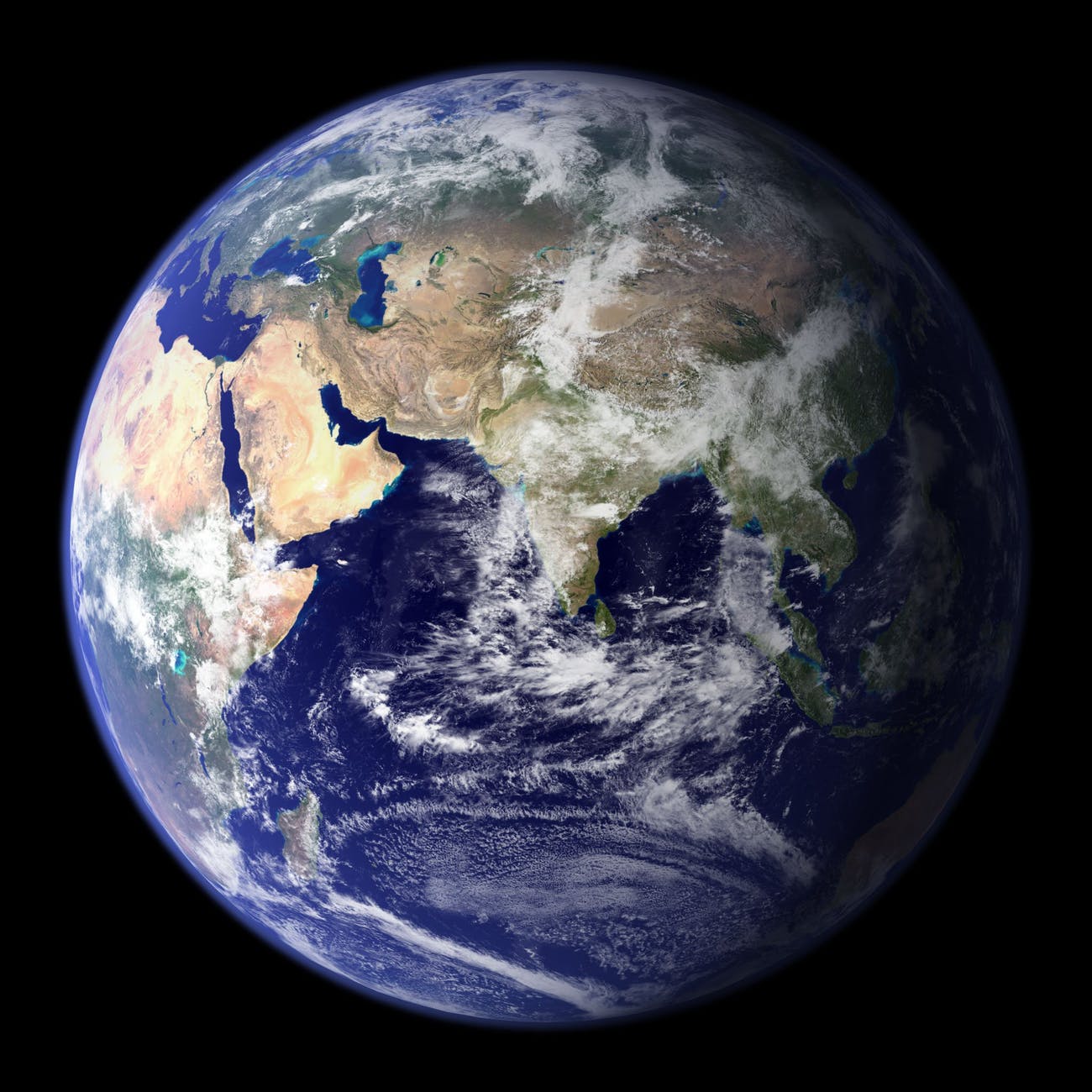
By looking for a distinctive global pattern of flooding and exposure in 320 million years of sea-level maps, researchers found four intervals of rapid true polar wander, including two in the Cretaceous.
The Earth is not a perfect sphere, and it does not spin like a perfectly balanced top. Its mass is distributed unevenly, and that distribution governs how the planet sits relative to its axis of rotation. When tectonic plates drift and material churns through the mantle, enough mass can shift that the solid Earth reorients itself, the crust and mantle sliding as a unit while the core and the climate belts stay fixed to the spin axis.
Geologists call this true polar wander, or TPW, and they have argued about it for decades. Some reconstructions suggest the planet has occasionally lurched by substantial angles in a geologically short time. Others conclude that any such motion has been slow and minor. A study published in Science now offers evidence from an unexpected source: the record of ancient sea levels.
“These findings refute the view of TPW as negligible or persistently slow,” the authors write, and “highlight the need to consider TPW as an episodic control on sea level change.”
Why the oceans would notice
The method rests on a simple consequence of reorientation. Sea level is not the same everywhere; the ocean surface follows the planet’s gravity field and the bulge created by rotation. If the solid Earth shifts relative to its spin axis, the water adjusts, and the result is a predictable pattern of flooding in some regions and exposure in others, distributed across the globe in a characteristic way.
Crucially, that pattern is not random. The paper’s title calls the signal quadrupolar, a term physicists use for a field or distribution with four alternating lobes rather than a single centre. Ordinary causes of sea-level change, such as the growth and melting of ice sheets or the slow subsidence of a basin, would not be expected to produce that geometry.
Mathew Domeier of the Centre for Planetary Habitability at the University of Oslo and colleagues used maps of ancient sea-level change at 10-million-year intervals, covering the past 320 million years, and applied statistical modelling to search for the signature.
Four intervals
The analysis turned up four intervals with significant TPW signals. The release names two of them: the mid-Cretaceous, roughly 100 to 90 million years ago, and the Late Jurassic to Early Cretaceous, roughly 150 to 140 million years ago.
Both results broadly support earlier studies based on paleomagnetism, the record of Earth’s magnetic field locked into rocks as they form, and on reconstructions of plate motion. Those methods had pointed toward rapid polar wander in the Cretaceous, but the conclusions were contested, in part because ordinary tectonic motion can leave similar traces. An independent line of evidence, drawn from an entirely different kind of data, carries weight.
The study also found what was not there. Through most of the Cenozoic, the era that began about 66 million years ago, there was little evidence of rapid TPW. And the analysis found no significant signal supporting a long-standing proposal that polar wander primarily drove the rapid northward movement of the supercontinent Pangea during the late Carboniferous and Permian.
A hard thing to detect
The difficulty with studying true polar wander has always been disentangling it from plate tectonics. Both move continents relative to the poles. Paleomagnetic data record a rock’s latitude at the time it formed, but they cannot by themselves distinguish a continent that drifted north from a planet that rolled beneath a stationary axis.
The usual workaround is to look for motion shared by all continents at once, since plate tectonics moves plates in different directions while polar wander moves everything together. That approach requires good global coverage and precise dating, and it has produced conflicting results.
Reconstructing sea level in the deep past is its own undertaking. Geologists infer it from the rock record: marine sediments deposited where there is now dry land indicate flooding, while erosion surfaces and gaps in the sequence indicate exposure. Compiling those observations continent by continent produces maps of which regions were underwater at a given time, and those maps are the raw material this study searched for its pattern.
Sea level offers a different handle on the problem. The flooding pattern produced by reorientation depends on the geometry of rotation rather than on the behaviour of individual plates, so it provides a check that does not rely on the same assumptions.
What a lurching planet would do
If the solid Earth has periodically shifted by appreciable amounts, the consequences would reach well beyond geophysics. Climate belts are tied to the spin axis, not to the rocks, so a continent carried to a new latitude by polar wander would find itself in a different climate regime without having drifted an inch by tectonic means.
Sea level itself is a consideration for the history of life. Shallow seas flooding or draining from continental interiors reshape habitats, alter the chemistry of ocean basins and leave their mark in the fossil record. Episodes of rapid reorientation would add a factor that paleontologists and climate modellers have not generally had to account for.
The authors say TPW likely affects other global environmental and biological processes as well, and that is the argument the paper makes most forcefully: not that polar wander is constant, but that it comes in episodes significant enough to be worth including in reconstructions of Earth’s past.
Whether the other two intervals the study identifies line up with known upheavals in the geological record, and how large the implied shifts were, are questions the paper’s full analysis will have to answer. The release gives no rates or degrees of rotation.
What the work establishes is that the oceans have been keeping a record of the planet’s balance, and that the record is legible.
Notes
- Domeier, M., et al. “Quadrupolar sea-level fluctuations reveal episodes of rapid polar wander.” Science, 2026. DOI: 10.1126/science.aec8423.
- American Association for the Advancement of Science. “Ancient seas reveal times when the Earth rapidly shifted relative to its axis.” EurekAlert!, 1 October 2026. https://www.eurekalert.org/news-releases/1145641.
Photo by Pixabay on Pexels.com


Leave a Reply