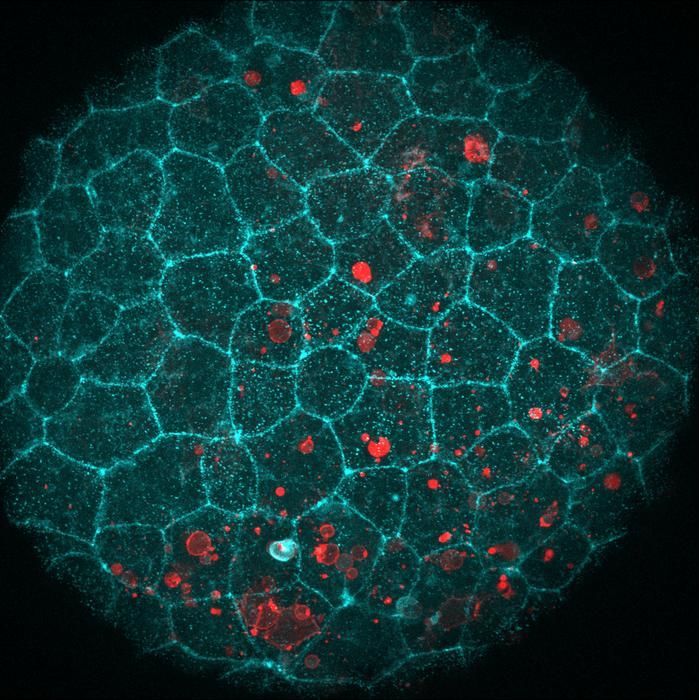
University of Turku researchers found functionally mature neutrophils in many developing tissues, often outside blood vessels, suggesting roles in tissue development as well as defense.
Neutrophils are the immune system’s rapid responders. These white blood cells are the most abundant in human blood and are typically the first to rush to a site of infection or injury, where they engulf microbes and release toxic chemicals to destroy them. They are usually thought of as cells that matter after birth, when the body faces a world full of pathogens.
New research from the University of Turku in Finland suggests that they are busy much earlier. In a study published in Nature Communications, researchers report that neutrophils are present in many tissues of the developing embryo and are already capable of performing adult immune functions.
“We were immediately intrigued. What is the role of these defence cells when the embryo is still safely inside the uterus?” said Laura Lintukorpi, a doctoral researcher at the university.
Defenders in a sterile place
The finding was unexpected because of where embryos develop. “The uterus provides an almost sterile environment where there should not yet be any need for rapid defence cells,” Lintukorpi said.
Working with experimental models, the team found neutrophils in large numbers in several developing embryonic tissues. Many of the cells sat outside blood vessels, in direct contact with developing tissue cells, rather than simply circulating in the blood. The release does not specify which species or tissues were examined.
The researchers describe the study as the first to show that neutrophils are present in many embryonic tissues.
Mature, not dormant
One possibility was that embryonic neutrophils are immature versions of adult cells, waiting to be activated after birth. To find out, the team used single-cell RNA sequencing, a technique that measures which genes are active in individual cells. Embryonic and adult neutrophils differed slightly in their gene activity but went through similar major developmental stages.
The researchers then tested what the cells could do. “Embryonic neutrophils were able to perform immune functions typical to adult neutrophils,” said Julian Hofmann, a doctoral researcher on the team.
Those functions included engulfing particles, producing reactive oxygen compounds that can kill microbes and forming neutrophil extracellular traps, web-like structures of DNA and proteins that ensnare pathogens. “Embryonic neutrophils are therefore not merely dormant developing cells, but functionally mature cells,” Hofmann said.
Neutrophils have a short lifespan in adults, typically circulating for less than a day before they die and are cleared away, which is one reason they were long viewed as simple, short-lived foot soldiers. Over the past decade, however, researchers have found that neutrophils are more diverse than once believed, with distinct subtypes and the ability to persist in certain tissues.
More than defense
The location of the cells, nestled among developing tissue rather than confined to blood vessels, hints that they may do more than fight infection. “This suggests that embryonic neutrophils may have functions related to tissue development and homeostasis,” Hofmann said, referring to the processes that keep tissues stable and functioning.
That idea fits a broader shift in immunology. Immune cells are increasingly recognized as contributors to development and tissue maintenance, not just defenders. Macrophages, another type of immune cell, help sculpt developing tissues by clearing away dying cells, support the growth of blood vessels and prune connections in the developing brain. In adults, neutrophils have been found to help repair tissue after injury.
Pia Rantakari, a docent and group leader in the university’s InFLAMES research flagship, said the findings from experimental models show that neutrophils play an active role in developing tissues. “Embryonic neutrophils are a functionally competent cell population adapted to a specific stage of development,” she said. The work was carried out with Marko Salmi, also an InFLAMES group leader.
Why it could matter
If similar cells are found in human embryonic tissues, the researchers say, the findings could eventually inform treatments for prenatal and perinatal infections and inflammatory diseases. Infections and inflammation during pregnancy are linked to complications for both mother and baby, and the immune environment of the developing fetus is still poorly understood.
Neutrophils also matter for newborns. Babies born prematurely have immature immune defenses and are particularly vulnerable to infections such as sepsis, and their neutrophils often function less effectively than those of full-term infants. Learning how neutrophils develop and behave before birth could help researchers understand why.
Neutrophils are also a double-edged sword. Their chemical weapons and extracellular traps can damage healthy tissue when they are overactive, and excessive neutrophil activity has been implicated in inflammatory conditions. Understanding how embryos keep these powerful cells in check while allowing them to contribute to development could offer insights relevant to adult disease as well.
The study leaves important questions open. The release does not describe which specific developmental processes embryonic neutrophils might support, and the findings come from experimental models rather than human tissue. Demonstrating that the cells actively shape tissue development will require experiments that remove or alter them and track the consequences.
InFLAMES is part of the Research Council of Finland’s Flagship Programme. The results suggest that the immune system’s first responders are on the scene long before birth, possibly with jobs that have little to do with fighting germs.
Notes
- “Tissue-resident neutrophils serve homeostatic and immunological functions in embryos.” Nature Communications, 31 August 2026. DOI: 10.1038/s41467-026-75410-0.
- University of Turku. “Immune system is already active before birth.” EurekAlert!, 19 October 2026. https://www.eurekalert.org/news-releases/1148347.
Laura F. Bianchi/Centro de Regulación Genómica



Leave a Reply