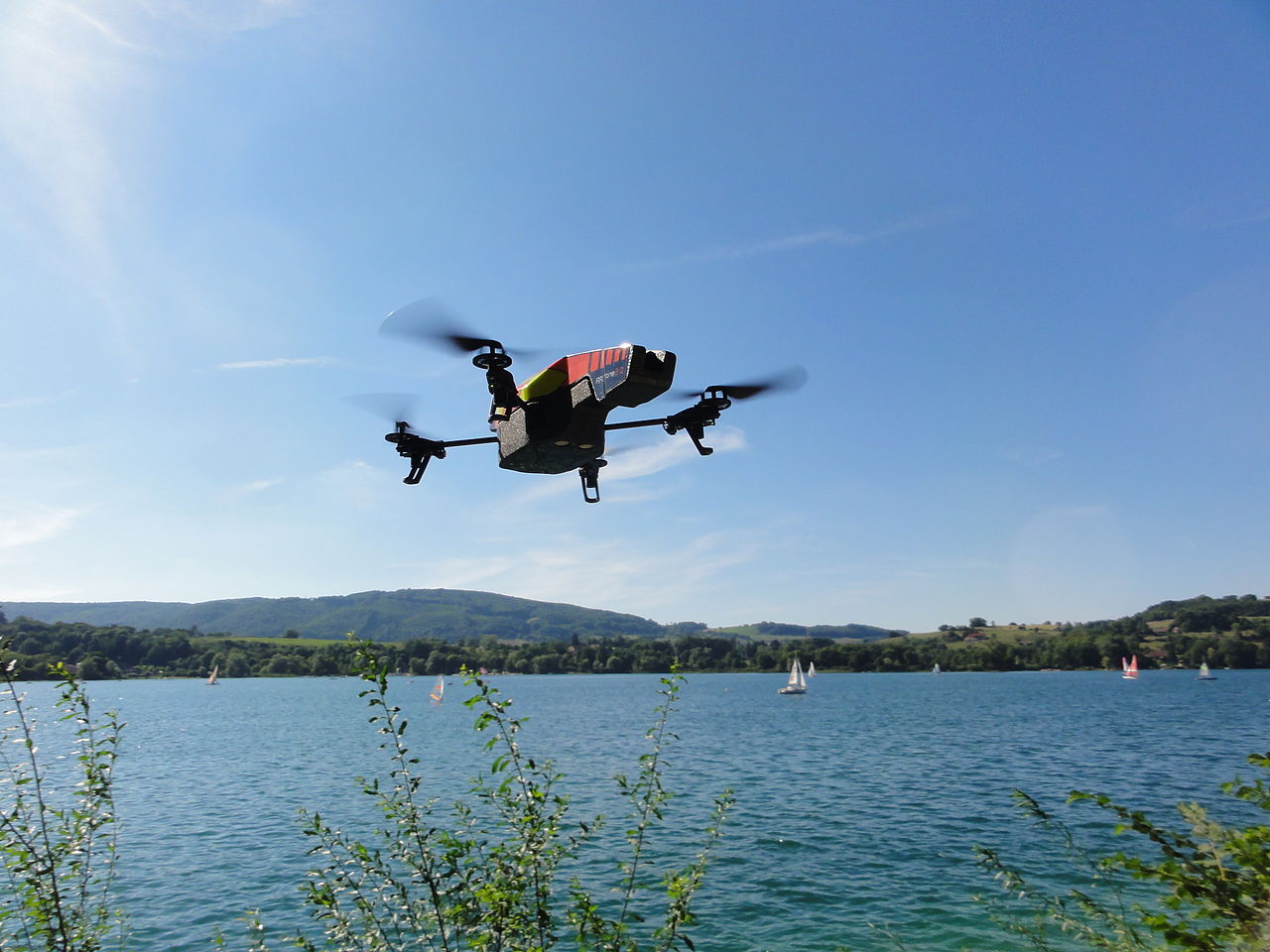
A Chinese team built a lightweight perovskite-thermoelectric receiver that turned 38.49% of green laser light into electricity and powered a stationary drone model’s propeller.
Drones have become indispensable for jobs from mapping farmland to inspecting power lines and searching disaster zones. But they share a stubborn limitation: batteries. Most small electric drones can stay aloft for well under an hour before they have to land and recharge or swap packs, which limits how far they can go and how long they can work.
Researchers in China are working on a way around that problem by beaming power to drones while they fly. In a study published in Matter & Light, they describe a lightweight receiver that converts laser light into electricity and stays efficient by managing the heat that comes with it.
“Imagine a future where drones inspecting forests, monitoring disasters, or delivering packages no longer need to land frequently to replace batteries,” said senior author Jianhua Han of the Civil Aviation University of China. “As drones take on longer missions, battery life has become one of the biggest barriers.”
Power by beam
The idea of laser power beaming has been around for decades. A ground-based laser is aimed at a receiver on a moving vehicle, which converts the light into electricity in much the same way a solar panel converts sunlight. Because a laser concentrates energy into a narrow beam at a single wavelength, receivers can be tuned to convert it far more efficiently than they convert broad-spectrum sunlight.
Earlier experiments have shown that laser beaming can keep small aircraft aloft, but practical systems face several problems. Receivers must be light enough for a drone to carry, efficient enough to be worthwhile, and robust enough to survive intense, concentrated light.
Too hot to handle
The team’s device is a tandem of two technologies. The front layer is a perovskite laser cell, based on the perovskite materials that have rapidly become one of the most promising alternatives to silicon in solar cells. It converts laser light directly into electricity.
Perovskites are a family of crystalline materials named for a mineral with the same structure. Their rise in solar energy has been unusually rapid: perovskite solar cells went from converting under 4 percent of sunlight to electricity in their first reported versions in 2009 to more than 25 percent in the best laboratory cells today, rivaling silicon. They are also thin and light, which suits applications where every gram counts.
Behind the perovskite layer sits a thermoelectric layer. Thermoelectric materials generate electricity from a temperature difference, a phenomenon known as the Seebeck effect. The larger the gap between the hot side facing the laser and the cooler side behind it, the more power they produce. In principle, the combination can harvest both the light and the waste heat it creates.
In practice, heat proved to be a bigger problem than expected. “When we tested the device under a high-power laser, the thermal camera showed temperatures of 80 to 90 degrees Celsius,” Han said. “That was much higher than we expected and made us realize that heat buildup was a far more serious problem than we had imagined.”
Perovskite materials are known to degrade at high temperatures, and heat reduces the efficiency of most photovoltaic devices. Without a way to control it, the receiver would undermine itself.
A thermal barrier
The team’s solution was to embed nanocrystals of antimony selenide, Sb₂Se₃, which conducts heat poorly and acts as a thermal barrier. The nanocrystals helped the device keep performing during long laser exposure.
Under a green laser, the system converted 38.49 percent of the incoming energy into electricity. The release describes that as among the highest efficiencies reported for this class of technology under similar conditions.
The researchers then fitted the device under the wing of a stationary drone model and cut air channels through the wing. The green laser powered the model’s propeller. Airflow through the channels also cooled the thermoelectric layer’s back side, widening the temperature gap and boosting performance, a neat example of turning flight itself into part of the cooling system.
“Previous studies largely focused on the materials or the device itself,” Han said. “We wanted to think beyond the laboratory, to how the system could actually be integrated into an aircraft, cooled during operation, and made compatible with flight. It isn’t just a materials science problem; it’s an engineering one.”
From one to a hundred
The system has not yet flown. The next step is a test on a lightweight drone to see whether it works reliably outdoors. The release does not report the device’s power output, the number of trials or error margins.
Larger challenges lie ahead. A laser must track a moving drone precisely, through wind, turbulence and changing distances, and any practical system must be safe for people, animals and other aircraft that might cross the beam. High-power lasers can damage eyes instantly, and regulators would need to be satisfied before such systems could operate in shared airspace. Weather is another obstacle, since clouds, fog and rain scatter laser light.
If those problems can be solved, the applications are wide. Drones that never need to land could monitor wildfires, patrol pipelines, relay communications after disasters or inspect long stretches of infrastructure. Military agencies have also shown long-standing interest in power beaming for drones and remote outposts.
Han is candid about the distance still to go. “Our work demonstrates the possibility of ‘refueling aircraft with light,’” he said. “Going from 1 to 100 will require solving many engineering challenges, but we hope this provides a starting point for future development.”
The work was funded by the National Natural Science Foundation of China.
Notes
- “Sb2Se3 nanocrystals enable efficient perovskite-thermoelectric tandem devices for laser-powered unmanned aerial vehicles.” Matter & Light, 29 July 2026. DOI: 10.1016/j.matlit.2026.100066.
- Cell Press. “Charging drones mid-flight with lasers.” EurekAlert!, 29 July 2026. https://www.eurekalert.org/news-releases/1137218.


Leave a Reply