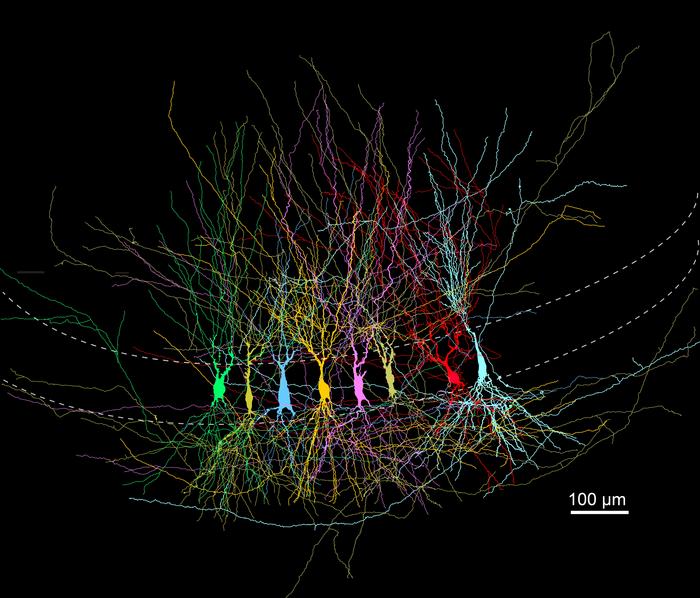
Blocking rewiring in pyramidal tract neurons stopped mice from learning a timed task, while more abundant neighbors proved dispensable.
A tennis player timing a return, a musician landing on the beat and a driver easing off the brake all rely on the same quiet skill: knowing not just how to move, but when. That sense of timing is learned, and the brain must physically rewire itself to learn it. A new study from the Max Planck Florida Institute for Neuroscience (MPFI) in Jupiter, Florida, shows that not every neuron gets an equal say in that rewiring.
Published in Nature Communications, the work led by Shouvik Majumder and senior author Hidehiko Inagaki finds that a single class of neurons in the premotor cortex is essential for learning the timing of an action, while a more numerous neighboring class is not.
Teaching mice to wait
The researchers trained mice to wait progressively longer after a tone before reaching for a reward. As the animals learned, the team recorded electrical activity from thousands of neurons in the premotor cortex, a region involved in timing movements, and watched the activity patterns shift as the mice learned to hold back.
That kind of recording shows what changes during learning, but not what causes it. “We had good knowledge of how brain activity changes during learning to shape movement timing,” Majumder said, “but to really understand how the brain learns we needed a way to test how the rewiring of specific neurons changes brain activity and behavior.”
So the team used molecular tools to disable the machinery of synaptic plasticity, the strengthening and weakening of connections between neurons, in specific cell types while the mice were learning. Then they recorded both neural activity and behavior to see what broke.
Widespread, but not redundant
The answer was striking. When plasticity was blocked in pyramidal tract (PT) neurons, which send signals out of the cortex toward the brainstem and spinal cord, the mice did not learn the new timing at all. When it was blocked in intratelencephalic (IT) neurons, which are more abundant and mostly communicate within the cortex and other forebrain regions, learning proceeded.
The study also found that two distinct subgroups of PT neurons played complementary roles in adjusting the timing of movement.
“We discovered that while plasticity in the brain is widespread, it is not redundant,” Inagaki said. “Plasticity in specific cell types plays precise roles that are required to shape neural activity and lead to changes in behavior.”
The finding cuts against a common intuition. Because nearly every kind of neuron can change its connections, it might seem that learning is distributed broadly, with many cell types sharing the load and able to cover for one another. In this case, at least, the premotor cortex appears to have assigned the job to a specific workforce.
Toward a cell-by-cell map of learning
The team plans to apply the same approach to other aspects of motor learning, building a picture of which cell types’ plasticity supports which kinds of skill. In the longer term, that kind of map could help clinicians and researchers trace particular learning difficulties back to specific neuron types, rather than to a brain region as a whole.
The work was carried out in mice, and a simple waiting task is a long way from the rich timing demands of human life. But the principle it points to, that the brain hands specific learning jobs to specific cells, may help explain how a single region can learn many things without its lessons getting tangled.
Notes
- Majumder, S., Hirokawa, K., Yang, Z., Jain, A., Paletzki, R., Gerfen, C. R., Fontolan, L., Romani, S., Yasuda, R., & Inagaki, H. K. “Complementary roles of cell-type-specific plasticity in shaping neocortical dynamics for learning action timing.” Nature Communications, 6 July 2026. DOI: 10.1038/s41467-026-74869-1.
- Max Planck Florida Institute for Neuroscience. “Setting the brain’s internal clock.” EurekAlert!, 29 September 2026. https://www.eurekalert.org/news-releases/1145967.
Featured image: Jose Guzman / Jonas group at ISTA



Leave a Reply