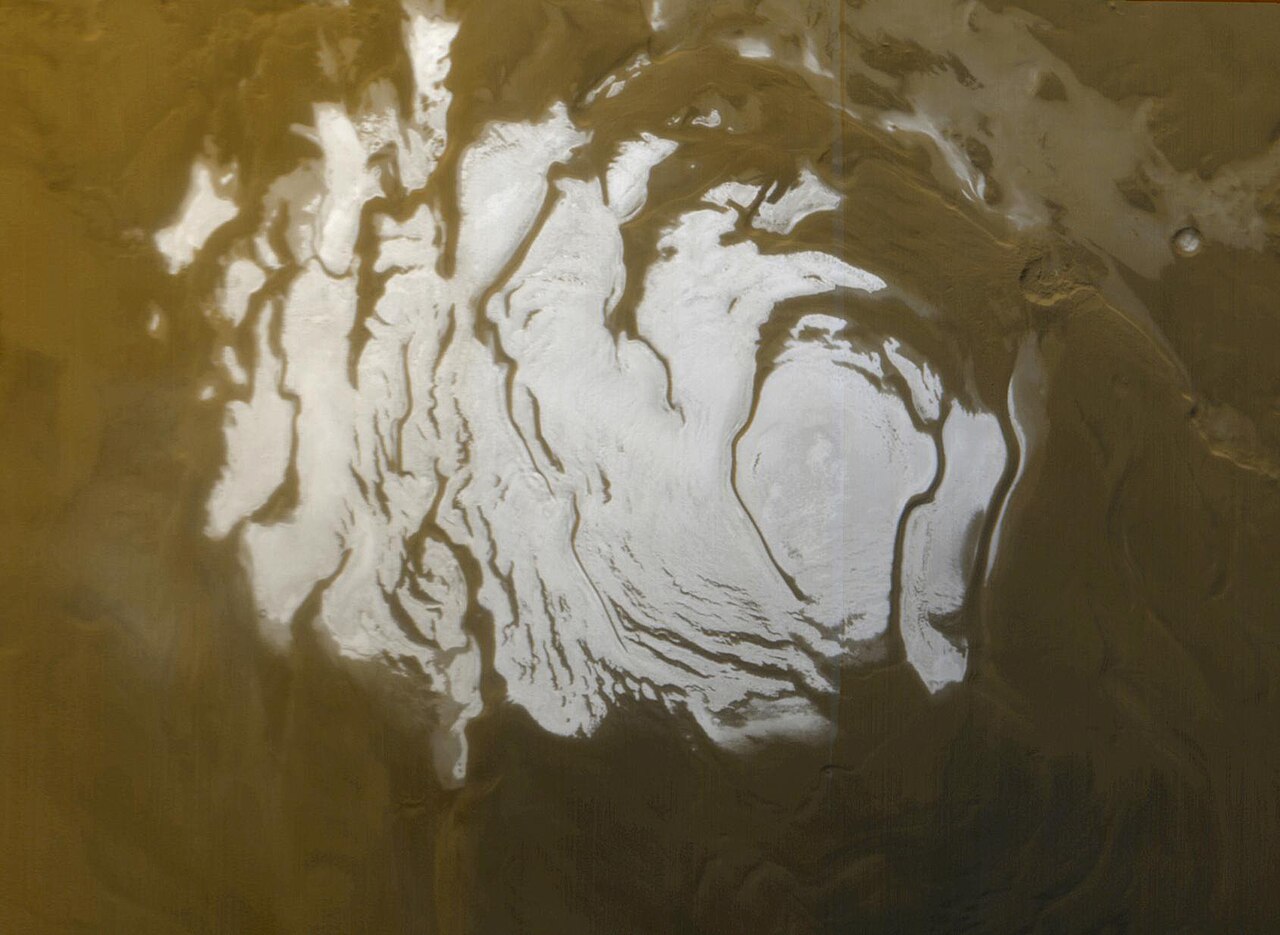
Borrowing a method built for Earth’s snow, researchers estimate the polar ice holds about 3 percent dust, not as much as 25 percent.
The ice cap at Mars’s north pole is a layered archive of the planet’s climate, built up over countless seasons of frost, dust and ice. How much of that archive is dust has been a matter of sharp disagreement. A new analysis suggests the answer is: much less than many scientists believed.
In a study published September 8 in npj Space Exploration, researchers at the University of Washington estimate that the top layer of exposed water ice near the north pole contains roughly 3 percent dust by mass. Previous estimates had put the figure as high as 25 percent.
“We know there is water ice in the area surrounding the north pole of Mars,” said Aditya Khuller, a senior research scientist at the UW Applied Physics Laboratory who led the work. Yet, he added, “there has been widespread disagreement as to how dusty that ice is.”
Why dust matters
The difference is more than a rounding error. Dust darkens ice, and darker ice absorbs more sunlight. “If it is dustier, the ice will be darker,” Khuller said. “Just like a dark T-shirt in the sun makes you warmer, dusty ice gets warmer and vaporizes faster on Mars.”
That makes dust content central to understanding how Mars’s polar ice grows and shrinks, and how faithfully its layers record the planet’s climate history. Mars lacks a large moon like Earth’s to steady its tilt; its two small moons do little to stop the axis from swinging, which drives dramatic climate shifts over time. Ice ages have left shallow ice across roughly a third of the planet.
An Earth method on another world
Earlier estimates relied on an approach developed for lunar soil, which the team found gave questionable results when tested on Earth. Khuller turned instead to the work of Steve Warren, a UW professor emeritus of Earth and space science, whose methods for studying snow and ice “had been used successfully to study snow and ice on Earth for decades.”
“So I thought it would be interesting to adapt these Earth-tested methods to Mars,” Khuller said.
Working with Pari Mohan, a recent UW geoscience graduate who co-led the analysis, Khuller combined observations from orbiting satellites with data from NASA’s 2008 Phoenix lander, which sampled ice near the north pole.
An ice-cream sandwich of a pole
The analysis also tracked how the polar surface brightens and darkens through the Martian year. The north pole, the release notes, is built like an ice-cream sandwich, with dustier layers sandwiched between slabs of cleaner ice. “By looking at how the brightness changed over time, we figured out that there is a frost that forms in the winter and it’s more dusty,” Khuller said. “In the Martian summer it goes away, exposing cleaner, older ice.”
The work builds on earlier research by Khuller and colleagues proposing that dark dust layers within ice could trap sunlight and form small, nutrient-rich pockets of meltwater, environments that on Earth host microbial life in summer. A cleaner pole does not rule that out, but it refines the conditions under which such pockets might form.
For Khuller, the parallel between the two planets is part of the draw. “The fact that Mars and Earth both have these similar layers of water ice and dust is interesting,” he said. “Why does one planet have life and the other doesn’t?”
Notes
- “Revised dust content and grain size of exposed water ice at the North Pole of Mars.” npj Space Exploration, 8 September 2026. https://www.nature.com/articles/s44453-026-00054-9.
- University of Washington. “The north pole of Mars is less dusty than scientists thought.” EurekAlert!, 29 September 2026. https://www.eurekalert.org/news-releases/1145953.
Featured image: Mars’s south polar cap, shown for context. Credit: NASA/JPL/MSSS


Leave a Reply