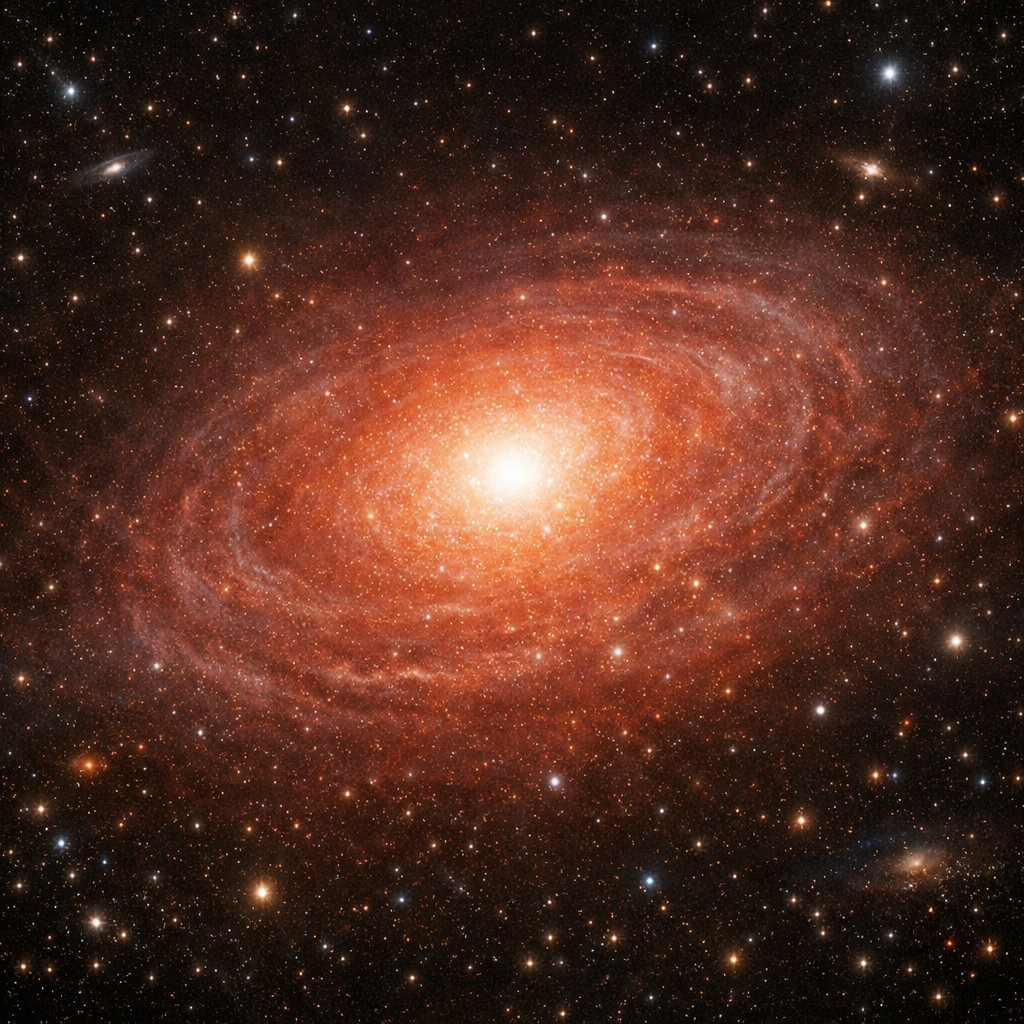
For the first time, researchers from the University of Copenhagen have detected a globular cluster stellar stream outside the Milky Way, specifically within an ultra-diffuse galaxy. This discovery, published in Nature, establishes a new method for studying dark matter.
PhD student Julie Kiel Holm explained the significance: “We have discovered a globular cluster stellar stream in another galaxy. This is the first time such a stream has been observed outside our own galaxy.”
Globular cluster stellar streams form when gravitational forces gradually strip stars from dense star clusters in a process called tidal stripping. Because these streams are shaped by gravity, they enable astronomers to investigate mass distribution within galaxies and provide insights into dark matter, which comprises approximately 80-85 percent of all matter in the universe.
The team studied the ultra-diffuse galaxy UGC9050-Dw1 and demonstrated that globular cluster stellar streams can effectively measure dark matter in galaxies beyond the Milky Way. Co-author Sarah Pearson noted the broader implications: “This opens entirely new possibilities. Not only can we now search for globular cluster stellar streams in other galaxies, but in the long term, we may also be able to measure the dark matter content of more ultra-diffuse galaxies.”
With new facilities like the Euclid and Nancy Grace Roman space telescopes on the horizon, observable stellar streams are expected to increase significantly.
Journal: Nature
DOI: 10.1038/s41586-026-10878-w
Source: University of Copenhagen / EurekAlert



Leave a Reply