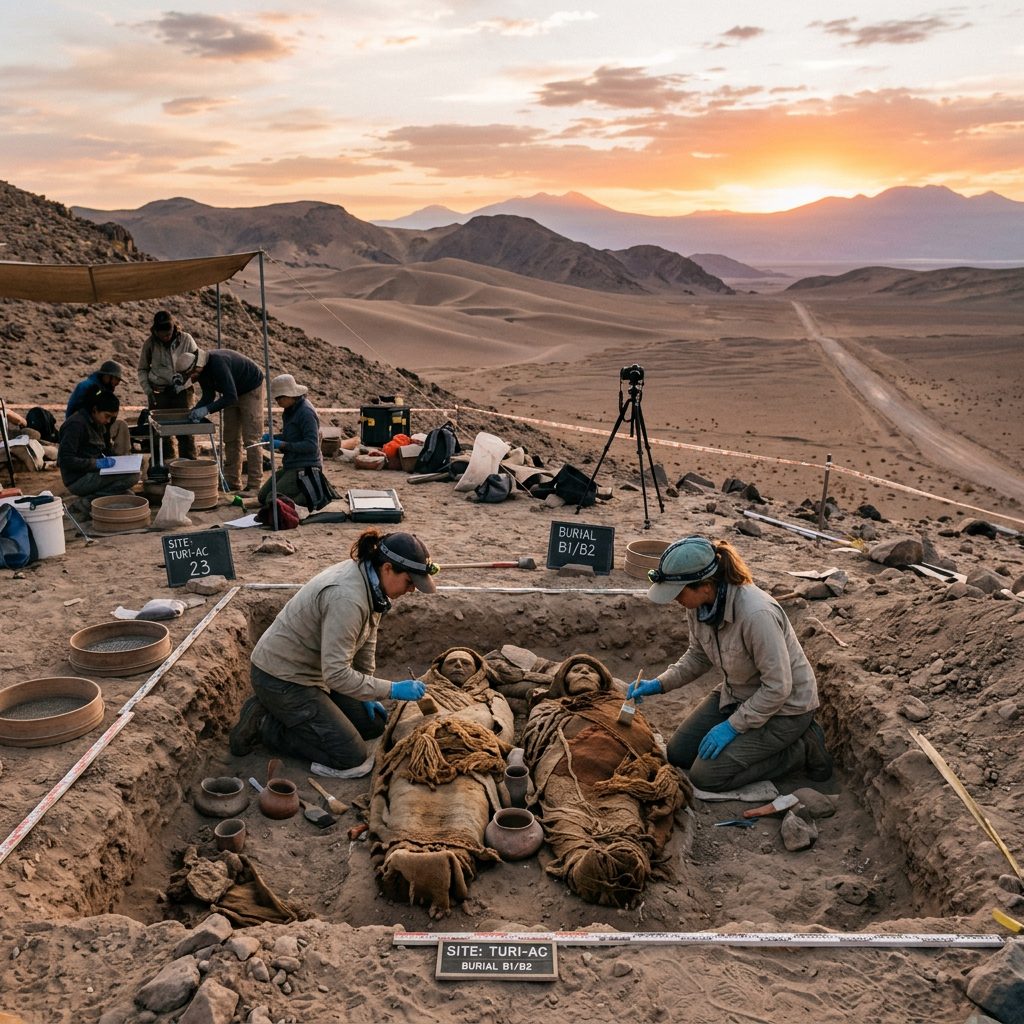
Ancient Chilean Mummies Reveal Colonial Smallpox Outbreak: Scientists have recovered the first molecular evidence of smallpox in the colonial Americas from two mummified individuals buried in northern Chile near the turn of the 17th century. Viral DNA preserved in their bones revealed nearly identical smallpox genomes, suggesting both died during the same outbreak. The strain was related to European lineages and likely reached the region after colonial contact, supporting accounts that imported diseases devastated Indigenous populations. Researchers dated the outbreak to between 1492 and 1631 and found that the virus occupied an evolutionary position between Viking-age strains and later European samples. The discovery suggests lesions previously attributed to arsenic exposure may have been caused by smallpox. Scientists say the genome provides an important benchmark for tracing the disease’s spread and evolution across the Americas. (Science)
State Department Restores $600 Million in Gavi Funding: The US State Department has agreed to release $600 million in congressionally approved funding for Gavi, the Vaccine Alliance, after lawmakers pressed the department to end the hold. Gavi helps lower-income countries purchase and administer vaccines protecting children against 20 infectious diseases. The money, allocated for fiscal years 2025 and 2026, was due to expire September 30. Health Secretary Robert F. Kennedy Jr. had reportedly objected to Gavi’s use of some vaccines containing thimerosal and questioned its safety practices, despite World Health Organization reviews finding that the preservative’s small vaccine doses do not cause harm. Gavi has nevertheless begun phasing out thimerosal-containing vaccines. Since 2000, the partnership has vaccinated more than 1.1 billion children in 78 countries. (CIDRAP)

Webb Finds a Warp in Nearby Planet-Building Disk: New James Webb Space Telescope observations reveal that the planet-forming disk surrounding TW Hydrae is not perfectly flat. Located about 194 light-years away, the roughly eight-million-year-old star hosts the nearest known gas-rich protoplanetary disk, making it an unusually detailed laboratory for studying planet formation. Webb’s NIRCam instrument detected radial changes in the disk’s inclination and orientation, indicating a warped architecture that could reflect gravitational interactions with forming planets. Researchers also resolved a bifurcated structure about 120 astronomical units from the star and found that the disk’s surface is dominated by extremely small dust grains. No large outer companions were detected, placing new limits on possible planets capable of shaping the disk. (Phys.org)
DESI Performs Chemical Autopsies on Destroyed Planets: The Dark Energy Spectroscopic Instrument is yielding unexpected information about planetary systems destroyed after their stars became white dwarfs. Astronomers examined spectra from 12 metal-rich white dwarfs and identified elements deposited in their atmospheres by disrupted asteroids, moons, or planets. Heavy elements should sink rapidly beneath a white dwarf’s visible surface, meaning their continued presence indicates relatively recent or ongoing accretion of planetary debris. Although DESI was designed primarily to map galaxies and investigate dark energy, its enormous spectral database also contains observations of thousands of stars. The newly analyzed systems offer some of the clearest DESI evidence that planetary material survives stellar evolution before being destabilized, torn apart, and consumed. The technique could eventually reveal how common rocky, differentiated planetary bodies are across the galaxy. (Phys.org)
eROSITA Releases Its Most Detailed X-Ray Sky Catalog: The German eROSITA consortium has released its second major public data set, producing the most sensitive publicly accessible catalog of the X-ray sky yet assembled. Data Release 2 combines the telescope’s first three all-sky surveys and contains nearly two million X-ray sources, including active galaxies, galaxy clusters, stars, and compact objects. An initial analysis of the massive cluster Abell 3266 identified a hot gaseous filament linking the cluster to an infalling galaxy group. Broadly, the observations agree with cosmological simulations describing how large structures grow, although smaller discrepancies may reveal missing physics in models of gas heating and cluster evolution. The release gives researchers a powerful resource for tracing black-hole activity, mapping matter, and testing theories of cosmic structure formation. (Phys.org)
Neptune’s Small Moons May Be Reassembled Wreckage: James Webb Space Telescope observations suggest that several of Neptune’s inner moons may be fragments of larger icy bodies destroyed during the planet’s turbulent history. Researchers studied Larissa, Galatea, and Proteus, along with material in Neptune’s rings, and found unusual spectral signatures associated with clay-like minerals that normally form through interactions between rock and liquid water. Their compositions differ from those of most known objects in the outer solar system. One possibility is that the moons formed from debris left behind when ancient, internally altered worlds collided or were shattered after Neptune captured its large moon Triton. The findings indicate that Neptune’s compact inner satellite system may preserve remnants of an earlier generation of moons rather than bodies that formed in their present locations. (Caltech)
ELT Could Search Nearby Worlds for Atmospheric Life: Simulations indicate that the Extremely Large Telescope’s planned ANDES spectrograph could detect water and potential biosignature gases in the atmospheres of nearby rocky exoplanets. Researchers modeled observations of 18 potentially habitable transiting worlds, including planets in the TRAPPIST-1 system and LHS 1140 b. Water vapor emerged as the easiest molecule to identify, potentially requiring 10 to 19 observed transits for some TRAPPIST-1 planets and about 30 for LHS 1140 b. Carbon dioxide, methane, and oxygen would demand substantially longer campaigns. The estimates assume cloud-free Earth-like atmospheres, favorable weather, and near-perfect data processing, so real observations could prove more difficult. Even so, the work outlines how the 39-meter telescope might move atmospheric biosignature searches from theoretical studies toward direct measurement. (Universe Today)
Roman Telescope Fueled Ahead of Planned Launch: NASA’s Nancy Grace Roman Space Telescope has been fueled with hydrazine as preparations continue for its scheduled August 30 launch aboard a SpaceX Falcon Heavy rocket. Roman’s Wide Field Instrument will produce infrared images covering an area roughly 50 times larger than the James Webb Space Telescope can capture in a comparable exposure. Although Webb is optimized to examine individual targets at greater depth, Roman will repeatedly survey enormous regions of the sky, making it particularly useful for studying dark energy, dark matter, gravitational microlensing, supernovae, galaxies, and exoplanets. NASA expects the observatory to generate more than 500 terabytes of data annually. After launch, Roman will travel to the Sun-Earth L2 region, where it will operate alongside Webb about one million miles from Earth. (Space)
Ancient Stardust Helped Seed the First Solar Solids: Presolar dust grains may have acted as microscopic seeds around which some of the earliest solid material in the solar system crystallized. Researchers analyzed refractory inclusions preserved inside primitive meteorites and identified isotopic relationships linking the inclusions to grains created around stars that existed before the Sun. The results challenge the traditional picture of an extremely hot, thoroughly mixed solar nebula that vaporized nearly all inherited solids before new minerals condensed. Instead, at least some ancient stellar grains apparently survived and provided nucleation surfaces for the first high-temperature minerals. These early solids later became incorporated into asteroids, planets, and moons. The findings establish a direct physical connection between material expelled by older stars and the first generations of solid matter assembled around the newborn Sun. (Phys.org)
Quasar Blast Shakes Gas 300,000 Light-Years Away: Observations from the XRISM X-ray observatory show that a supermassive black hole can violently disturb gas far beyond its host galaxy. Researchers examined the quasar H1821+643, located approximately 3.4 billion light-years away, and measured the motion of hot iron-bearing gas across its surrounding galaxy group. The gas exhibited powerful turbulence extending roughly 300,000 light-years from the central black hole. The estimated energy was about 100 times larger than earlier calculations and comparable to the combined output of several billion supernova explosions. The result demonstrates that quasar winds and shock waves can transport energy throughout an entire galactic environment, influencing gas circulation and potentially regulating future star formation. Such feedback is an essential ingredient in models explaining how black holes and galaxies evolve together. (Phys.org)
Machine Learning Could Clean Cosmic Background Maps: Researchers have developed a machine-learning approach for removing foreground dust from observations of the cosmic microwave background, potentially improving searches for primordial gravitational-wave signatures. Galactic dust contaminates measurements of CMB B-mode polarization, while conventional cleaning methods generally require observations at several frequencies. The new system uses correlations between structures at different angular scales to estimate large-scale dust contamination from smaller-scale patterns. In simulations, a hybrid network combining inter-scale information with multiple observing frequencies reduced residual foreground power to roughly seven times below that produced by a standard internal linear-combination method. The technique was designed to preserve the underlying cosmological signal. However, it has so far been validated using one family of simulated dust maps, and its ability to generalize to the real Milky Way remains uncertain. (arXiv)
August Brings Eclipses and Excellent Perseid Conditions: August 2026 offers an unusually crowded calendar of major skywatching events. A total solar eclipse on August 12 will cross parts of Greenland, Iceland, Spain, and the Arctic, while the Perseid meteor shower peaks around August 12–13 under exceptionally dark, nearly moonless conditions. Later in the month, a partial lunar eclipse on August 27 will cover most of the Moon and appear close to total from some locations. Planetary highlights include appearances by Saturn, Mars, Venus, Jupiter, and Mercury, along with several conjunctions involving the Moon. Comet 10P/Tempel also reaches perihelion and makes its closest approach to Earth early in the month. Binocular targets include the Hyades, M22, the Dumbbell Nebula, the Ring Nebula, and the Sagittarius Star Cloud. (Space)




Leave a Reply