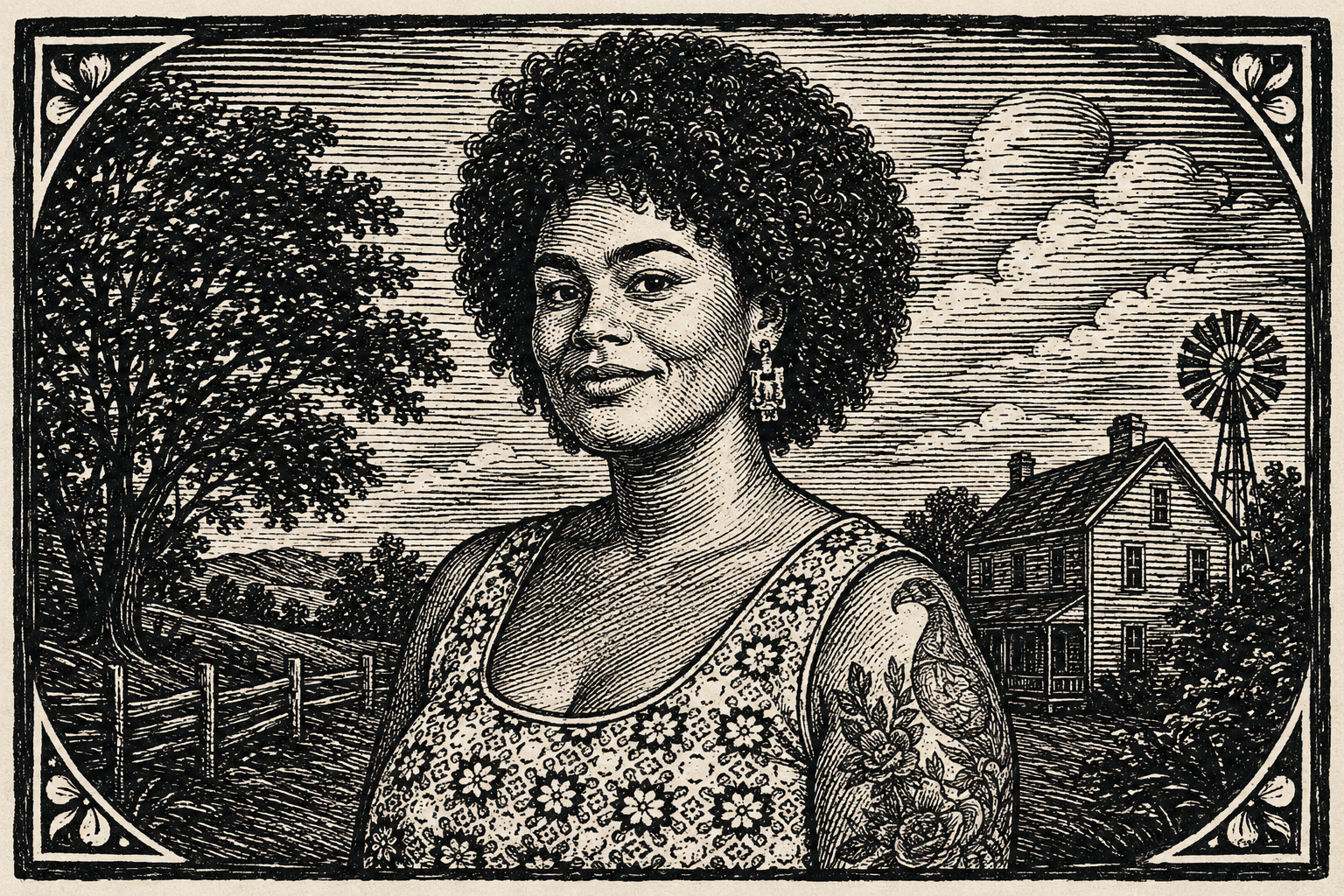
Dr. Aja Lans is a bioarchaeologist of the African diaspora and, since 2023, an assistant professor of anthropology and Africana studies at Johns Hopkins University. She holds a BS in anthropology from Binghamton University, an MA from NYU, and a PhD in historical archaeology from Syracuse, where her 2021 dissertation — “♀ Negro: Embodied Experiences of Inequality in Historic New York City,” completed with support from a Ford Dissertation Fellowship — traced the long history of violence against Black women by merging skeletal data with archival records. After a postdoctoral fellowship at Harvard’s Inequality in America Initiative, she arrived at Hopkins with a research agenda that fuses Black feminist and critical race theory with the physical evidence of bones: an approach that treats the objectification of Black human remains in university and museum collections not as a historical footnote but as an ongoing ethical crisis, one she argues can only be resolved through repatriation.
That agenda is most visible in her current role as site bioarchaeologist for the Harlem African Burial Ground, a project run jointly by the NYC Economic Development Corporation and the Harlem African Burial Ground Initiative. The cemetery was established by the Dutch Reformed church in the 1660s as a segregated burial ground in what was then Nieuw Haarlem, remained in use for roughly two centuries, and was sold and built over repeatedly after the 1800s — most recently as an MTA bus depot, decommissioned in 2014. Working alongside her mentor Dr. Rachel Watkins and the excavation team at AKRF, Lans has spent the past several years inventorying the partial remains recovered from the site, resisting the instinct to reduce them to clinical data points, and insisting instead that the ancestors buried there be understood as full people who lived inside — and against — the constraints of slavery and segregation, not just casualties of it.
It’s that last insistence that makes this conversation essential background for the Ghosts of Newtown project. The Elmhurst African Burial Ground shares almost every structural feature of the Harlem site: a segregated cemetery tied to a Dutch Reformed congregation, land sold off and repeatedly built over once the church no longer needed it, a community that was pushed out even as it kept insisting the ancestors were still there, and a disinterment record that — much like Harlem’s — raises more questions than it answers. Lans’s thinking on who has standing to speak for the dead when direct descendants can’t be traced, her insistence on primary documentation over inherited assumption, and her refusal to let a burial ground’s neglect be mistaken for a community’s forgetting, all map directly onto the questions this project has been wrestling with and in the archives. This interview represents a methodological and ethical grounding for it, from someone doing the same work, under the same pressures, a few subway stops away.

Marc Landas: Your work integrates black feminist theory and bioarchaeological practice. For people unfamiliar with that combination — including myself — how do you bring them together, and how does that theoretical lens shape the questions you ask?
Aja Lans: The simplest way to define black feminism and black women’s theory is that it treats black women’s knowledge and experience as intellectually valuable in their own right. It has a long history, but we often point to the Combahee River Collective statement — a group of radical, largely queer black women writing about interlocking oppression. They actually coined the term “identity politics,” which has since been bastardized. What it’s really about is this: if you look at the members of a society who are most oppressed and understand how the tools of oppression are used against them, you understand how those same tools get repurposed against everyone else too. Historically, black women in what’s now the United States have occupied the lowest rung of society in many ways.
I try not to be too professorial, but Hortense Spillers has a wonderful paper, “Mama’s Baby, Papa’s Maybe: An American Grammar Book,” about how ideas of blackness and racism are what she calls “hieroglyphics of flesh” — mapped onto black women’s bodies. You can trace it historically: black women started as property, valued for their reproductive potential because their children were property, and after emancipation were no longer seen as valuable at all — which is how you get the myths and narratives that follow, from mammies and Jezebels to welfare queens.
That whole body of theory helps explain why the category “black woman,” like the category “black” itself, had to be created for a white supremacist nation. I’d also be remiss not to mention Indigenous people, who occupy what’s called the “savage slot” in anthropology (Ed. Note: The “savage slot” is a critical concept coined by Haitian anthropologist Michel-Rolph Trouillot. It describes how the discipline of anthropology was historically structured to study the “Other”—non-Western, colonized, or “primitive” societies—while other social sciences studied European and North American centers of power.) — you have to invent categories of the “other” to claim whiteness is superior, “civilizing savages” in other terms. And then you have black people who weren’t considered people at all. Black feminism and black study take all of this into account. I often think about what the category “black” even means — that’s a major focus of black study.
I started out in biological anthropology broadly — primatology, forensic anthropology, and what I do now, bioarchaeology. It’s a wide field, but historically, in American biological anthropology especially, people of color are the subjects being researched. We are not the researchers. Going through my training, I realized the skeletons I was studying were all Indigenous people, marginalized people.
When I got into museum collections, I was struck by how many black people were there. My dissertation title was literally “Female Negro,” because that’s what’s written on their bones. So I asked myself: what does it mean to be a “female Negro”? That question led me to black feminism and black study. One of my favorite scholars is Katherine McKittrick, who draws on Sylvia Wynter, and there’s Fred Moten too. The problem with higher education, as McKittrick puts it, is that you accept black suffering and death as legitimate scholarly currency — you can do research in any field and it just restates the obvious: lower life expectancies, lower birth weights, higher maternal mortality — never going beyond that. It’s as if the finding is simply “black people die early,” and the response is “yes, excellent — from a black feminist bioanthropologist, excellent question.” That framing can mean a lot of things.
I’m also particular about terminology. I use “black” or “African-descended” to refer to everyone whose ancestors were from the continent of Africa, rather than “African American.” Something I’ve noticed in anthropology — you can see it in things like calls for an African American Burial Ground Protection Act — is that “African American” typically means people enslaved in the American South specifically, and lumping everyone into that category erases the diverse paths by which people ended up here. My own family was enslaved on the island of St. Thomas before coming to the Bronx. Does that make me less American? These are the kinds of theoretical questions that come up.
Marc Landas: You see that a lot with people from the Caribbean, like Haitians.
Aja Lans: A lot of these distinctions, while important, can also split up people who should be united — the same way class does. When I think about blackness, I think about it a few different ways.
Historically, from anthropology’s perspective — especially biological anthropology — anthropologists truly created the category “black.” Early physical anthropologists, what we’d now call race scientists, like Samuel Morton with his skull collection, actually built “black” by measuring people’s skulls and bodies. But coming from black feminism and black study, we’re asking something different: what is blackness beyond that exploitation and its links to biological positivism? Because we’re still alive, we still feel things, and we still carry knowledge and traditions valuable to research in their own right.
My intervention, especially somewhere like the Harlem African Burial Ground, targets a specific problem with anthropology: you can be trained to analyze a skeleton without ever telling anyone something new. You need to be embedded in the historical context these ancestors came from, and anthropologists simply aren’t trained in black history. That’s actually why my PhD was in historical archaeology at Syracuse, which has a strong focus on the archaeology of the African diaspora — a field that only really grew starting in the ’70s and ’80s and still has a long way to go. Right now I’m going back through remains someone else cataloged with no sense of that historical context, and I keep thinking: this is all wrong, they weren’t looking for what I’m looking for. So the way you look at things — your theoretical lens —
Marc Landas: I asked whether it shapes the questions you ask, but really two things: does it also shape the conclusions you draw? Do you catch yourself interpreting through an institutional lens — where things are so ingrained you reproduce them without meaning to?
Aja Lans: I’ll say this — I’m actually working on a paper about it. We always say black feminism doesn’t make science less rigorous by some narrow Western standard. If anything, it makes it more rigorous.
I’m primarily working with descendant communities — in this case, the Harlem African Burial Ground Initiative — and I only ask the questions they want answered. I offer them: here’s what I could learn for you, here’s what might be possible — what are you interested in knowing? We’re trained to go about it backwards. Many anthropologists ask questions based on our own institutional position, when what we should be asking is what the living community members affected by this research actually want to know, and what would help them. That overlap makes for a better project.
The way you’re trained in bioarchaeology is: go through the remains, say who’s here to the best of your ability — estimated age, biological sex, stature. But what many of us, especially black folks, actually want to know is: what can you tell us about what this person lived through, did, or experienced? The difficulty of working from a site like this, starting from dead people, is that you tend to skew toward — I won’t say negative, but that history of discrimination is rarely made explicit. Oftentimes we’re looking for glimpses of humanity, or some acknowledgment of it. Bioarchaeologists are trained to notice these things, but I don’t know that we always communicate them well.
For example: an ancestor with an old, healed traumatic injury — meaning they lived through it. Or stains from shroud pins, meaning someone loved them and wrapped them when they passed. That’s something we look for at historic sites. Unfortunately, what I see a lot here, because this cemetery was so disregarded and abused, is repeated evidence of damage — historical shovel marks, disturbance of every kind — which again speaks to that disregard, in life and after. So it’s less “here’s a wound, here’s this” and more thinking of these as the ancestors they were, likely enslaved black people.
Marc Landas: Do you feel a push and pull between the “bio” and the “anthropological”? I’d imagine the scientific side of you wanting to avoid over-interpreting what’s there.
Aja Lans: Not exactly — this is where I turn to Saidiya Hartman and ideas like critical fabulation. It’s not that I want to over-interpret, but I want to offer possibilities, because our reports are often written in definitive terms when honestly nothing we know is truly definitive, even from a scientific standpoint. Everything is generated within a context.
At this site, for example, it’s very commingled — no discrete individuals. I go through skeletal elements one at a time; some don’t say much, others tell you a great deal. I found a lower lumbar vertebra with a hole that belongs there naturally, except this one was unusually large, and there was a fracture — interesting, I hadn’t seen that before. So I consulted modern medical literature, which I think many bioarchaeologists underuse, and found a whole body of research on that specific foramen size, how it leads to a particular fracture, and how it’s more common in women. That one bone tells me something — and in the context of a black cemetery in use during these years, it tells me something about a possible woman with a whole life to her.
It’s about adding that context so people can go beyond a bare report. Some researchers do detailed osteobiographies where they give someone a name — I don’t think that’s appropriate for my work. Instead, I give the full historical context and describe what I’m seeing, so people can draw their own conclusions, while thinking about these people as living within the constraints of racism but as full people — not just a report of trauma and injury.
Marc Landas: I don’t know quite how to phrase this question — do you ever find yourself painting an overly miserable picture of their lives? Emancipation gets remembered as almost uniformly grim, but they weren’t living 24/7 inside just one thing — we all do lots of things with our lives. Do you catch yourself falling into that, then swerving back toward something good?
Aja Lans: Yeah, I do — I write and talk about this a lot. It’s a lot of emotional labor, because it’s close to me; it’s my own family’s history. But they did live. What I think about, which feels almost terrifying given the broader retreat from empathy these days, is that we all feel the same emotions. Even when I’m thinking “this must have been painful,” I know that person also laughed sometimes, had people who cared about them, was part of a community. The fact that they’re in a cemetery at all means someone cared enough to put them there.
One of the ancestors at Harvard, who should be heading back to Virginia soon — I found a description of his execution in a Richmond newspaper. It’s pretty awful, but reading between the lines, it notes he smiled and nodded at people in the crowd. He wasn’t alone. Through everything that was done to people, and to black people in particular, there was still kinship, still people around — and I think that matters enormously, to me and to the descendants I work with.
I recently attended a city council meeting on protecting black burial grounds here in New York. As a community, we’re careful not to reduce this to a narrative of resilience alone — but it is still a testament to something humans are capable of. We’re all here because of what these people did, no matter what they suffered or how they were constrained. That’s part of a bigger push toward things like “black boy joy” — remembering the times they had joy too.



Leave a Reply