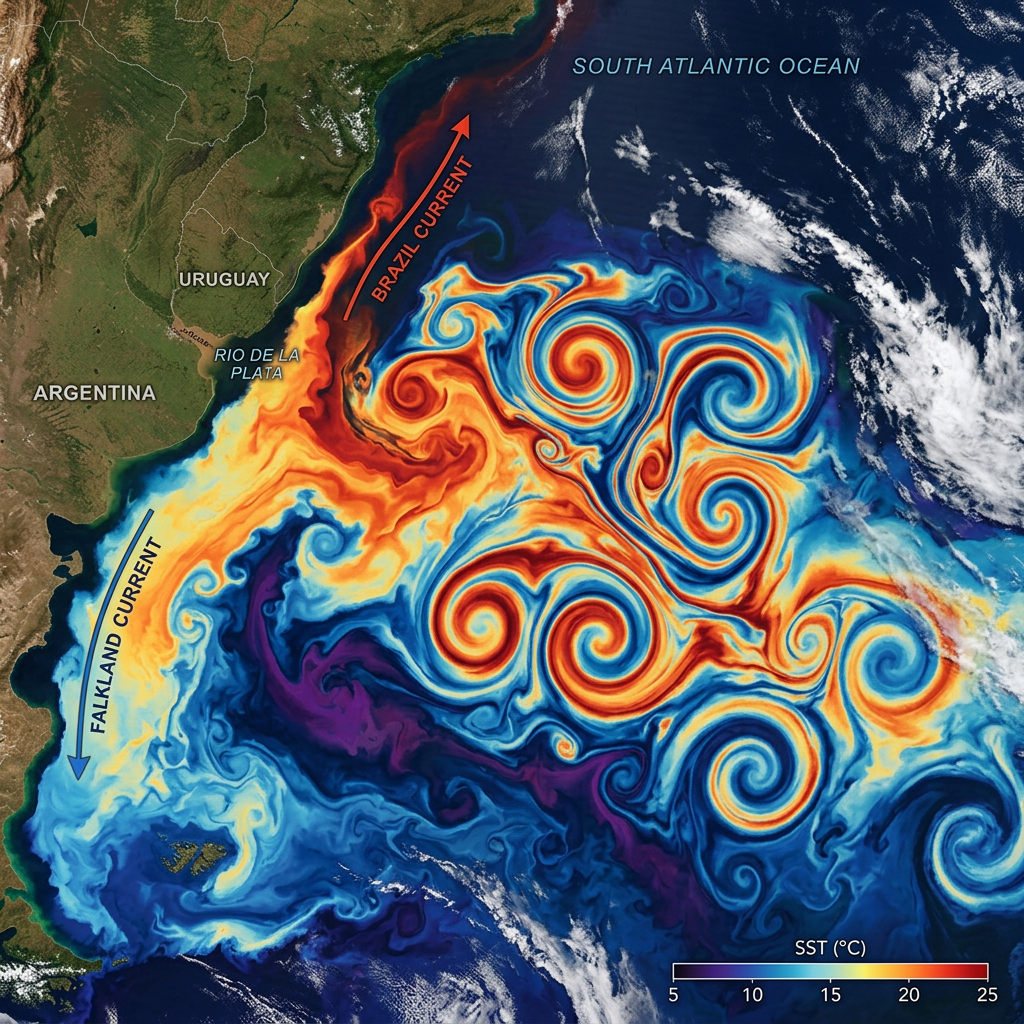
Lisa Beal, a professor of ocean sciences at the University of Miami Rosenstiel School of Marine, Atmospheric, and Earth Science, collaborated with South African researchers to study the Agulhas Current, a fast and narrow western boundary current flowing poleward along the southeast coast of Africa. Over a two-year period, they gathered high-resolution mooring data, recording hourly measurements of velocity, temperature, and salinity throughout the entire depth and width of the current.
The dataset launched more than a decade of research, with foundational work led at the Rosenstiel School and now advanced through sustained collaboration with Kathryn Gunn at the University of Southampton in the United Kingdom. Gunn and Beal use this dataset to show that increasing eddy activity is reshaping the Agulhas Current and intensifying adjacent coastal temperature extremes. Their findings, published in a new study in the journal Nature Climate Change, identify small frontal instabilities, about 10 kilometers across, along with larger, iconic meanders of the current, that transfer heat, salt, and nutrients between the open ocean and coastal environments.
“More eddy activity is accelerating surface warming in the Agulhas, while simultaneously enhancing hidden upwelling that cools deeper waters,” said Beal, the study’s senior author. “This combination—along with the onshore encroachment also driven by eddies—will create more extreme conditions in shelf seas in the future, potentially placing significant strain on coastal ecosystems.”

Both frontal eddies and meanders pump deep, cold, nutrient-rich water up onto the shelf, potentially enhancing productivity there, while farther offshore meanders trap heat and salt closer to the surface. The result is rapidly warming surface waters above cooler waters at depth.
Decades of satellite data have shown that surface waters in the Agulhas Current are warming at three or four times the global ocean average. At the same time, this new study shows that eddies have kept deeper waters comparatively cool. This layered structure helps explain how rapid surface warming—leading to increased rainfall in South Africa—has occurred alongside a reported decline in the current’s total heat transfer to higher latitudes.
These major changes are happening even as the overall strength (volume transport) of the Agulhas Current remains stable.
The implications extend far beyond southern Africa. The researchers suggest that intensifying eddies may provide a unifying explanation for observed changes in major ocean currents worldwide, including the Gulf Stream along the U.S. East Coast.
“Our findings suggest that eddies are fundamental in shaping how the ocean responds to climate change,” said Beal.



Leave a Reply