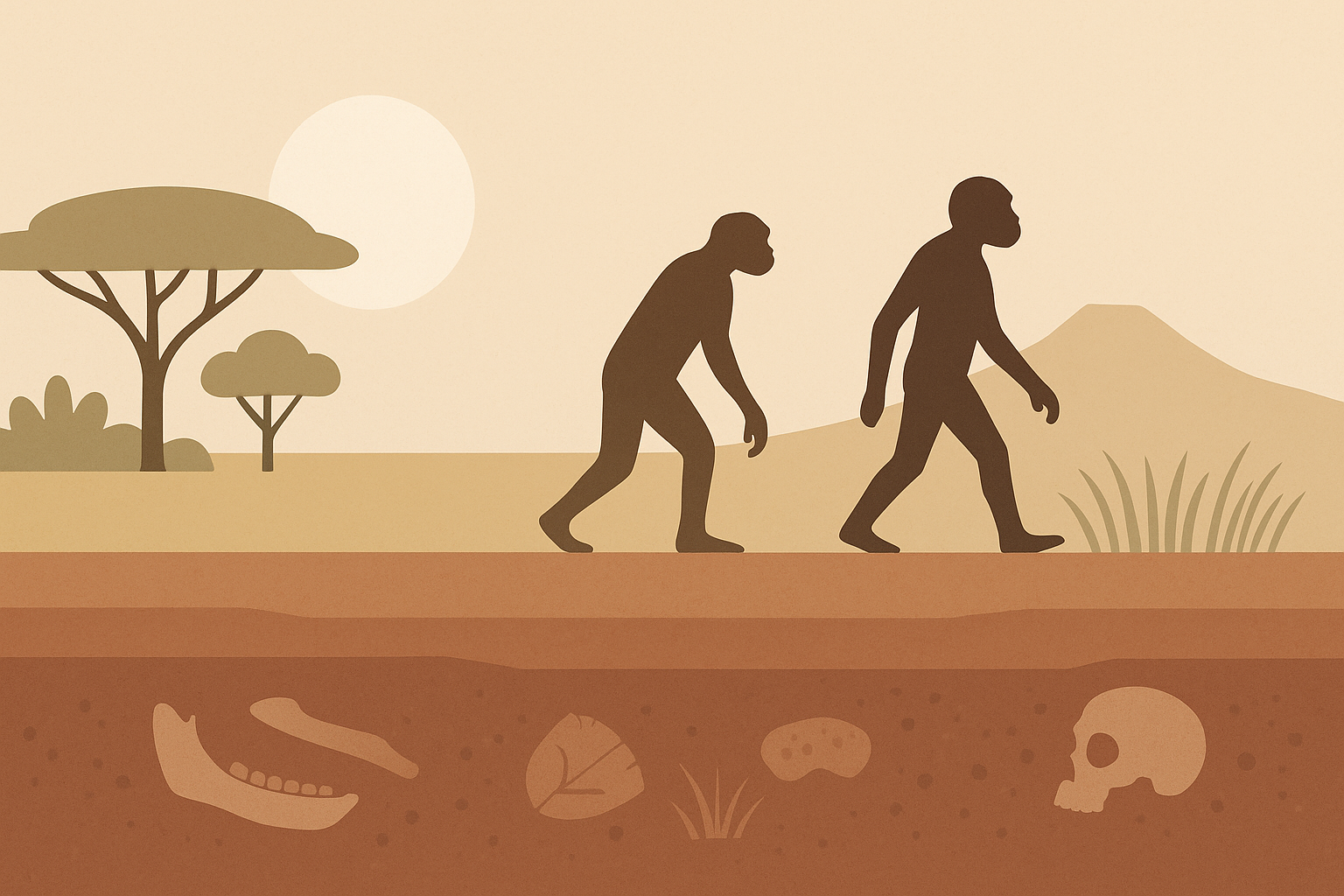
A trove of newly discovered fossils from Ethiopia is reshaping our understanding of human evolution during a critical period roughly 3.4 million years ago, when multiple hominin species walked the Earth simultaneously. The findings, published in Nature, provide the most complete picture yet of Australopithecus deyiremeda, a species that coexisted with the famous “Lucy” species but appears to have retained more apelike characteristics while developing its own unique adaptations.
The discoveries center on fossils recovered from the Burtele (BRT) area of the Woranso-Mille site in Ethiopia’s Afar region. Among the most significant finds is a juvenile mandible containing both baby teeth and developing permanent teeth, along with isolated teeth and bone fragments from multiple individuals. These specimens date to between 3.47 and 3.33 million years ago, placing them squarely in the middle Pliocene epoch when Africa’s climate was transforming and hominin diversity appears to have peaked.

“The new material demonstrates that overall, A. deyiremeda was dentally and postcranially more primitive than A. afarensis, particularly in aspects of canine and premolar morphology, and in its retention of pedal grasping traits,” the researchers write in their study. The research team was led by Yohannes Haile-Selassie of Arizona State University’s Institute of Human Origins, with collaborators from institutions including Washington University in St. Louis, Case Western Reserve University, and the University of Michigan.
Perhaps most intriguingly, the researchers have now confidently assigned a previously discovered partial foot to A. deyiremeda. This foot, originally described in 2012 but not attributed to a specific species, shows clear adaptations for grasping—suggesting this hominin was still an accomplished tree climber despite also being capable of walking upright on two legs.

“The BRT foot and its assignment to A. deyiremeda provides conclusive evidence that arboreality was a significant component of the positional behaviour of this australopith,” the authors note. This finding directly challenges the notion that all australopiths evolved similar forms of bipedalism, instead revealing considerable diversity in how these early human relatives moved through their environments.
The dental evidence proves equally revealing. The juvenile mandible, discovered in 2016 by team member Diane Bernardoni, preserves an exceptional snapshot of development in this ancient child, who died at approximately 4.5 years old based on tooth formation patterns. The specimen’s premolars—teeth between the canines and molars—show primitive features more similar to even earlier hominins like Ardipithecus ramidus and Australopithecus anamensis than to A. afarensis.

“Both left and right third premolars of BRT-VP-2/135 and BRT-VP-1/324 have large anterior foveae and diminutive to absent metaconids,” the researchers explain, referring to specific anatomical features. In contrast to A. afarensis, which had evolved a different premolar structure, A. deyiremeda retained the more primitive oval outline and simplified cusp patterns seen in older species.
The canine teeth tell a similar story. Unlike A. afarensis, which had prominent vertical ridges on the tongue-side of the canines, A. deyiremeda canines lack this relief, instead showing a simpler morphology. This pattern extends across the entire dental arcade, with A. deyiremeda possessing notably smaller teeth overall than its contemporaries.

Diet analysis using stable carbon isotopes extracted from tooth enamel reveals that A. deyiremeda subsisted primarily on C3 plants—trees, shrubs, and herbs that grow in forested environments, rather than the C4 grasses that dominate open savannas. Eight teeth analyzed showed carbon isotope values averaging -10.2‰, nearly identical to the earlier species A. ramidus and A. anamensis, but distinctly different from A. afarensis, which consumed a more varied diet including significant amounts of savanna-based foods.
“The lower carbon-13 values of the BRT hominin teeth, with more limited distributions, and their similarity to those from A. ramidus and A. anamensis, indicate that the BRT hominins may have retained dietary strategies of these older (more primitive) hominins,” the researchers conclude.
This dietary conservatism, combined with the retention of tree-climbing abilities, paints a picture of a hominin that remained closely tied to woodland habitats even as the African landscape was becoming more open and grassland-dominated. Meanwhile, just a few kilometers away, A. afarensis was adapting to exploit a broader range of environments and food sources.

The coexistence of these species raises fundamental questions about early human evolution. For decades, the narrative suggested a relatively linear progression from apelike ancestors to increasingly human-like descendants. The A. deyiremeda evidence instead reveals a bushier family tree, with multiple experiments in bipedalism and diet occurring simultaneously.
“The origin of Australopithecus correlates with increased craniodental size—possibly linked to selection for smaller canines and premolar molarization—preceding full obligate bipedality,” the authors write, suggesting that the evolution of larger chewing teeth and reduced fighting canines occurred before these hominins fully committed to ground-based living.
The findings also demonstrate that postcanine megadontia—the evolution of large cheek teeth for processing tough foods—and human-like bipedality did not evolve as a package deal. Instead, different hominin lineages mixed and matched these adaptations in various combinations, exploring different ecological niches in the changing African landscape.
The A. deyiremeda fossils come from sandstone layers that have been precisely dated using radiometric techniques and paleomagnetic data. A volcanic tuff below the fossil-bearing sediments yielded an age of 3.469 million years, while the normal paleomagnetic polarity of the entire sequence indicates the fossils accumulated between 3.596 and 3.330 million years ago.
As researchers continue fieldwork at Woranso-Mille and analyze existing collections, the picture of middle Pliocene hominin diversity continues to sharpen. The A. deyiremeda discoveries underscore that human evolution was not a straightforward march toward modernity, but rather a complex adaptive radiation in which multiple species experimented with different solutions to the challenges of a changing world.
Endnotes:
- Haile-Selassie, Y., et al. (2025). New finds shed light on diet and locomotion in Australopithecus deyiremeda. Nature. https://doi.org/10.1038/s41586-025-09714-4
- EurekAlert! press release: “New fossils reveal what the ‘midlife crisis’ in human evolution looked like” (November 26, 2025)



Leave a Reply