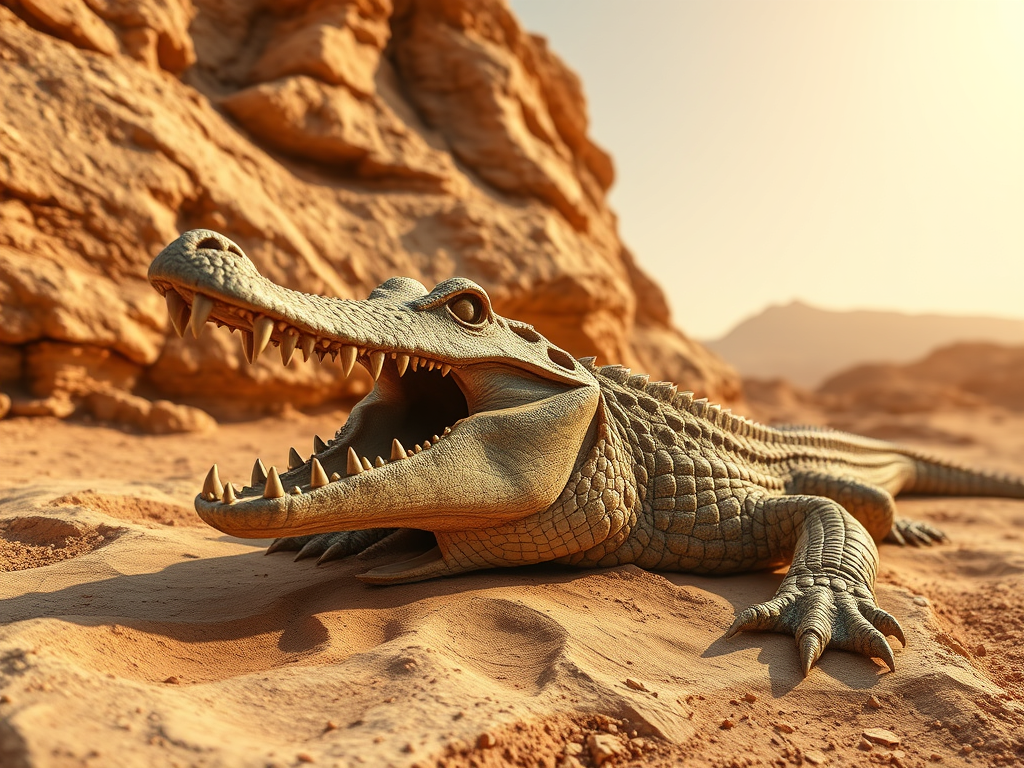
In the Egyptian Western Desert, where red sandstones and green shales rise above the arid plains of Kharga Oasis, paleontologists have uncovered a fossil that fundamentally reshapes our understanding of crocodile evolution.
The new discovery, published in The Zoological Journal of the Linnean Society, was led by a team of Egyptian paleontologists. The newly described species, Wadisuchus kassabi, lived about 80 million years ago and is now recognized as the earliest known member of Dyrosauridae—a group of ancient crocodiles that differed markedly from their modern relatives.
Unlike today’s crocodiles, dyrosaurids thrived in coastal and marine environments, equipped with elongated snouts and slender, needle-sharp teeth ideal for seizing slippery prey such as fish and turtles. Their remarkable survival and dispersal after the extinction of the dinosaurs make them crucial for understanding how reptiles adapted and diversified when global ecosystems collapsed.
The name Wadisuchus kassabi blends Egypt’s landscape and legacy—Wadi (“وادي,” Arabic for “valley”) for the New Valley, where it was discovered, and Suchus for the ancient crocodile god Sobek. The species also honors Professor Ahmed Kassab (Assiut University), whose work in Egyptian paleontology continues to inspire new generations.
Professor Hesham Sallam, Egyptian Vertebrate Paleontologist at Mansoura University, and senior author of the study, said: “The fossils of Wadisuchus kassabi were excavated near Kharga and Baris oases in Egypt’s Western Desert. They include two partial skulls and two snout tips representing four individuals at different stages of growth, providing rare insight into how dyrosaurids developed”. Sallam added: “High-resolution CT scans and 3D surface models enabled us to reveal unprecedented anatomical details”.
Sara Saber, Assistant Lecturer at Assiut University, member of the Sallam Lab team at MUVP, and lead author of the study, said: “Wadisuchus kassabi, was a 3.5–4-meter-long crocodile-like reptile with a very long snout and tall, sharp teeth. It differed from other dyrosaurids, in having four teeth at the front of the snout instead of the primitive five, nostrils positioned on top of the snout for surface breathing, and a deep notch at the tip of the snout where the jaws met.

These features show a gradual adaptation in the dyrosaurid bite, marking an important step in their evolutionary history. Saber added: “Beyond the distinctive features of Wadisuchus, it plays a crucial role in understanding the origin of the dyrosaurid group. The new species pushes back evidence for an African origin of Dyrosauridae and suggests that their diversification began earlier than previously thought—possibly during the Early Coniacian–Santonian (about 87–83 million years ago), rather than the traditionally assumed Maastrichtian (about 72–66 million years ago)”.
Belal Salem, PhD student at Ohio University, member of the Sallam Lab, Curator of Fossil Reptiles and Birds at MUVP, and faculty member at Benha University, states: “this discovery indicates that Africa was the cradle of dyrosaurid evolution, from which later lineages spread across the globe and our phylogenetic analyses consistently place Wadisuchus an ancestor of the dyrosaurid group”.
Salem continued: “The significance of Wadisuchus lies not only in what it reveals about the evolutionary history of this remarkable group of crocodiles—though that is a major achievement—but also in what it reminds us of: Egypt’s Western Desert still holds treasures that preserve the secrets of our planet’s deep past. Our mission is not only to uncover these fossils but also to protect the fossil-rich sites from urban expansion and agricultural encroachment. They are a legacy for generations of Egyptians to come.”
IMAGE CREDIT: NASA.

Leave a Reply