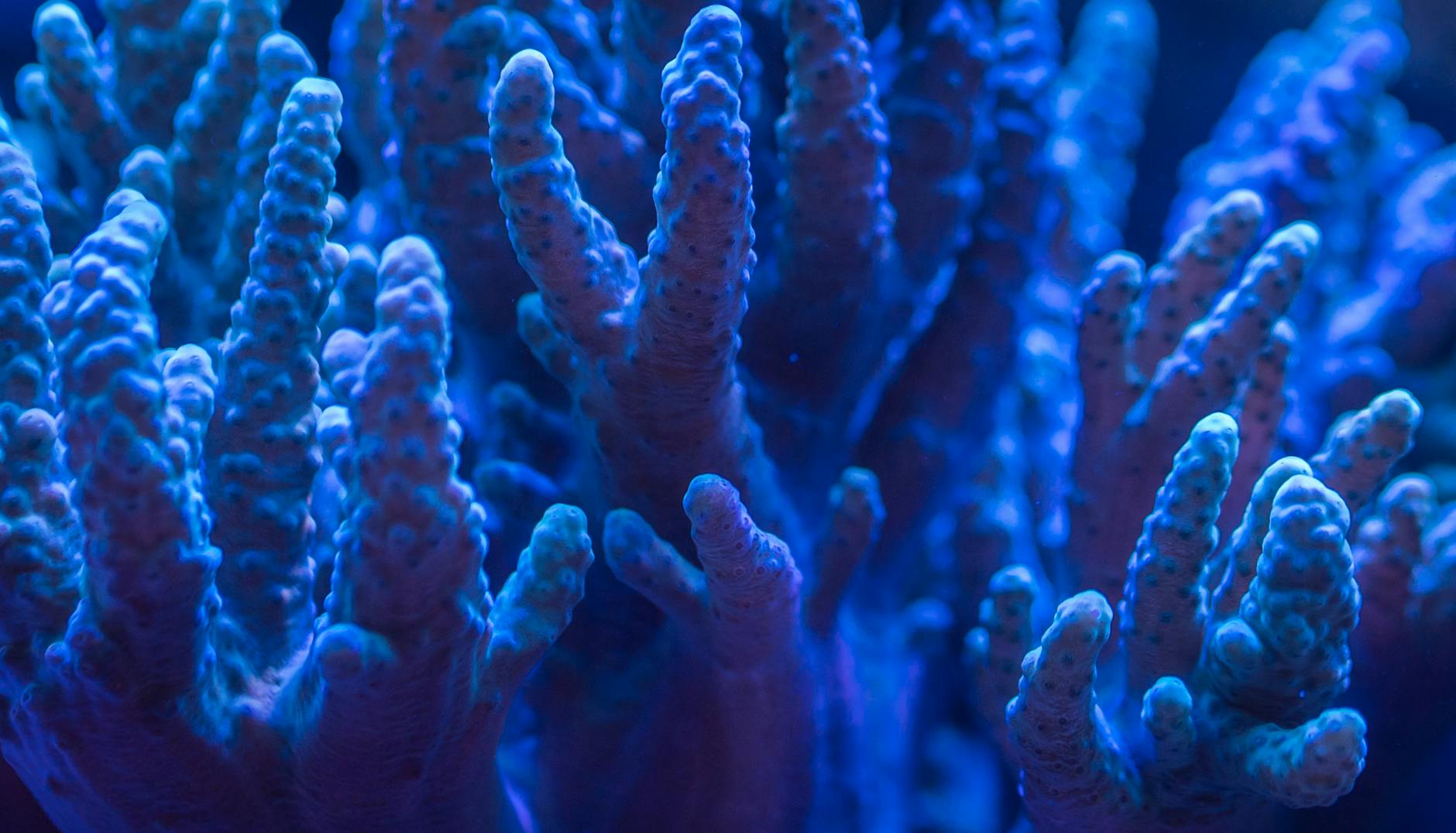
Corals may lack eyes, but they are far from blind. These delicate animals sense light in ways that continue to amaze and inspire the scientific community.
Researchers from Osaka Metropolitan University’s Graduate School of Science have uncovered a unique light-sensing mechanism of reef-building corals, in which light-detecting proteins, known as opsins, use chloride ions to flip between UV and visible light sensitivity depending on the pH of their surroundings. Their findings suggest a unique functionality that expands our understanding of vision and photoreception across the animal kingdom.
Animal vision relies on opsins, which are proteins that detect light using a small molecule called retinal. Retinal, however, naturally absorbs ultraviolet (UV) light only, meaning it sees shorter light than the visible light that we see. To extend its sensitivity into the visible range, retinal binds to the opsin to form a light-sensitive pigment through a special chemical bond called a Schiff base. This bond carries a positive charge that normally requires a nearby negatively charged amino acid, or counterion, to remain stable.
Anthozoans, such as corals and sea anemones, have opsins belonging to the anthozoan-specific opsins (ASO)-II group, which is a newly discovered opsin group. ASO-II opsins have properties that are different from the opsins of mammals.
“Some ASO-II opsins of reef-building corals lack the usual counterion amino acids found in other animal opsins,” said Akihisa Terakita, a professor at Osaka Metropolitan University’s Graduate School of Science and one of the lead authors of the study.
So, how do these opsins manage to ‘see’ visible light at all without these amino acids?
To understand this question, the team studied ASO-II opsins of the reef-building coral Acropora tenuis.
Sign up for the Daily Dose Newsletter and get every morning’s best science news from around the web delivered straight to your inbox? It’s easy like Sunday morning.
Using mutational experiments, spectroscopy, and targeted advanced simulation, the researchers found that instead of using amino acids, ASO-II opsins employ chloride ions (Cl⁻) from the surrounding environment as counterions. This is the first time scientists have reported an opsin that uses inorganic ions in this way.
“We found that chloride ions stabilize the Schiff base more weakly than amino acids do,” Yusuke Sakai, a postdoctoral researcher in Terakita’s lab and the first author of the study, said, “so the opsin can reversibly switch between visible-light sensitivity and UV sensitivity depending on the pH.”
This suggests a mechanism where the opsin’s sensitivity depends on whether the retinal–opsin bond, Schiff base, is protonated or not, with pH shifting that balance. Low pH conditions increase number of protons, meaning the Schiff base becomes positively charged and absorbs longer wavelengths, including visible light. This is then stabilized by chloride. On the other hand, in high pH conditions, there are fewer protons, making the Schiff base deprotonated and absorbing UV light.
This pH-dependent switching may have ecological importance. Corals live in close symbiosis with algae that produce nutrients through photosynthesis. Since photosynthesis alters the pH inside coral cells, this may then shift opsin sensitivity between visible and UV light. This suggests that coral light sensitivity can adjust according to the algae’s photosynthetic activity — a new insight into their symbiotic relationship.
Beyond a better understanding of coral biology, the discovery could inspire new biotechnology. “The ASO-II opsin of Acropora tenuis was shown to regulate calcium ions in a light-dependent way, hinting at potential applications as an optogenetic tool whose wavelength sensitivity changes with pH,” Mitsumasa Koyanagi, a professor at Osaka Metropolitan University’s Graduate School of Science and one of lead authors of the study, said.
IMAGE CREDIT: Egor Kamelev.



Leave a Reply