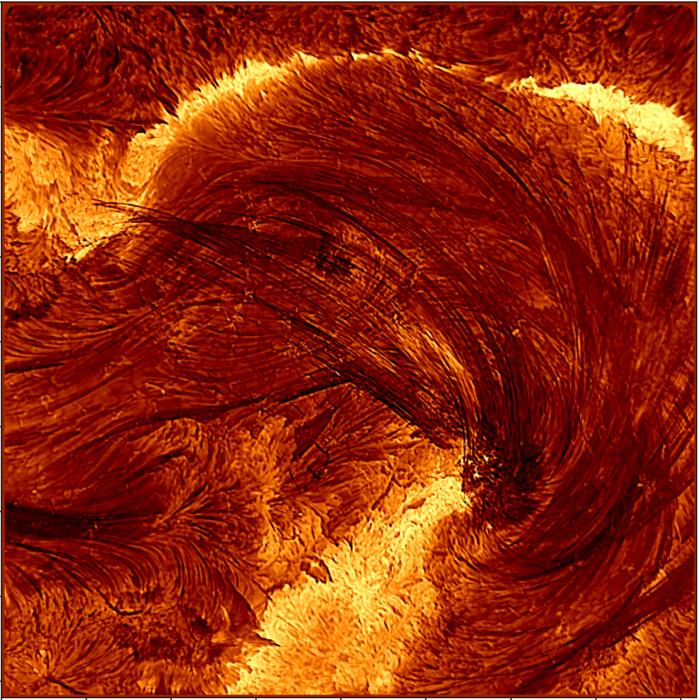
The highest-resolution images of a solar flare captured at the H-alpha wavelength (656.28 nm) may reshape how we understand the Sun’s magnetic architecture—and improve space weather forecasting. Using the U.S. National Science Foundation (NSF) Daniel K. Inouye Solar Telescope, built and operated by the NSF National Solar Observatory (NSO), astronomers captured dark coronal loop strands with unprecedented clarity during the decay phase of an X1.3-class flare on August 8, 2024, at 20:12 UT. The loops averaged 48.2 km in width—perhaps as thin as 21 km—the smallest coronal loops ever imaged. This marks a potential breakthrough in resolving the fundamental scale of solar coronal loops and pushing the limits of flare modeling into an entirely new realm.
Coronal loops are arches of plasma that follow the Sun’s magnetic field lines, often preceding solar flares that trigger sudden releases of energy associated with some of these magnetic field lines twisting and snapping. This burst of energy fuels solar storms that can impact Earth’s critical infrastructure. Astronomers at the Inouye observe sunlight at the H-alpha wavelength (656.28 nm) to view specific features of the Sun, revealing details not visible in other types of solar observations.
“This is the first time the Inouye Solar Telescope has ever observed an X-class flare,” says Cole Tamburri, the study’s lead author who is supported by the Inouye Solar Telescope Ambassador Program while completing his Ph.D. at the University of Colorado Boulder (CU). The program is funded by the NSF and is designed to support Ph.D. students as they create a well-networked cohort of early-career scientists at U.S. Universities, who will bring their expertise in Inouye data reduction and analysis to the broader solar community. “These flares are among the most energetic events our star produces, and we were fortunate to catch this one under perfect observing conditions.”
The team—which includes scientists from the NSO, the Laboratory for Atmospheric and Space Physics (LASP), the Cooperative Institute for Research in Environmental Sciences (CIRES), and CU—focused on the razor-thin magnetic field loops (hundreds of them) woven above the flare ribbons. On average, the loops measured about 48 km across, but some were right at the telescope’s resolution limit. “Before Inouye, we could only imagine what this scale looked like,” Tamburri explains. “Now we can see it directly. These are the smallest coronal loops ever imaged on the Sun.”
The Inouye’s Visible Broadband Imager (VBI) instrument, tuned to the H-alpha filter, can resolve features down to ~24 km. That is over two and a half times sharper than the next-best solar telescope, and it is that leap in resolution that made this discovery possible. “Knowing a telescope can theoretically do something is one thing,” Maria Kazachenko, a co-author in the study and NSO scientist, notes. “Actually watching it perform at that limit is exhilarating.”
Sign up for the Daily Dose Newsletter and get every morning’s best science news from around the web delivered straight to your inbox? It’s easy like Sunday morning.
While the original research plan involved studying chromospheric spectral line dynamics with the Inouye’s Visible Spectropolarimeter (ViSP) instrument, the VBI data revealed something unexpected treasures—ultra-fine coronal structures that can directly inform flare models built with complex radiative-hydrodynamic codes. “We went in looking for one thing and stumbled across something even more intriguing,” Kazachenko admits.
Theories have long suggested coronal loops could be anywhere from 10 to 100 km in width, but confirming this range observationally has been impossible—until now. “We’re finally peering into the spatial scales we’ve been speculating about for years,” says Tamburri. “This opens the door to studying not just their size, but their shapes, their evolution, and even the scales where magnetic reconnection—the engine behind flares—occurs.”
Perhaps most tantalizing is the idea that these loops might be elementary structures—the fundamental building blocks of flare architecture. “If that’s the case, we’re not just resolving bundles of loops; we’re resolving individual loops for the first time,” Tamburri adds. “It’s like going from seeing a forest to suddenly seeing every single tree.”
The imagery itself is breathtaking: dark, threadlike loops arching in a glowing arcade, bright flare ribbons etched in almost impossibly sharp relief—a compact triangular one near the center, and a sweeping arc-shaped one across the top. Even a casual viewer, Tamburri suggests, would immediately recognize the complexity. “It’s a landmark moment in solar science,” he concludes. “We’re finally seeing the Sun at the scales it works on.” Something made only possible by the NSF Daniel K. Inouye Solar Telescope’s unprecedented capabilities.
IMAGE CREDIT: NSF/NSO/AURA.




Leave a Reply