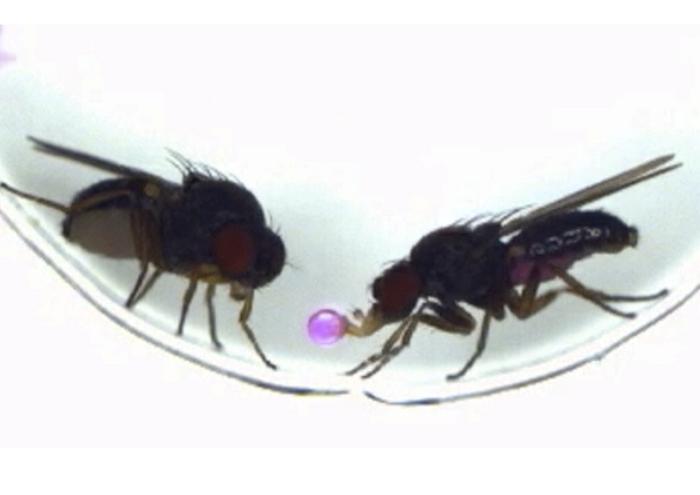
Researchers in Japan have genetically transferred a unique courtship behavior from one fruit fly species to another. By turning on a single gene in insulin-producing neurons, the team successfully made a species of fruit fly (Drosophila melanogaster) perform a gift-giving ritual it had never done before. The study, published in the journal Science, represents the first example of manipulating a single gene to create new neural connections and transfer behavior between species.
In nature, most male fruit flies court mates by rapidly vibrating their wings to create sound patterns or “courtship songs.” However, Drosophila subobscura has evolved a very different strategy: males regurgitate food and offer it as a gift to females during courtship. This behavior does not exist in closely related species such as D. melanogaster.
These two fruit fly species diverged about 30-35 million years ago. Both have a gene called “fruitless” or “fru” that controls courtship behavior in males, but they use different strategies—one species sings and the other gives gifts. The researchers found the reason for this difference: in gift-giving flies (D. subobscura) insulin-producing neurons are connected to the courtship control center in the brain, while in singing flies (D. melanogaster) these cells remain disconnected.
“When we activated the fru gene in insulin-producing neurons of singing flies to produce FruM proteins, the cells grew long neural projections and connected to the courtship center in the brain, creating new brain circuits that produce gift-giving behavior in D. melanogaster for the first time,” Dr. Ryoya Tanaka, co-lead author and lecturer at Nagoya University’s Graduate School of Science, explained.
The researchers inserted DNA into D. subobscura embryos to create flies with heat-activated proteins in specific brain cells. They used heat to activate groups of these cells and compared the brains of flies that did and did not regurgitate food. They identified 16-18 insulin-producing neurons that make the male-specific protein FruM, clustered in a part of the brain called the pars intercerebralis.
“Our findings indicate that the evolution of novel behaviors does not necessarily require the emergence of new neurons; instead, small-scale genetic rewiring in a few preexisting neurons can lead to behavioral diversification and, ultimately, contribute to species differentiation,” Dr. Yusuke Hara, co-lead author from the National Institute of Information and Communications Technology (NICT), noted.
Sign up for the Daily Dose Newsletter and get every morning’s best science news from around the web delivered straight to your inbox? It’s easy like Sunday morning.
“We’ve shown how we can trace complex behaviors like nuptial gift-giving back to their genetic roots to understand how evolution creates entirely new strategies that help species survive and reproduce,” senior author Dr. Daisuke Yamamoto from NICT said.
The study, “Cross-species implementation of an innate courtship behavior by manipulation of the sex-determinant gene” was published in the journal Science, on August 14, 2025, at DOI: 10.1126/science.adp5831. It represents the result of collaborative efforts led by Drs. Yusuke Hara and Daisuke Yamamoto at the National Institute of Information and Communications Technology (NICT), in partnership with researchers at Nagoya University.
IMAGE CREDIT: Tanaka et al., 2025.



Leave a Reply