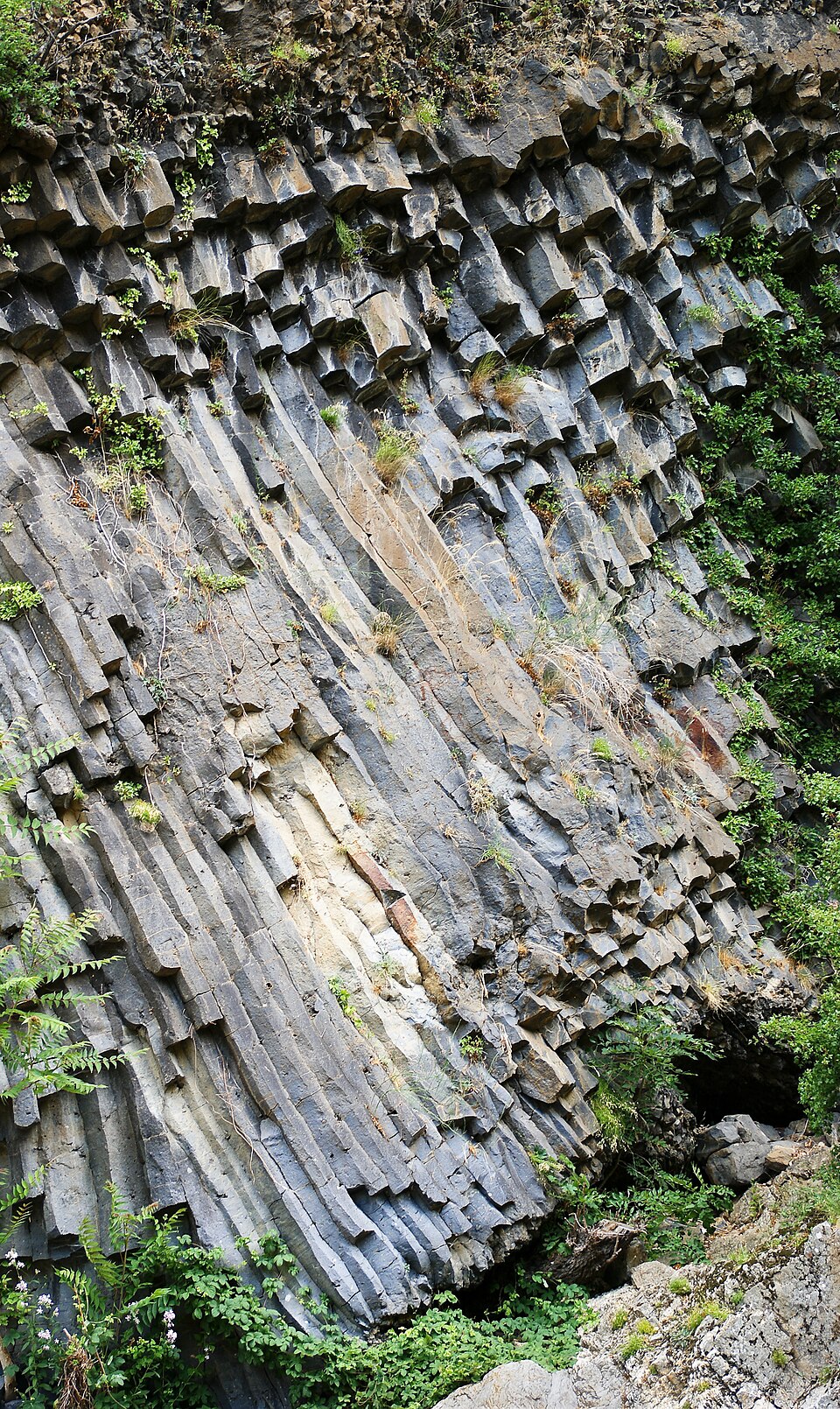

When a thick basaltic lava flow cools uniformly and slowly, physical stresses cause it to crack into regular, often hexagonal columns—a process known as columnar jointing. The basalt cliffs visible here near Jaujac in Ardèche, France, are a textbook example. These 2009–photographed columns reach several meters in height and reveal how molten rock solidifies into natural architecture.
As basalt cools from the top and bottom surfaces inward, the cooling fronts create tensile stresses perpendicular to the flow. This stress is relieved by fracturing into vertical columns that intersect, usually forming six-sided prisms—the most efficient shape for uniform tension release. Column diameter reflects cooling rate: slow cooling in insulated cores produces wider, straighter columns; faster cooling near surfaces yields tighter, more irregular structures.
These basalt flows likely erupted in the Tertiary, during regional volcanic activity that blanketed parts of central France. Centuries of erosion—and the action of local rivers—have exposed these colonnades, turning erstwhile subterranean structures into visible cliffs. The River Lignon has cut through overlying layers, revealing the cooling joints as exposed walls of polygonal symmetry.
Beyond their beauty, columnar basalts provide insights into volcanic history and cooling regimes. Geologists map joint spacing, orientation, and cross-sectional shapes to estimate lava flow thickness, original temperatures, and thermal gradients. These insights help reconstruct past volcanic environments and guide modern comparisons—in locations like Devil’s Postpile (California), Svartifoss (Iceland), or Giant’s Causeway (Northern Ireland).
Occasionally, weathering reveals concentric rings or crystal lamellae on column surfaces, clues to mineral growth and contraction patterns. Though not evident in this exposure, spacing striations trace fracture propagation stage-by-stage. Together, these features record a complex interplay between fluid basalt crystallization, thermal diffusion, and tensile failure.
In essence, the Ardèche columns are geology in geometric form—a freeze-frame of molten rock’s descent into cold rigidity, translating physical law into enduring, hexagonal stone.




Leave a Reply