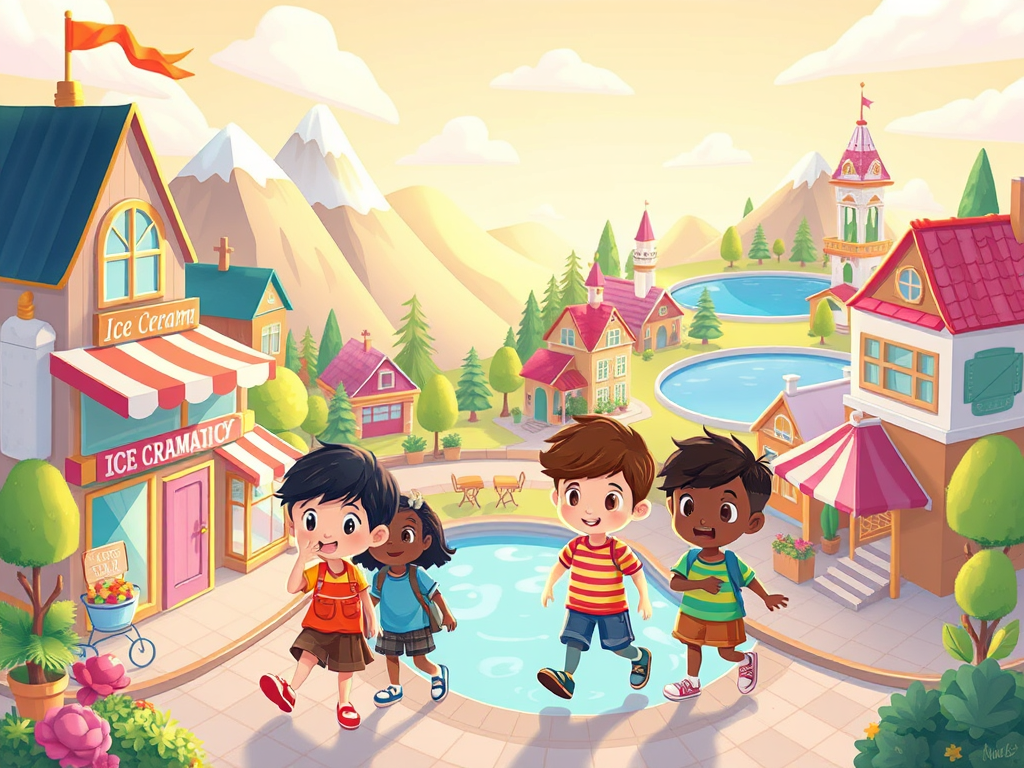
Many behavioral studies suggest that using landmarks to navigate through large-scale spaces — known as map-based navigation — is not established until around age 12.
A neuroscience study at Emory University counters that assumption. Through experiments combining brain scans and a virtual environment the researchers dubbed Tiny Town, they showed that five-year-olds have the brain system that supports map-based navigation.
The journal Proceedings of the National Academy of Sciences published the finding, the first neural evidence that this cognitive ability is in place in such young children.
“While large-scale navigation abilities certainly continue to develop throughout childhood, our findings show that the underlying neural system is established remarkably early,” says Yaelan Jung, first author of the study and a postdoctoral fellow in Emory’s Department of Psychology.
“Rather than taking a decade or more, map-based navigation is underway in half that time,” adds Daniel Dilks, associate professor of psychology and senior author of the study. “Five-year-olds have the brain system enabling them to find their way around a tiny, virtual town. They not only know that the ice cream store in the mountain region is different than the ice cream store in the lake region, they know how to navigate the streets to get to each of them.”
Sign up for the Daily Dose Newsletter and get every morning’s best science news from around the web delivered straight to your inbox? It’s easy like Sunday morning.
Dilks is at the forefront of identifying specific functions of the visual cortex related to face, place and object processing — how we recognize and get around our world. He’s also pioneering methods to study the timeline for the development of these functions, from infancy to adulthood.
“Two fundamental questions in neuroscience,” he explains, “are how knowledge is organized in the brain and the origins of that knowledge. In other words, what knowledge are you born with and how does knowledge develop as you grow?”
The technology of fMRI offers a window into those questions. The harmless, noninvasive technique uses a giant magnet to scan the brain and record the magnetic properties in blood. It measures heightened blood flow to a brain region, indicating that region is more active.
In adult studies during the past decade, the Dilks lab has showed that three scene-selective regions in the brain perform separate, non-overlapping, tasks. The parahippocampal place area (PPA) allows us to recognize places and cluster them into categories. The retrosplenial complex (RSC) maps the places into their proper locations within a larger space, allowing us to navigate from one place to another. The occipital place area (OPA) allows us to walk around our immediate surroundings, not bumping into boundaries or other obstacles.
“We can’t fix most neurological problems right now,” Dilks says. “But by continuing to learn more about how the brain develops and functions normally, we keep moving closer to being able to repair it when something goes wrong.”
Walking navigation versus map-based navigation
In 2024, Dilks and Jung discovered that the brain system for walking through the immediate environment, avoiding boundaries and obstacles, does not look adultlike until age 8.
“It seems counterintuitive,” Dilks says. “Most children can walk before the age of two. And yet the brain system helping you walk around your immediate surroundings doesn’t start appearing adultlike until relatively late.”
Dilks and Jung had a theory that the seemingly more complex and sophisticated abilities of map-based navigation develop earlier. They noted that even before they can walk well, children are carried from room-to-room and taken in strollers from place-to-place, allowing them to essentially build up a map of their surroundings.
For the current paper, they created experimental protocols for five-year-olds to test their theory.
They started with a virtual town known as Neuralville, developed by the Dilks lab for an adult study. It consists of eight buildings laid out on streets surrounding a town square and oriented by the four cardinal directions.
In tests with five-year-old participants registered with the Emory Child Study Center, Jung soon learned that Neuralville was a bit too complicated for them to navigate. She simplified the paradigm, turning it into a triangle, and called it Tiny Town. Instead of cardinal directions, distinctive landscapes delineate each point of the triangle, including the mountain corner, the tree corner and the lake corner.
She created six structures for Tiny Town, including two each of categories generally of interest to children: ice cream stores, playgrounds and fire stations.
Making science fun
Doing experiments with child participants requires creativity and patience, Jung says.
“We want to get at the scientific questions that we’re trying to answer,” she explains, “but it’s also important that a child who participates in a study has a good time. We want them to leave with a good impression of science.”
Jung first familiarized a child to the virtual town using the arrow keys on a computer to move through its streets and arrive at different places. She then invited the child to do the same. “It was fascinating that they were so good at it,” she says.
This familiarization was followed by tests of their knowledge. She showed still images of Tiny Town to a child and asked questions such as: Did you see this building in Tiny Town? Is it in the mountain corner?
Most of the children passed this test and moved into the next phase: training for scanning.
Jung turned the training process into a game involving the children and adult lab members. An adult would point at the child and say, “Freeze!”
“The kids loved it! They especially liked to freeze the adults in the room,” Jung says. “They’d point at one of us and say, ‘It’s your turn now!’”
The researchers explained to the participants that the scanner was like a camera and they would need to hold perfectly still so their photo wasn’t blurry when they performed a task while in the machine.
The children were then trained to do the game-like task, pushing a button in response to paired images from Tiny Town. For instance, if an image of a particular fire station was shown with an image of mountains, they needed to push the button if this scenario mapped correctly onto Tiny Town.
The participants practiced the task in a mock scanner before entering the real one for the experiment. “We gave them a blanket and a pillow to make it cozy and explained that they would be watching a movie in their own private theater,” Jung says. “They really liked that idea.”
The resulting data showed that five-year-olds can learn a map and hold it in their minds. And to do so, they used their RSC — the brain region specialized for coding the location of buildings in a map, allowing us to navigate from one place to another.
The icing on the cake is that everyone involved in the study — including the researchers — enjoyed the experience.
“It was really fun to work with the children,” Jung says. “I learned that the age of five is a magical time to scan a child. They don’t tend to be afraid of new things.”
The Dilks lab is now doing a deeper dive into the question of how the brain develops the ability to recognize and move about the world by working on a protocol for toddlers.
They are proving a bigger challenge than infants and five-year-olds. “Between the ages of two and three, children basically don’t listen to you,” says Jung, who is the mother of a three-year-old.
She and her lab mates are trying out strategies involving a cardboard mockup of a scanner, cartoons and Cheerios.
“It’s fascinating to explore how humans use different parts of the brain for complex behaviors and how that changes with age and experiences,” Jung says. “We’re laying the groundwork for clinical applications, including getting a better understanding of typical versus atypical neural development.”


Leave a Reply