Dry reforming of methane (DRM) is a widely studied method for converting carbon dioxide (CO2) and methane (CH4) into syngas. Traditionally, this reaction operates with a CO2/CH4 feed ratio of 1. However, future feedstocks—such as CO2-rich natural gas—are expected to contain much higher concentrations of CO2, requiring costly separation processes to achieve the desired CH4.
In a study published in Nature Chemistry, a team led by Profs. WANG Guoxiong, XIAO Jianping, and BAO Xinhe from the Dalian Institute of Chemical Physics of the Chinese Academy of Sciences developed a novel process for the direct production of syngas via super-dry reforming of methane (CO2/CH4 ≥ 2), and offered a promising way for efficient and direct utilization of CO2-rich natural gas using high-temperature tandem electro-thermocatalysis based on solid oxide electrolysis cells (SOECs).
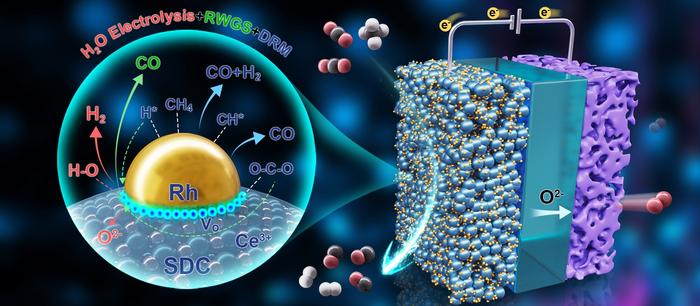
Operating at 600 to 850 °C, SOECs are capable of converting CO2 and H2O into CO and H2. With high reaction rates, high energy efficiency, and low operating costs, they have great potential for CO2 utilization, hydrogen production, and renewable energy storage. Considering the similar temperature range of SOECs and DRM, researchers developed a novel process that coupled DRM, reverse water-gas shift (RWGS), and H2O electrolysis at the SOEC cathode.
In this setup, the in situ electrochemical reduction of H2O byproduct generates H2 and O2- ions. These O2- ions then migrate through the electrolyte and are electrochemically oxidized to O2 at the anode under an applied potential. This process drives the RWGS equilibrium forward, enhancing CO2 conversion and H2 selectivity beyond conventional thermodynamic limitations.
Moreover, researcher in suit exsolved Rh nanoparticles onto a CeO2-x support, creating high-density Ce3+-VO-Rhδ+ interfacial active sites. When operating at a CO2/CH4 ratio of 4, the system achieved CH4 conversion of 94.5% and CO2 conversion of 95.0%, with nearly 100% selectivity toward CO and H2. The apparent methane reducibility reached the theoretical maximum of 4.0.
Sign up for the Daily Dose Newsletter and get every morning’s best science news from around the web delivered straight to your inbox? It’s easy like Sunday morning.
Further investigation revealed that Rhδ+ sites are primarily responsible for CH4 dissociation, while the Ce3+-VO-Rhδ+ interface—rich in oxygen vacancies—promotes CO2 adsorption, activation, and the RWGS reaction. This same interface also catalyzed electrochemical H2O reduction, boosting both CO2 conversion and H2 selectivity.
“Our study may open a new avenue for the direct utilization of CO2-rich natural gas and industrial tail gases using renewable energy,” said Prof. WANG.
IMAGE CREDIT: DICP



Leave a Reply