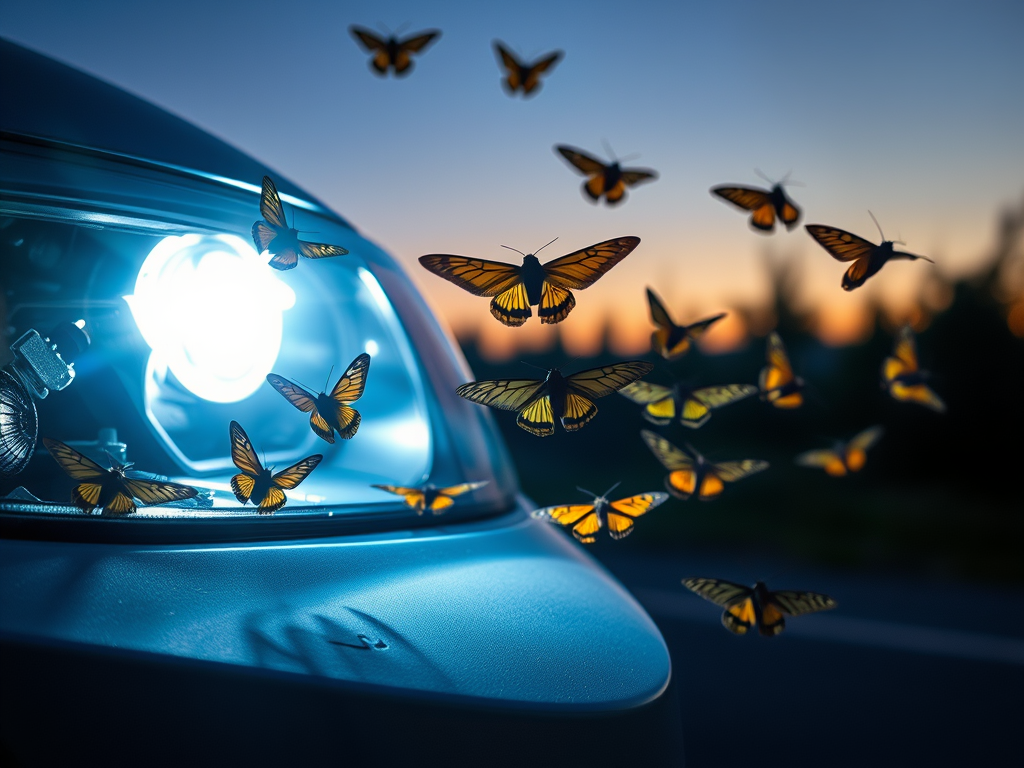
“Cool” white lights – such as those in modern car headlights – endanger moths by causing them to fly erratically, new research shows.
University of Exeter scientists exposed moths to shorts bursts of light, simulating car headlights, then observed their flight patterns.
They found that the “cool” white phosphor-coated LEDs used in modern car headlights dazzled moths and affected their flight.
Moths exposed to this light were 80% more likely to fly erratically or towards the light, compared to those exposed to other lights – and 25 times more likely to fly in these abnormal ways compared to a control group not exposed to any light.
Moths are important pollinators, pests, and prey. In the UK alone there are over 2,500 species, many of which are showing rapid population declines, with similar trends worldwide.
Light pollution is implicated in their declines and most studies have focused on the effect of streetlights. However, vehicle headlights create intense pulses of light along road networks that extend deep into rural and “dark sky” areas.
Sign up for the Daily Dose Newsletter and get every morning’s best science news from around the web delivered straight to your inbox? It’s easy like Sunday morning.
“Vehicle headlights are becoming ever brighter and bluer,” said Dr Jolyon Troscianko, of the Centre for Ecology and Conservation on Exeter’s Penryn Campus in Cornwall.
“In humans, our pupils can change size in less than a second in response to dazzling glare, but in insects the process can take tens of minutes, potentially making them highly vulnerable.
“Moths that fly towards car headlights may be killed in a collision, while erratic flight also wastes energy and may increase the risk from predators such as bats.
“Many moths are only active for a very short time at night, so this disruption could interfere with their ability to feed and find mates.”
The research team caught and released 428 moths from 64 species on the Penryn Campus, exposing each moth to one of the following for 10 seconds immediately before release:
- “Cool” (blue-shifted) white phosphor-coated LEDs.
- “Warm” (amber-shifted) white phosphor-coated LEDs.
- “Cool” RGB (Red-Green-Blue) LEDs – light from three LEDs of different colours.
- “Warm” RGB LEDs.
- No light (control group).
On release, moths from the light-free control group typically flew either up or down.
Those exposed to the cool phosphor-coated LEDs were more likely to fly towards the light, or in tight circles (something rarely seen in moths when night-lighting is not present).
“Simply by switching to warmer-coloured LEDs or different LED technology, we can dramatically reduce their impact on moths,” said Madeleine Fabusova, who collected the data as part of her MSci in Conservation Biology and Ecology at the University of Exeter.
“The phosphor-coated cool LEDs were more harmful than RGB LEDs that have an identical white colour to human vision.
“Our results were remarkably consistent across different moth species.
“Reducing the blue spectrum in headlights may therefore benefit moths, the flowers they pollinate, and the animals that feed on them.”
Commenting on the trend for brighter, bluer headlights, Professor Kevin Gaston, of the Environment and Sustainability Institute at the University of Exeter, said: “There’s no safety benefit to humans from these blue lights compared to lights with more red and green – the current trends appear to come from car manufacturers.
“Car manufacturers, consumers and policymakers could all play a role in making a fairly simple change to reduce our impact on the natural world.”




Leave a Reply