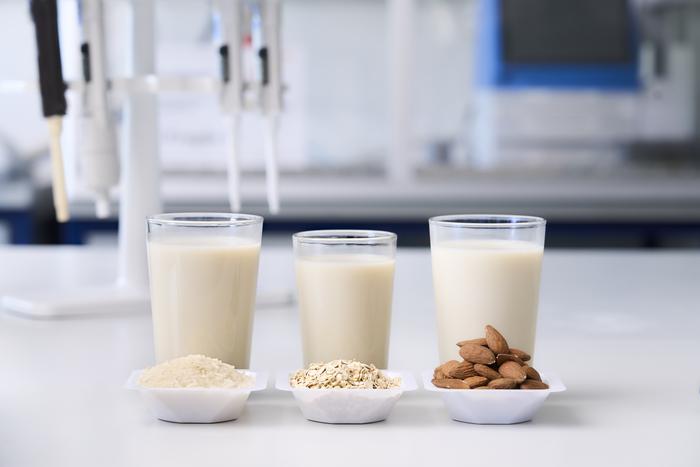
Over the last decade, the global market for plant-based beverages has seen remarkable growth, with oat, almond, soy and rice drinks emerging as popular alternatives to cow’s milk in coffee and oatmeal during this time.
One of the likely reasons for millions of liters of plant-based drinks ending up in the shopping baskets of consumers is that their climate footprint is often lower than that of cow’s milk. But consumers would be mistaken if they considered plant-based beverages healthier than cow’s milk. This is highlighted in a new study conducted by the University of Copenhagen in collaboration with the University of Brescia, Italy.
In the study, researchers examined how chemical reactions during processing affect the nutritional quality of ten different plant-based drinks, comparing them with cow’s milk. The overall picture is clear:
“We definitely need to consume more plant-based foods. But if you’re looking for proper nutrition and believe that plant-based drinks can replace cow’s milk, you’d be mistaken,” says Department of Food Science professor Marianne Nissen Lund, the study’s lead author.
While milk is essentially a finished product when it comes out of a cow, oats, rice, and almonds require extensive processing during their conversion to a drinkable beverage. Moreover, each of the plant-based drinks tested underwent Ultra High Temperature (UHT) treatment, a process that is widely used for long-life milks around the world. In Denmark, milk is typically found only in the refrigerated sections of supermarkets and is low-pasteurized, meaning that it receives a much gentler heat treatment.
“Despite increased plant-based drink sales, cow milk sales remain higher. Consequently, plant-based drinks undergo more intense heat treatments than the milk typically sold in Denmark, in order to extend their shelf life. But such treatment comes at a cost,” says Marianne Nissen Lund.
UHT treatment triggers a so-called “Maillard reaction”, a chemical reaction between protein and sugar that occurs when food is fried or roasted at high temperatures. Among other things, this reaction impacts the nutritional quality of the proteins in a given product.
“Most plant-based drinks already have significantly less protein than cow’s milk. And the protein, which is present in low content, is then additionally modified when heat treated. This leads to the loss of some essential amino acids, which are incredibly important for us. While the nutritional contents of plant-based drinks vary greatly, most of them have relatively low nutritional quality,” explains the professor.
For comparison, the UHT-treated cow’s milk used in the study contains 3.4 grams of protein per liter, whereas 8 of the 10 plant-based drinks analyzed contained between 0.4 and 1.1 grams of protein. The levels of essential amino acids were lower in all plant-based drinks. Furthermore, 7 out of 10 plant-based drinks contained more sugar than cow’s milk.
Sign up for the Daily Dose Newsletter and get every morning’s best science news from around the web delivered straight to your inbox? It’s easy like Sunday morning.
Besides reducing nutritional value, heat treatment also generates new compounds in plant-based drinks. One such compound measured by the researchers in four of the plant-based drinks made from almonds and oats is acrylamide, a carcinogen that is also found in bread, cookies, coffee beans and fried potatoes, including French fries.
“We were surprised to find acrylamide because it isn’t typically found in liquid food. One likely source is the roasted almonds used in one of the products. The compound was measured at levels so low that it poses no danger. But, if you consume small amounts of this substance from various sources, it could add up to a level that does pose a health risk,” says Marianne Nissen Lund.
Additionally, the researchers detected α-dicarbonyl compounds and hydroxymethylfurfural (HMF) in several of the plant-based drinks. Both are reactive substances that could potentially be harmful to human health when present in high concentrations, although this is not the case here.
While professor of nutrition Lars Ove Dragsted is not particularly concerned about the findings either, he believes that the study highlights how little we know about the compounds formed during food processing:
“The chemical compounds that result from Maillard reactions are generally undesirable because they can increase inflammation in the body. Some of these compounds are also linked to a higher risk of diabetes and cardiovascular diseases. Although our gut bacteria break down some of them, there are many that we either do not know of or have yet to study,” says Lars Ove Dragsted of the Department of Nutrition, Execercise and Sports.
Professor Dragsted adds: “This study emphasizes why more attention should be paid to the consequences of Maillard reactions when developing plant-based foods and processed foods in general. The compounds identified in this study represent only a small fraction of those we know can arise from Maillard reactions.”
According to Professor Marianne Nissen Lund, the study highlights broader issues with ultra-processed foods
“Ideally, a green transition in the food sector shouldn’t be characterized by taking plant ingredients, ultra-process them, and then assuming a healthy outcome. Even though these products are neither dangerous nor explicitly unhealthy, they are often not particularly nutritious for us either.”
Her advice to consumers is to: “generally opt for the least processed foods and beverages, and to try to prepare as much of your own food as possible. If you eat healthy to begin with, you can definitely include plant-based drinks in your diet – just make sure that you’re getting your nutrients from other foods.”
At the same time, Professor Lund hopes that the industry will do more to address these issues:
“This is a call to manufacturers to further develop their products and reconsider the extent of processing. Perhaps they could rethink whether UHT treatment is necessary or whether shorter shelf lives for their products would be acceptable.”
IMAGE CREDIT: Jakob Helbig
.



Leave a Reply