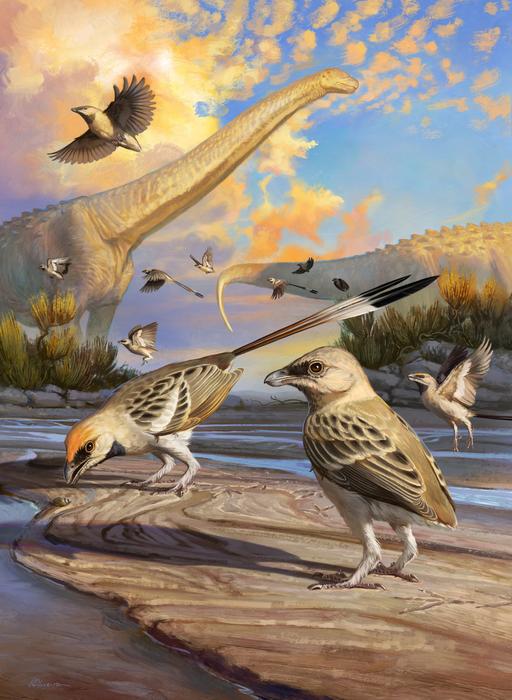
A ‘one of a kind’ fossil discovery could transform our understanding of how the unique brains and intelligence of modern birds evolved, one of the most enduring mysteries of vertebrate evolution.
Researchers have identified a remarkably well-preserved fossil bird, roughly the size of a starling, from the Mesozoic Era. The complete skull has been preserved almost intact: a rarity for any fossil bird, but particularly for one so ancient, making this one of the most significant finds of its kind.
The extraordinary three-dimensional preservation of the skull allowed the researchers, led by the University of Cambridge and the Natural History Museum of Los Angeles County, to digitally reconstruct the brain of the bird, which they have named Navaornis hestiae. Navaornis lived approximately 80 million years ago in what is now Brazil, before the mass extinction event that killed all non-avian dinosaurs.
The researchers say their discovery, reported in the journal Nature, could be a sort of ‘Rosetta Stone’ for determining the evolutionary origins of the modern avian brain. The fossil fills a 70-million-year gap in our understanding of how the brains of birds evolved: between the 150-million-year-old Archaeopteryx, the earliest known bird-like dinosaur, and birds living today.
Navaornis had a larger cerebrum than Archaeopteryx, suggesting it had more advanced cognitive capabilities than the earliest bird-like dinosaurs. However, most areas of its brain, like the cerebellum, were less developed, suggesting that it hadn’t yet evolved the complex flight control mechanisms of modern birds.
“The brain structure of Navaornis is almost exactly intermediate between Archaeopteryx and modern birds – it was one of these moments in which the missing piece fits absolutely perfectly,” said co-lead author Dr Guillermo Navalón from Cambridge’s Department of Earth Sciences.
Sign up for the Daily Dose Newsletter and get every morning’s best science news from around the web delivered straight to your inbox? It’s easy like Sunday morning.
Navaornis is named after William Nava, director of the Museu de Paleontologia de Marília in Brazil’s São Paolo State, who discovered the fossil in 2016 at a site in the neighbouring locality of Presidente Prudente. Tens of millions of years ago, this site was likely a dry area with slow-flowing creeks, which enabled the fossil’s exquisite preservation. This preservation allowed the researchers to use advanced micro-CT scanning technology to reconstruct the bird’s skull and brain in remarkable detail.
“This fossil is truly so one-of-a-kind that I was awestruck from the moment I first saw it to the moment I finished assembling all the skull bones and the brain, which lets us fully appreciate the anatomy of this early bird,” said Navalón.
“Modern birds have some of the most advanced cognitive capabilities in the animal kingdom, comparable only with mammals,” said Professor Daniel Field from Cambridge’s Department of Earth Sciences, senior author of the research. “But scientists have struggled to understand how and when the unique brains and remarkable intelligence of birds evolved—the field has been awaiting the discovery of a fossil exactly like this one.”
Before this discovery, knowledge of the evolutionary transition between the brains of Archaeopteryx and modern birds was practically non-existent. “This represents nearly 70 million years of avian evolution in which all the major lineages of Mesozoic birds originated – including the first representatives of the birds that live today,” said Navalón. “Navaornis sits right in the middle of this 70-million-year gap and informs us about what happened between these two evolutionary points.”
While the skull of Navaornis somewhat resembles that of a small pigeon at first glance, closer inspection reveals that it is not a modern bird at all but instead a member of a group of early birds named enantiornithines, or the ‘opposite birds.’
‘Opposite birds’ diverged from modern birds more than 130 million years ago, but had complex feathers and were likely competent flyers like modern birds. However, the brain anatomy of Navaornis poses a new question: how did opposite birds control their flight without the full suite of brain features observed in living birds, including an expanded cerebellum, which is a living bird’s spatial control centre?
“This fossil represents a species at the midpoint along the evolutionary journey of bird cognition,” said Field, who is also the Strickland Curator of Ornithology at Cambridge’s Museum of Zoology. “Its cognitive abilities may have given Navaornis an advantage when it came to finding food or shelter, and it may have been capable of elaborate mating displays or other complex social behaviour.”
“This discovery shows that some of the birds flying over the heads of dinosaurs already had a fully modern skull geometry more than 80 million years ago,” said co-lead author Dr Luis Chiappe from the Natural History Museum of Los Angeles County.
While Navaornis is one of the best-preserved bird fossils ever found from the Mesozoic Era, the researchers believe many more finds from the Brazilian site where it was found could offer further insights into bird evolution.
“This might be just one fossil, but it’s a key piece in the puzzle of bird brain evolution,” said Field. “With Navaornis, we’ve got a clearer view of the evolutionary changes that occurred between Archaeopteryx and today’s intelligent, behaviourally complex birds like crows and parrots.”
While the discovery is a significant breakthrough, the researchers say it is only the first step in understanding the evolution of bird intelligence. Future studies may reveal how Navaornis interacted with its environment, helping to answer broader questions about the evolution of bird cognition over time.
Navaornis is the most recent in a quartet of Mesozoic fossil birds described by Field’s research group since 2018, joining Ichthyornis, Asteriornis (the ‘Wonderchicken’), and Janavis. The group’s work on new fossil discoveries combined with advanced visualisation and analytical techniques have revealed fundamental insights into the origins of birds, the most diverse group of living vertebrate animals.
IMAGE CREDIT: Júlia D’Oliveira




Leave a Reply