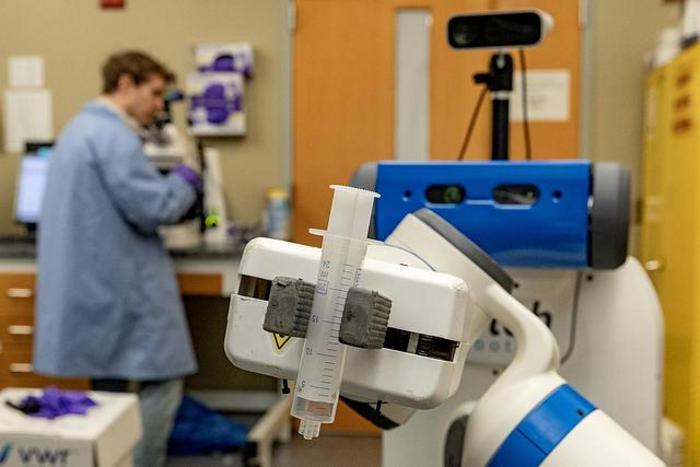
Science laboratories across disciplines—chemistry, biochemistry and materials science—are on the verge of a sweeping transformation as robotic automation and AI lead to faster and more precise experiments that unlock breakthroughs in fields like health, energy and electronics, according to UNC-Chapel Hill researchers in the paper, “Transforming Science Labs into Automated Factories of Discovery,” published in Science Robotics, the most prestigious journal covering robotics research.
“Today, the development of new molecules, materials and chemical systems requires intensive human effort,” said Dr. Ron Alterovitz, senior author of the paper and Lawrence Grossberg Distinguished Professor in the Department of Computer Science. “Scientists must design experiments, synthesize materials, analyze results and repeat the process until desired properties are achieved.”
This trial-and-error approach is time-consuming and labor-intensive, slowing the pace of discovery. Automation offers a solution. Robotic systems can perform experiments continuously without human fatigue, significantly speeding up research. Robots not only execute precise experimental steps with greater consistency than humans, they also reduce safety risks by handling hazardous substances. By automating routine tasks, scientists can focus on higher-level research questions, paving the way for faster breakthroughs in medicine, energy and sustainability.
“Robotics has the potential to turn our everyday science labs into automated ‘factories’ that accelerate discovery, but to do this, we need creative solutions to allow researchers and robots to collaborate in the same lab environment,” said Dr. James Cahoon, a co-author of the paper and chair of the Department of Chemistry. “With continued development, we expect robotics and automation will improve the speed, precision and reproducibility of experiments across diverse instruments and disciplines, generating the data that artificial intelligence systems can analyze to guide further experimentation.”
The researchers defined five levels of laboratory automation to illustrate how automation can evolve in science labs:
- Assistive Automation (A1): At this level, individual tasks, such as liquid handling, are automated while humans handle the majority of the work.
- Partial Automation (A2): Robots perform multiple sequential steps, with humans responsible for setup and supervision.
- Conditional Automation (A3): Robots manage entire experimental processes, though human intervention is required when unexpected events arise.
- High Automation (A4): Robots execute experiments independently, setting up equipment and reacting to unusual conditions autonomously.
- Full Automation (A5): At this final stage, robots and AI systems operate with complete autonomy, including self-maintenance and safety management.
The levels of automation defined by the researchers can be used to assess progress in the field, help in establishing appropriate safety protocols and set goals for future research in both science domains and robotics. Although lower levels of automation are common today, achieving high and full automation is a research challenge that will require robots capable of operating across different lab environments, handling complex tasks and interacting with humans and other automation systems seamlessly.
Sign up for the Daily Dose Newsletter and get every morning’s best science news from around the web delivered straight to your inbox? It’s easy like Sunday morning.
Artificial intelligence plays a key role in advancing automation beyond physical tasks. AI can analyze vast datasets generated by experiments, identify patterns and suggest new compounds or research directions. Integrating AI into the laboratory workflow will allow labs to automate the entire research cycle—from designing experiments to synthesizing materials and analyzing results.
In AI-driven labs, the traditional Design-Make-Test-Analyze (DMTA) loop can become fully autonomous. AI could determine which experiments to conduct, make real-time adjustments, and continuously improve the research process. While AI systems have shown early success in tasks like predicting chemical reactions and optimizing synthesis routes, the researchers caution that AI must be carefully monitored to avoid risks, such as the accidental creation of hazardous materials.
Transitioning to automated labs presents significant technical and logistical challenges. Laboratories differ widely in their setups, ranging from single-process labs to large, multiroom facilities. Developing flexible automation systems that work across diverse environments will require mobile robots capable of transporting items and performing tasks across multiple stations.
Training scientists to work with advanced automation systems is equally important. Researchers will not only need to develop expertise in their scientific fields but also understand the capabilities of robots, data science and AI to accelerate their research. Educating the next generation of scientists to collaborate with engineers and computer scientists will be essential for realizing the full potential of automated laboratories.
“The integration of robotics and AI is poised to revolutionize science labs,” said Angelos Angelopoulos, a co-author of the paper and research assistant in Dr. Alterovitz’s Computational Robotics Group. “By automating routine tasks and accelerating experimentation, there is great potential for creating an environment where breakthroughs occur faster, safer and more reliably than ever before.”
IMAGE CREDIT: Johnny Andrews/UNC-Chapel Hill
.



Leave a Reply