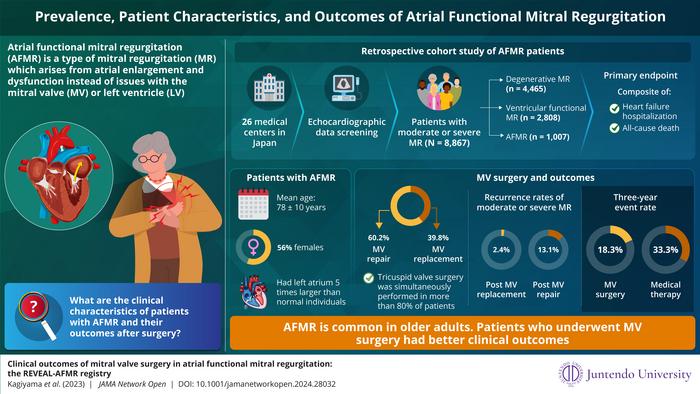
Mitral regurgitation (MR) is a serious heart condition that often requires corrective surgery. It is characterized by the backflow or “regurgitation” of blood from the heart’s left ventricle into the left atrium. Atrial Functional Mitral Regurgitation (AFMR), characterized by normal mitral valve (MV) function and left ventricular function but with atrial dilation and defects in the ring-like structure that supports the MV leaflets (mitral annulus), poses diagnostic and therapeutic challenges due to its distinct pathophysiological mechanisms. Historically, studies on AFMR have been limited by small sample sizes and single-center data, leading to variability in reported prevalence and clinical outcomes.
To address this gap, a team of researchers led by Associate Professor Nobuyuki Kagiyama from the Department of Cardiovascular Biology and Medicine at Juntendo University Graduate School of Medicine, Japan, collaborated with Tomohiro Kaneko and Tohru Minamino, also from the same department, alongside Minoru Tabata from the Department of Cardiovascular Surgery at Juntendo University School of Medicine, and Yukio Abe from the Department of Cardiology at Osaka City General Hospital. Together, they conducted a retrospective study analyzing echocardiographic reports of patients who underwent transthoracic echocardiography. Their findings were published on August 15, 2024, in JAMA Network Open.
Called the REVEAL-AFMR study, the team analyzed a vast dataset comprising 225,163 echocardiographic reports from 177,235 patients who underwent transthoracic echocardiography in 2019. Through rigorous screening and validation processes, the study identified 1,007 cases of AFMR, accounting for 11.4% of all patients with MR in the study cohort.

The study’s findings shed light on several pivotal aspects of AFMR. Firstly, AFMR was found to predominantly affect elderly patients burdened with conditions like atrial fibrillation, enlarged left atria, and stiffened left ventricles. Secondly, the study’s evaluation of MV surgery outcomes upon a 3-year follow-up in 113 patients revealed a marked reduction in MR severity post-operation, correlating with substantially better clinical outcomes, including smaller rates of heart failure hospitalizations and all-cause mortality. These findings are the first report of outcomes after MV surgery in AFMR, and will be an important basis of decision- making in management strategies of AFMR.
“The study showed that patients with AFMR generally have poor prognoses, but those who underwent mitral valve surgery had significantly better outcomes. Notably, the surgical group had a three-year event rate of 18.3% compared to 33.3% in the non-surgical group. These findings underscore the importance of understanding AFMR and its treatment options. We believe this study provides critical insights into the real-world characteristics and treatment strategies for AFMR, paving the way for future trials to explore causal relationships and optimize patient care,” observes Kagiyama.
Sign up for the Daily Dose Newsletter and get every morning’s best science news from around the web delivered straight to your inbox? It’s easy like Sunday morning.
Although patients with AFMR are older, the study revealed that younger patients were most likely to receive corrective mitral valve surgery. Compared to those who remained on medical therapy, patients who underwent surgery also had more severe MR, had greater left atrium volume and suffered heart failure more frequently.
Although further research is required to prove the relationships definitively, the general trends in AFMR and outcomes of corrective mitral valve surgery in patients uncovered by this study are expected to guide clinicians in improved decision-making. The knowledge generated may also stimulate more scientific investigations into the origins of AFMR.
“This research addresses the significant challenge of underdiagnosis and undertreatment of AFMR by providing robust data on its clinical characteristics and outcomes. Healthcare providers can use this information to develop better screening protocols and treatment strategies, potentially improving the quality of life and survival rates for patients with AFMR. Additionally, this study could influence healthcare policies and resource allocation to ensure that patients with AFMR receive the attention and care they need,” Dr. Kagiyama explains. “Overall, our research contributes to a deeper understanding of AFMR and paves the way for future studies and clinical trials aimed at optimizing management and treatment for affected patients,” he concludes.
IMAGE CREDIT: Nobuyuki Kagiyama of Juntendo University
If you enjoy the content we create and would like to support us, please consider becoming a patron on Patreon! By joining our community, you’ll gain access to exclusive perks such as early access to our latest content, behind-the-scenes updates, and the ability to submit questions and suggest topics for us to cover. Your support will enable us to continue creating high-quality content and reach a wider audience.
Join us on Patreon today and let’s work together to create more amazing content! https://www.patreon.com/ScientificInquirer



Leave a Reply