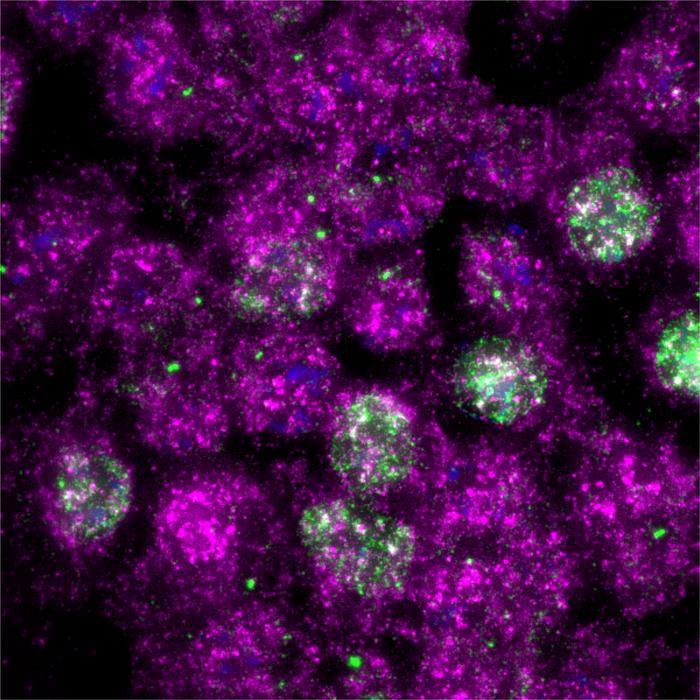
In a recent study, researchers at Johns Hopkins Medicine suggest the cell’s messenger RNA (mRNA) — the major translator and regulator of genetic material — along with a critical protein called ZAK, spur the cell’s initial response to UV radiation damage and play a critical role in whether the cell lives or dies.
While UV radiation has long been known to damage DNA, it also damages mRNA, and the latest findings, published June 5 in Cell, indicate that mRNAs act as first responders in telling the cells how to manage the stress.
“RNA is a canary in the coal mine. It’s telling the cell, ‘We’ve got major damage here and we need to do something,’” says Rachel Green, Ph.D., a Bloomberg Distinguished Professor of Molecular Biology and Genetics and Daniel Nathans Director of the Department of Molecular Biology and Genetics at the Johns Hopkins University School of Medicine. Green, also an investigator at Howard Hughes Medical Institute, is the corresponding author of the new study.

ZAK is a key player in a process that identifies cellular damage by sensing the collisions of ribosomes, tiny macromolecular machines that help RNA translate the language of genes into the language of proteins. Collisions occur when ribosomes move along UV-damaged mRNAs and, unable to decode the damaged message, cause stalled ribosomes to get “rear-ended” by upstream ribosomes. Ribosome collisions activate ZAK, which triggers a cellular signaling program known as the ribotoxic stress response. ZAK then instigates a cascade of downstream events that decide the cell’s fate.
A more comprehensive understanding of how cellular life-and-death decisions are made upon encountering UV radiation could help investigators understand underlying causes of skin and other cancers, says Niladri Sinha, Ph.D., Jane Coffin Childs Memorial Fund Postdoctoral Fellow at Johns Hopkins School of Medicine. Companies developing drugs that target ribosomes may also find that ZAK could be a driver of cell death across cancer types, he says.
The findings indicate that ZAK senses the extent of cellular damage and responds depending on how much UV radiation the cell receives, offering a more nuanced understanding of UV-caused cell death and identifying new ways to keep ZAK’s activity under control, Green says.
Sign up for the Daily Dose Newsletter and get every morning’s best science news from around the web delivered straight to your inbox? It’s easy like Sunday morning.
“There are graded ways that ZAK responds, it’s not all or nothing,” she says.
The research also “very clearly shows” that, for example, a skin cell’s fate in the immediate aftermath of UV radiation is “driven primarily by the extent of colliding ribosomes and ZAK signaling,” Green says.
“In this regime, DNA damage and the well-characterized DNA damage response pathway, including the key protein p53, do not significantly determine cell fate decisions,” she says.
DNA damage repair is critical and occurs in a subset of cells that are copying their genetic material, but these pathways are not the major “deciders” of cell fate, she says.
Green co-led the research with Sergi Regot, Ph.D., associate professor of molecular biology and genetics at the Johns Hopkins University School of Medicine, and Alban Ordureau, Ph.D., assistant member of the Cell Biology Program at Memorial Sloan Kettering Cancer Center’s Sloan Kettering Institute and an assistant professor at Weill Cornell.
To conduct their research, the scientists exposed human cellular models to a UV lamp mimicking the sun’s radiation. Using proteomics to understand cell signaling in an approach led by Ordureau, they evaluated ZAK’s role and made predictions about how cells would respond to different levels of stress. From there, live cell imaging experiments led by Regot, in addition to in-house ribosome biochemistry — the workhorse of Green’s laboratory — helped characterize how cellular death is regulated as a consequence of ZAK-mediated UV radiation.
In the future, the researchers plan to investigate cell types with different protein synthesis regimes, including those in melanoma and other cancers. The researchers suspect that fast-growing cells will rely on ZAK-mediated regulation more than others, Green says.
Funding for this research was provided by the Howard Hughes Medical Institute, the National Institutes of Health (NIH 1R35GM133499), a National Science Foundation Career grant, the Jane Coffin Childs Memorial Fund for Medical Research Fellowship, and the National Institute of General Medical Sciences, Sloan Kettering Institute startup funds, Pew Charitable Trusts, a Memorial Sloan Kettering Cancer Center support grant, and the Basic Science Research Program from the National Research Foundation of Korea; Ministry of Education.
Other scientists who contributed to this study are Connor McKenney, Zhong Y. Yeow, and Jeffrey J. Li of Johns Hopkins; Ki Hong Nam of Memorial Sloan Kettering Cancer Center’s Sloan Kettering Institute; and Tomer M. Yaron-Barir, Jared L. Johnson, Emily M. Huntsman and Lewis C. Cantley of Weill Cornell Medicine.
Green is a member of the scientific advisory board of Alltrna, Initial Therapeutics and Arrakis Pharmaceuticals, consults for Vertex Pharmaceuticals, Bristol-Myers Squibb (Celgene), Monta Rosa Therapeutics and Flagship Pioneering, and served on the scientific advisory board at Moderna.
Green, Regot, Sinha and McKenney have filed for a patent related to work described in this research.
IMAGE CREDIT: Zhong Yeow and Niladri Sinha
If you enjoy the content we create and would like to support us, please consider becoming a patron on Patreon! By joining our community, you’ll gain access to exclusive perks such as early access to our latest content, behind-the-scenes updates, and the ability to submit questions and suggest topics for us to cover. Your support will enable us to continue creating high-quality content and reach a wider audience.
Join us on Patreon today and let’s work together to create more amazing content! https://www.patreon.com/ScientificInquirer




Leave a Reply