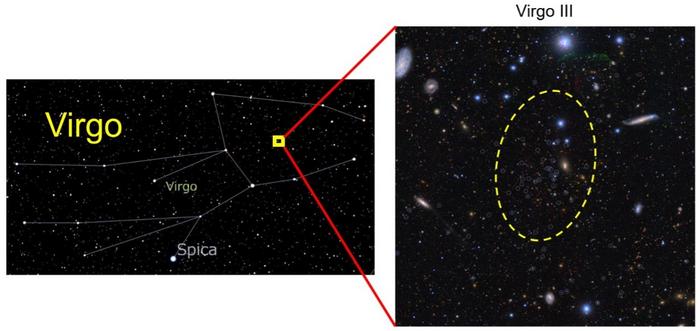
For years, astronomers have worried about how to explain why the Milky Way has fewer satellite galaxies than the standard dark matter model predicts. This is called the “missing satellites problem.” In order to bring us closer to solving this problem, an international team of researchers used data from the Hyper Suprime-Cam (HSC) Subaru Strategic Program (SSP) to discover two completely new satellite galaxies.
These results were published in the Publications of the Astronomical Society of Japan on June 8, 2024 by a team of researchers from Japan, Taiwan, and America.
We live in a galaxy called The Milky Way, which has other, smaller galaxies orbiting it called satellite galaxies. Studying these satellite galaxies can help researchers unravel mysteries surrounding dark matter, and better understand how galaxies evolve over time.

“How many satellite galaxies does the Milky Way have? This has been an important question for astronomers for decades,” remarks Masahi Chiba, a professor at Tohoku University.
The research team recognized the possibility that there are likely many undiscovered, small satellite galaxies (dwarf galaxies) which are far away and difficult to detect. The powerful ability of the Subaru telescope – which sits atop an isolated mountain above the clouds in Hawaii – is well-suited to find these galaxies. In fact, this research team previously found three new dwarf galaxies using the Subaru telescope.
Sign up for the Daily Dose Newsletter and get every morning’s best science news from around the web delivered straight to your inbox? It’s easy like Sunday morning.
Now, the team has discovered an additional two new dwarf galaxies (Virgo III and Sextans II). With this discovery, a total of nine satellite galaxies have been found overall by different research teams. This is still much fewer than the 220 satellite galaxies predicted by the standard theory of dark matter.
However, the footprint of the HSC-SSP does not cover the entire Milky Way. If the distribution of those nine satellite galaxies across the entire Mily Way is similar to what was found in the footprint captured by the HSC-SSP, the research team calculates that there actually may be closer to 500 satellite galaxies. Now, we are faced with a “too many satellites problem,” rather than a “missing satellites problem.”
To better characterize the actual amount of satellite galaxies, more high-resolution imaging and analysis is required. “The next step is to use a more powerful telescope that captures a wider view of the sky,” explains Chiba, “Next year, the Vera C. Rubin Observatory in Chile will be used to fulfill that purpose. I hope that many new satellite galaxies will be discovered.
IMAGE CREDIT: NAOJ/Tohoku University
If you enjoy the content we create and would like to support us, please consider becoming a patron on Patreon! By joining our community, you’ll gain access to exclusive perks such as early access to our latest content, behind-the-scenes updates, and the ability to submit questions and suggest topics for us to cover. Your support will enable us to continue creating high-quality content and reach a wider audience.
Join us on Patreon today and let’s work together to create more amazing content! https://www.patreon.com/ScientificInquirer



Leave a Reply