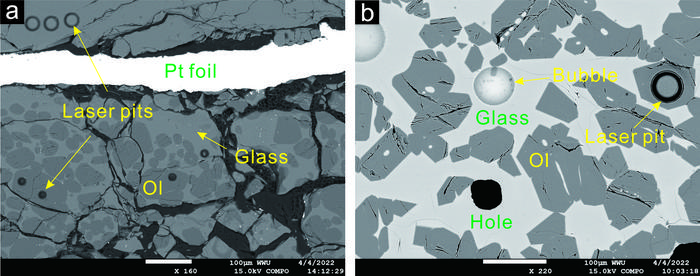
Olivine is the earliest mineral to crystallize from basaltic magma, and accurate knowledge of olivine/melt partition coefficients (DOl–melt ) for first-transition row elements (FTREs) Ga and Ge, is required in quantitative modeling of petrogenetic processes in planetary basalts.
Numerous experimental studies have focused on this topic, but most investigations concentrated on minor elements found in olivine, and the oxygen fugacities (fO2) in many of these experiments were commonly designed to be similar to those found in Earth’s mantle.
However, for applications involving the formation of basalt on other rocky planetary bodies including the Moon, Mars, and asteroids, oxygen fugacities during basalt formation can range widely from 2 log units below the iron-wüstite buffer (herein referred to as IW-2) to IW+6. In addition, lunar basalts are generally iron-rich compared to terrestrial basalts.

To assess the effects of oxygen fugacity and iron content on partition coefficients of FTREs, Ga and Ge, Dr. Jiejun Jing (a JSPS postdoctoral fellow in Ehime University) conducted a series of high-temperature experiments (around IW-2 to IW+5.5) at 1 atm using a gas-mixing furnace with the cooperation of colleagues in Ehime University, and in other universities in the Netherlands, China and Germany.
The results show that most DOl–melt show no sensitivity to bulk system iron contents, but DOl–meltCr is significantly higher in our experiments compared to DOl–meltCr derived from olivine-melt inclusion pairs in lunar samples with much higher FeO content. DOl–meltNi values are nearly constant at a range of oxygen fugacities above the IW buffer, but abruptly decrease when the system is iron metal saturated (below the IW buffer).
Sign up for the Daily Dose Newsletter and get every morning’s best science news from around the web delivered straight to your inbox? It’s easy like Sunday morning.
Using the newly derived partition coefficients, the authors re-assessed two aspects of lunar basalt generation. First, they conclude that the Cr-rich nature of the olivines in lunar basalts compared to terrestrial basalts must be attributed to the Cr-nature of the cumulate mantle source of lunar basalts, which is linked to the early crystallization of Cr-poor minerals olivine and orthopyroxene in the lunar magma ocean resulting in shallow Cr-rich cumulates. Second, the higher Co/Ni ratios in olivine in high-titanium lunar basalts compared to olivine in low-titanium lunar basalts suggest the former were formed at a more reduced condition in the lunar mantle (below the IW buffer, saturated with metal).
IMAGE CREDIT: Jiejun Jing
If you enjoy the content we create and would like to support us, please consider becoming a patron on Patreon! By joining our community, you’ll gain access to exclusive perks such as early access to our latest content, behind-the-scenes updates, and the ability to submit questions and suggest topics for us to cover. Your support will enable us to continue creating high-quality content and reach a wider audience.
Join us on Patreon today and let’s work together to create more amazing content! https://www.patreon.com/ScientificInquirer
Leave a Reply