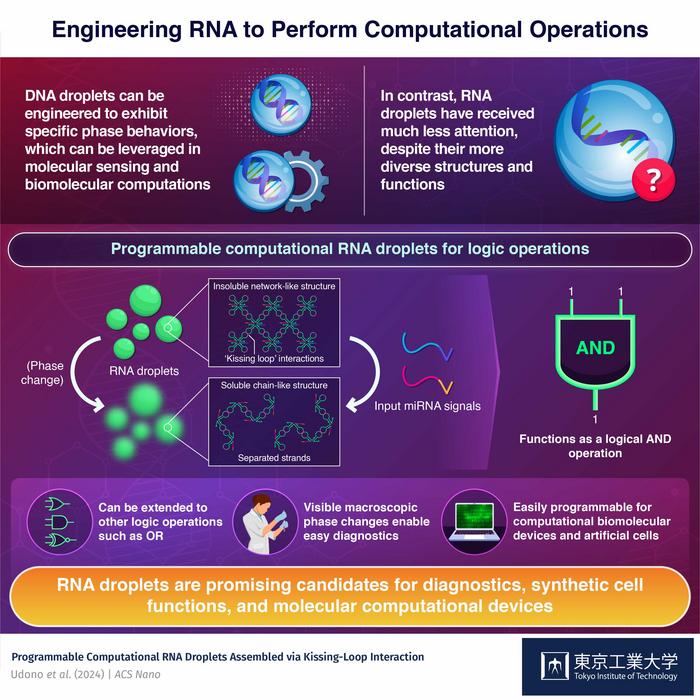
RNA droplets can now be used to perform logical operations that take microRNA sequences as inputs, report scientists from Tokyo Tech. By self-assembling into network-like structures, RNA molecules form liquid-state droplets. These RNA droplets disperse only when the correct microRNA sequences are present by performing the logical AND operation. This innovative strategy could pave the way to advances in biomolecular sensing, artificial cells, and computational biodevices.
DNA and RNA encode genetic information and are involved in protein synthesis. In DNA/RNA nanotechnology, their information-processing capabilities are harnessed to form programmable 2D/3D structures. In recent years, DNA droplets, liquid-state condensates of synthetic DNA, have attracted increasing attention as molecular sensing and biocomputational devices. While DNA droplets have captured the spotlight in this advanced research field, their RNA counterparts can be just as powerful, if not more. Compared to DNA, RNA has much more varied functions besides its role in protein synthesis. Additionally, it can adopt a broad array of molecular structures. Unfortunately, despite its versatility, few studies have explored the untapped potential of RNA droplets as a tool for biocomputing and bio-nanotechnology.
Against this backdrop, a team of researchers, including Professor Masahiro Takinoue and post-doctoral researcher Hirotake Udono from Tokyo Institute of Technology, Japan, set out to develop a new type of ‘computational RNA droplets,’ which can be used to perform logic operations akin to electronic devices. Their study findings were published on June 3 in ACS Nano and selected as supplementary cover.

These programmable RNA droplets are constructed through RNA’s capabilities for sequence recognition and secondary structure formation. “Our approach is based on the kissing loop (KL) interaction, which occurs between two internally folded single-stranded RNAs,” explains Takinoue. “This enables the self-assembly of these folded structures into stable complex structures.” Simply put, the researchers carefully engineered the nucleotide sequence of the RNA strands so that they would spontaneously assemble into predetermined molecular structures, which also attract each other to form a large-scale network.
The phase-state controllability of RNA droplets is underlain by a type of key-and-lock mechanism that can only be ‘opened’ by a specific microRNA sequence. Due to the way the RNA structures were designed, only when two given microRNA sequences are present at the same time will the network disassemble into chain-like structures. When this happens, it causes a noticeable change in the phase of the RNA droplets, which become more dispersed in the solution.
Sign up for the Daily Dose Newsletter and get every morning’s best science news from around the web delivered straight to your inbox? It’s easy like Sunday morning.
In computational terms, the proposed RNA droplets can effectively perform the logical AND operation, taking two microRNA sequences as inputs. The researchers also stated that designing similar RNA droplets for other logical operations is also possible. This versatility could prove useful in several applications, as Takinoue remarks: “Our computational RNA droplets can be applied to the in situ programmable assembly of computational biomolecular devices and artificial cells from transcriptionally derived RNA within biological or artificial cells.”
On top of this, these RNA droplets hold much promise as convenient diagnostic tools. Since they can detect the presence of specific RNA sequences, they can be used to look for disease biomarkers. “Unlike previously reported submicroscopic RNA-based logic operators, the macroscopic phase change of our RNA droplets provides a readout for molecular sensing that can be distinguished with the naked eye,” highlights Takinoue.
Overall, this study highlights RNA’s dual role as both a tool and a building block for versatile bioengineering devices. Stay tuned for more breakthroughs in this rapidly evolving field!
IMAGE CREDIT: Tokyo Institute of Technology
If you enjoy the content we create and would like to support us, please consider becoming a patron on Patreon! By joining our community, you’ll gain access to exclusive perks such as early access to our latest content, behind-the-scenes updates, and the ability to submit questions and suggest topics for us to cover. Your support will enable us to continue creating high-quality content and reach a wider audience.
Join us on Patreon today and let’s work together to create more amazing content! https://www.patreon.com/ScientificInquirer


Leave a Reply