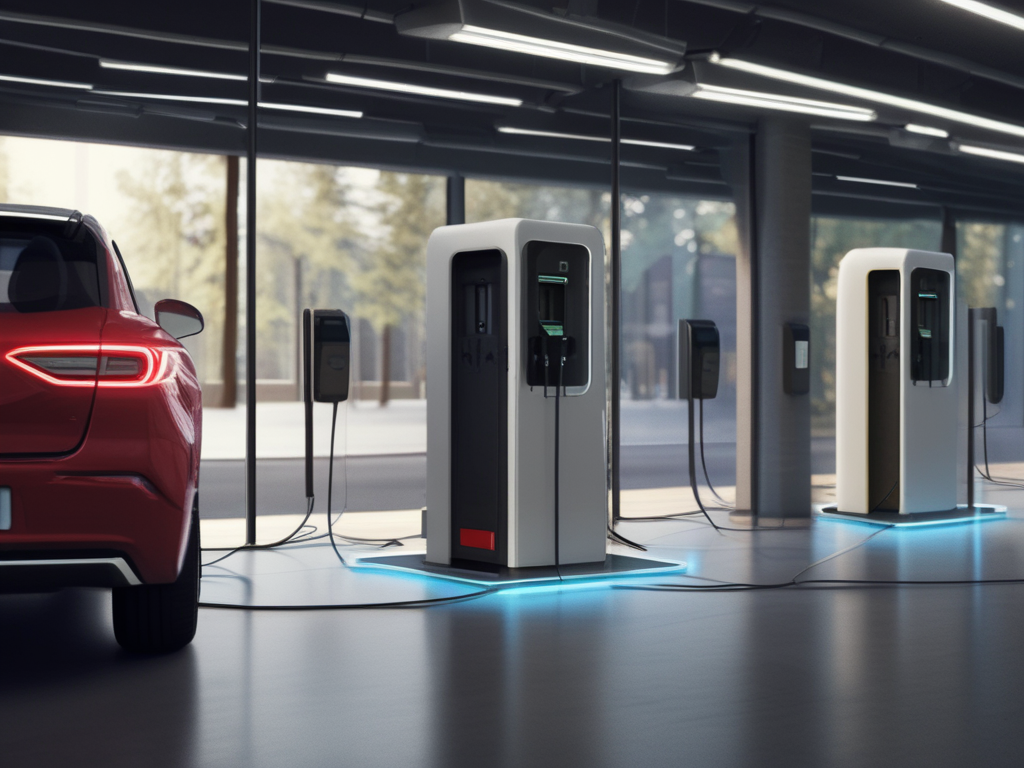
As more and more people drive electric cars, congestion and queues can occur when many people need to charge at the same time. A new study from Chalmers University of Technology in Sweden shows how AI-controlled charging stations, through smart algorithms, can offer electric vehicle users personalised prices, and thus minimise both price and waiting time for customers. But the researchers point to the importance of taking the ethical issues seriously, as there is a risk that the artificial intelligence exploits information from motorists.
Today’s commercial charging infrastructure can be a jungle. The market is dynamic and complex with a variety of subscriptions and free competition between providers. At some fast charging stations, congestion and long queues may even occur. In a new study, researchers at Chalmers have created a mathematical model to investigate how fast charging stations controlled by artificial intelligence, AI, can help by offering electric car drivers personalised prices, which the drivers can choose to accept or refuse. The AI uses algorithms that can adjust prices based on individual factors, such as battery level and the car’s geographic location.
“The electric car drivers can choose to share information with the charging station providers and receive a personal price proposal from a smart charging station. In our study, we could show how rational and self-serving drivers react by only accepting offers that are beneficial to themselves. This leads to both price and waiting times being minimized”, says Balázs Kulcsár, professor at the department of electrical engineering at Chalmers.
In the study, the drivers always had the option to refuse the personal price, and choose a conventional charging station with a fixed price instead. The personal prices received by the drivers could differ significantly from each other, but were almost always lower than the market prices. For the providers of charging stations, the iterative AI algorithm can find out which individual prices are accepted by the buyer, and under which conditions. However, during the course of the study, the researchers noted that on some occasions the algorithm raised the price significantly when the electric car’s batteries were almost completely empty, and the driver consequently had no choice but to accept the offer.

“Smart charging stations can solve complex pricing in a competitive market, but our study shows that they need to be developed and introduced with privacy protection for consumers, well in line with responsible-ethical AI paradigms”, says Balázs Kulcsár.
The researchers created a mathematical model of the interaction between profit-maximising fast charging stations and electric car users. The “charging stations” could offer public market prices or AI-driven profit-maximising personal prices, which the “electric car users” could then accept or reject based on their own conditions and needs. In most cases, the results were promising, as the AI-generated prices were lower than the market prices.
Sign up for the Daily Dose Newsletter and get the morning’s best science news from around the web delivered straight to your inbox? It’s easy like Sunday morning.




Leave a Reply