Some of the ocean’s tiniest organisms get swept into underwater currents that act as a conduit that shuttles them from the sunny surface to deeper, darker depths where they play a huge role in affecting the ocean’s chemistry and ecosystem, according to new research.
Published in the Proceedings of the National Academy of Sciences and based on fieldwork during three research cruises spanning 2017 to 2019, the study focuses on subtropical regions in the Mediterranean Sea. It uncovered how some microscopic single-celled organisms that are too light to sink beyond 100 meters or so — like phytoplankton and bacteria — end up going deeper into the ocean where there’s not enough sunlight for these photosynthetic organisms to grow, live and eat.

“We found that because these organisms are so small, they can be swept up by ocean currents that then bring them deeper than where they grow,” said Mara Freilich, an assistant professor in Brown University’s Division of Applied Mathematics and Department of Earth, Environmental and Planetary Sciences who launched the work as a Ph.D. student a joint program at MIT and the Woods Hole Oceanographic Institution. “It’s often a one-way trip for these organisms, but by taking this trip, they play a critical role in connecting different parts of the ocean.”
Freilich conducted the research during her Ph.D. with Amala Mahadevan, senior scientist at Woods Hole, in a close collaboration with senior scientist at the Marine Biological Laboratory Alexandra Z. Worden and her team.
Sign up for the Daily Dose Newsletter and get every morning’s best science news from around the web delivered straight to your inbox? It’s easy like Sunday morning.
The currents the team found are called intrusions and by sweeping up the tiny organisms, they help change the types of food available in the deeper layers of the ocean while also transporting a significant amount of carbon from the water surface. This helps feed other organisms in the ocean’s food chain and increases the complexity of the ecosystem at deeper depths, influencing how life and chemistry work underwater.
Altogether, the study challenges conventional understanding of how carbon, which is turned into organic matter by photosynthesis in the sunlit layer of the ocean, gets transported to depth.
“The majority of photosynthesis — by which light is converted into organic carbon, a food source for living organisms — happens in the upper 50 meters of the ocean, so the question has always been: How does the carbon that gets fixed through photosynthesis get into the deep ocean?” Freilich said. “The sinking of carbon-rich particles has always been thought to be the only answer to this question. But what we found is that tiny, single-celled organisms get caught in the oceanic flow to form intrusions… Such intrusions are significant features of the subtropical ocean — while they extend tens of kilometers laterally, they also descend hundreds of meters in the vertical, bringing cells and carbon with them. This mechanism has been unaccounted in previous estimates of carbon transport.”
The researchers found the intrusions occur year-round and originate in areas rich with biomass, including where the plant-like organisms are at their highest concentrations. Previously, ocean currents were only thought to carry carbon to depth seasonally. The researchers suggest these intrusions are widespread in the world’s subtropical oceans. They provide conduits for the continual transport of carbon and oxgyen from the sunlit ocean to depth.
“We observed microbial communities that looked just like surface microbial communities down to 200 meters,” Freilich said. “In other regions, we think this could be a lot deeper. To our surprise we found that the majority of microbes in the intrusions were bacteria that feed on carbon fixed by the photosynthesizing cells. This showed that the bulk of the biomass transported from the sunlit layers comprised of non-photosynthetic microbes.”
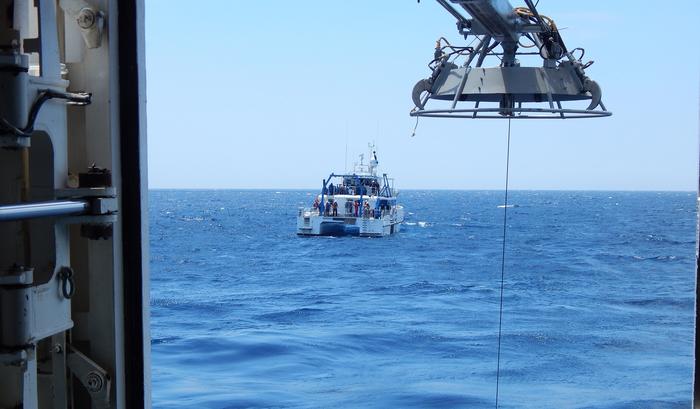
As a collaboration between the US, Spain and Italy, the scientists went on three trips to the subtropical Mediterranean ocean for the study. They used special tools to measure properties like water temperature, salinity and the abundance of the tiny organisms at different depths. The analyses, conducted in collaboration with microbial ecologist, Alexandra Worden at the Marine Biological Laboratory, helped show the differences between intrusion samples and background waters. Seeing that the microbial communities in the deeper intrusion samples resembled surface microbial communities showed that they were being transported to depth. The researchers also used computer models to simulate ocean currents to reveal how the communities of tiny plants and bacteria moved in the water.
“With the strong data from the Mediterranean establishing this process of three-dimensional conduits as a mechanism for bringing surface microbes to the dark ocean in warm waters, we have been able to see traces of similar export in major open ocean regions,” said Worden.
Along with underscoring the ecological importance of intrusions in shaping oceanic biodiversity, the study also touches on how intrusions could be affected by climate change. It is thought that as the Earth’s oceans get warmer, the proportion of carbon in tiny cells would increase and the transport in intrusions may not be as affected as other mechanisms that carry carbon to depth. Intrusions change our understanding of how carbon moves around in the ocean and could help regulate carbon storage and microbial dynamics in the deep ocean.
“There’s so much more to explore now that we’ve found this,” Freilich said. “What’s next is taking what we’ve learned here and determining if we can use this to predict how changes in the microbial community composition would affect the transport of carbon and the global carbon cycle in a changing climate.”
IMAGE CREDIT: Kausalya Mahadevan.
If you enjoy the content we create and would like to support us, please consider becoming a patron on Patreon! By joining our community, you’ll gain access to exclusive perks such as early access to our latest content, behind-the-scenes updates, and the ability to submit questions and suggest topics for us to cover. Your support will enable us to continue creating high-quality content and reach a wider audience.
Join us on Patreon today and let’s work together to create more amazing content! https://www.patreon.com/ScientificInquirer




Leave a Reply