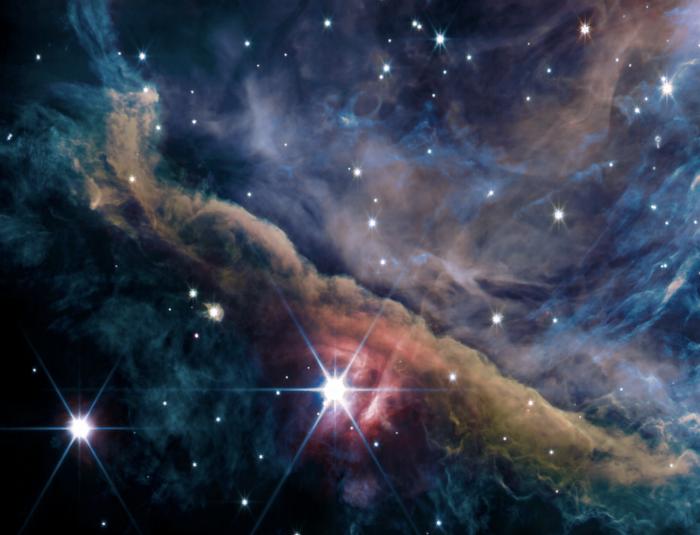
To find out how planetary systems such as our Solar System form, an international research team including scientists from the University of Cologne studied a stellar nursery, the Orion Nebula, using the James Webb Space Telescope (JWST). By observing a protoplanetary disc named d203-506, they discovered the key role massive stars play in the formation of planetary systems that are less than a million years old. The study, led by Dr Olivier Berné from the National Centre for Scientific Research (CNRS) in Toulouse, was published under the title ‘A far-ultraviolet-driven photoevaporation flow observed in a protoplanetary disk’ in Science.
These stars, which are around ten times more massive, and, more importantly, 100,000 times more luminous than the Sun, expose any planets forming in such systems nearby to very intense ultraviolet radiation. Depending on the mass of the star at the centre of the planetary system, this radiation can either help planets to form, or alternatively prevent them from doing so by dispersing their matter. In the Orion Nebula, the scientists found that, due to the intense irradiation from massive stars, a Jupiter-like planet would not be able to form in the planetary system d203-506.

The team encompasses a wide range of experts from areas such as instrumentation, data reduction and modelling. The data from the JWST were combined with data collected with the Atacama Large Millimeter Array (ALMA) in order to constrain the physical conditions in the gas. The calculated rate at which the disk lost mass implies that the whole disk will evaporate faster than it would take for a giant planet to form.
“It is great that so many contributions from the team over the years, including the planning of the observations and the evaluation the data, are bearing fruit in the form of these results that represent a significant step forward in understanding the formation of planetary systems”, said Dr Yoko Okada from the University of Cologne’s Institute of Astrophysics.
Sign up for the Daily Dose Newsletter and get every morning’s best science news from around the web delivered straight to your inbox? It’s easy like Sunday morning.
The JWST data in the Orion Nebula is very rich, keeping scientists busy to conduct various detailed analyses in the fields of star- and planet-formation as well as the evolution of the interstellar medium.
IMAGE CREDIT: NASA/ESA/CSA/S. Fuenmayor/PDRs4All
If you enjoy the content we create and would like to support us, please consider becoming a patron on Patreon! By joining our community, you’ll gain access to exclusive perks such as early access to our latest content, behind-the-scenes updates, and the ability to submit questions and suggest topics for us to cover. Your support will enable us to continue creating high-quality content and reach a wider audience.
Join us on Patreon today and let’s work together to create more amazing content! https://www.patreon.com/ScientificInquirer



Leave a Reply