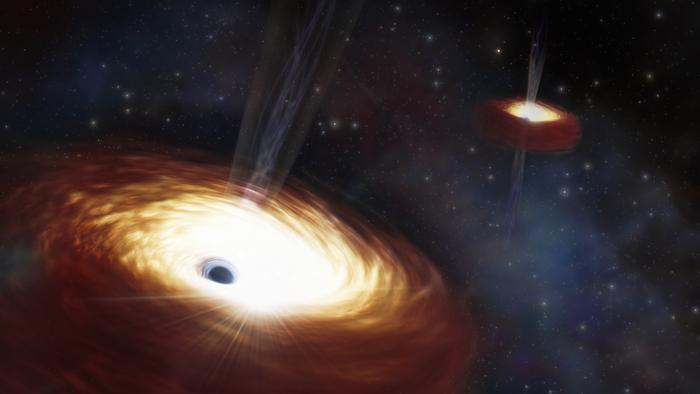
Nearly every massive galaxy hosts a supermassive black hole at its center. When two galaxies merge, their black holes can form a binary pair, meaning they are in a bound orbit with one another. It’s hypothesized that these binaries are fated to eventually merge, but this has never been observed. The question of whether such an event is possible has been a topic of discussion amongst astronomers for decades. In a recently published paper in The Astrophysical Journal, a team of astronomers have presented new insight into this question.
The team used data from the Gemini North telescope in Hawai‘i, one half of the International Gemini Observatory operated by NSF’s NOIRLab, which is funded by the U.S. National Science Foundation, to analyze a supermassive black hole binary located within the elliptical galaxy B2 0402+379. This is the only supermassive black hole binary ever resolved in enough detail to see both objects separately, and it holds the record for having the smallest separation ever directly measured — a mere 24 light-years. While this close separation foretells a powerful merger, further study revealed that the pair has been stalled at this distance for over three billion years, begging the question; what’s the hold-up?

To better understand the dynamics of this system and its halted merger the team looked to archival data from Gemini North’s Gemini Multi-Object Spectrograph (GMOS), which allowed them to determine the speed of the stars within the vicinity of the black holes. “The excellent sensitivity of GMOS allowed us to map the stars’ increasing velocities as one looks closer to the galaxy’s center,” said Roger Romani, Stanford University physics professor and co-author of the paper. “With that, we were able to infer the total mass of the black holes residing there.”
The team estimates the binary’s mass to be a whopping 28 billion times that of the Sun, qualifying the pair as the heaviest binary black hole ever measured. Not only does this measurement give valuable context to the formation of the binary system and the history of its host galaxy, but it supports the long-standing theory that the mass of a supermassive binary black hole plays a key role in stalling a potential merger.
Sign up for the Daily Dose Newsletter and get every morning’s best science news from around the web delivered straight to your inbox? It’s easy like Sunday morning.
“The data archive serving the International Gemini Observatory holds a gold mine of untapped scientific discovery,” says Martin Still, NSF program director for the International Gemini Observatory. “Mass measurements for this extreme supermassive binary black hole are an awe-inspiring example of the potential impact from new research that explores that rich archive.”
Understanding how this binary formed can help predict if and when it will merge — and a handful of clues point to the pair forming via multiple galaxy mergers. The first is that B2 0402+379 is a ‘fossil cluster,’ meaning it is the result of an entire galaxy cluster’s worth of stars and gas merging into one single massive galaxy. Additionally, the presence of two supermassive black holes, coupled with their large combined mass, suggests they resulted from the amalgamation of multiple smaller black holes from multiple galaxies.
Following a galactic merger, supermassive black holes don’t collide head-on. Instead they begin slingshotting past each other as they settle into a bound orbit. With each pass they make, energy is transferred from the black holes to the surrounding stars. As they lose energy, the pair is dragged down closer and closer until they are just light-years apart, where gravitational radiation takes over and they merge. This process has been directly observed in pairs of stellar-mass black holes — the first ever recorded instance being in 2015 via the detection of gravitational waves — but never in a binary of the supermassive variety.
With new knowledge of the system’s extremely large mass, the team concluded that an exceptionally large number of stars would have been needed to slow the binary’s orbit enough to bring them this close. In the process, the black holes seem to have flung out nearly all the matter in their vicinity, leaving the core of the galaxy starved of stars and gas. With no more material available to further slow the pair’s orbit, their merger has stalled in its final stages.
“Normally it seems that galaxies with lighter black hole pairs have enough stars and mass to drive the two together quickly,” said Romani. “Since this pair is so heavy it required lots of stars and gas to get the job done. But the binary has scoured the central galaxy of such matter, leaving it stalled and accessible for our study.”
Whether the pair will overcome their stagnation and eventually merge on timescales of millions of years, or continue in orbital limbo forever, is yet to be determined. If they do merge, the resulting gravitational waves would be a hundred million times more powerful than those produced by stellar-mass black hole mergers. It’s possible the pair could conquer that final distance via another galaxy merger, which would inject the system with additional material, or potentially a third black hole, to slow the pair’s orbit enough to merge. However, given B2 0402+379’s status as a fossil cluster, another galactic merger is unlikely.
“We’re looking forward to follow-up investigations of B2 0402+379’s core where we’ll look at how much gas is present,” says Tirth Surti, Stanford undergraduate and the lead author on the paper. “This should give us more insight into whether the supermassive black holes can eventually merge or if they will stay stranded as a binary.”
IMAGE CREDIT: NOIRLab/NSF/AURA/J. daSilva/M. Zamani
If you enjoy the content we create and would like to support us, please consider becoming a patron on Patreon! By joining our community, you’ll gain access to exclusive perks such as early access to our latest content, behind-the-scenes updates, and the ability to submit questions and suggest topics for us to cover. Your support will enable us to continue creating high-quality content and reach a wider audience.
Join us on Patreon today and let’s work together to create more amazing content! https://www.patreon.com/ScientificInquirer


Leave a Reply