It’s time to recognize the power of healthy forests in managing global growing flood risk, and to shift towards more sustainable forestry practices and policy.
This call is emphasized by UBC researchers in a peer-reviewed article published recently in the journal Science of the Total Environment.

Dr. Younes Alila, a hydrologist and professor in the faculty of forestry, and his graduate student Henry Pham synthesized decades of hydrology studies and found that many “severely and consistently underestimated” the impact of forest cover on flood risk.
As a consequence, it led to forest management policies and practices that were either unsound or poorly informed.
Sign up for the Daily Dose Newsletter and get every morning’s best science news from around the web delivered straight to your inbox? It’s easy like Sunday morning.
Cause and effect
For more than a century, Dr. Alila explained, scientists have clung to a “deterministic” analysis. To use a strategic board game analogy, this is like looking at each move in isolation and thinking, “If I move here, then I should win.” It fails to account for the roll of the dice, the cards you draw, and what your opponents might do—all of which can change the game.
When it comes to understanding how logging might increase flood risk, a deterministic approach would look at the logging alone and try to figure out its direct effect. But the risk of flooding is influenced by many things, such as how much snow is on the ground, whether it’s melting or not, how much rain is falling, and the characteristics of the landscape itself. These factors interact over time in complex ways.
Taking them all into account is called a “probabilistic” approach and provides a better overall picture of flood risk. It’s like a savvy board game player considering all the game’s variables instead of just one.
“The probabilistic approach is already well established in other disciplines such as climate change science. It is the most accurate method for evaluating the effects of deforestation on floods,” said Henry Pham, a student in UBC’s master of science in forestry program.
Forests can lower flood risk
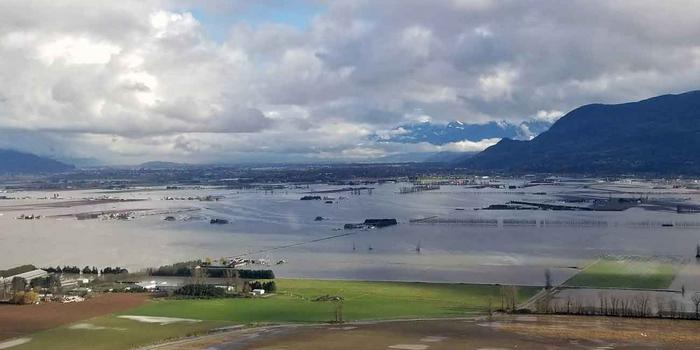
Dr. Alila says the probabilistic framework is designed to understand and predict, for instance, how much of the 2021 Fraser Valley floods could be attributed to climate change, land use change or logging. The approach also can be extended to investigate the causes of flood risk in other cities and regions.
He added: “In B.C. alone, the flood risk is escalating as we continue to lose forest cover due to ongoing large-scale logging and wildfires. If we want to mitigate the costs of disasters like the 2021 flooding in the Fraser Valley or the 2018 flooding in Grand Forks, we need to change the way we manage our forest cover. Regenerative practices such as selective logging, small patch cutting, and other alternatives to clear-cutting are an important way forward.”
Pham noted that clear-cut logging causes more severe and much more frequent floods, and such floods can have harsh consequences. “They can negatively impact river ecosystems, degrade water quality in community watersheds, and cause sedimentation issues downstream. Thousands of lives and many ecosystems further downstream of clear-cut logging stand to be affected.”
Dr. Alila concludes, “Forests serve as the most effective natural defense against a global escalating flood risk attributed to factors such as climate change. Now is the time for water and forest management policies to start being guided by the most up-to-date and defensible science.”
IMAGE CREDIT: UBC Applied Science
If you enjoy the content we create and would like to support us, please consider becoming a patron on Patreon! By joining our community, you’ll gain access to exclusive perks such as early access to our latest content, behind-the-scenes updates, and the ability to submit questions and suggest topics for us to cover. Your support will enable us to continue creating high-quality content and reach a wider audience.
Join us on Patreon today and let’s work together to create more amazing content! https://www.patreon.com/ScientificInquirer




Leave a Reply