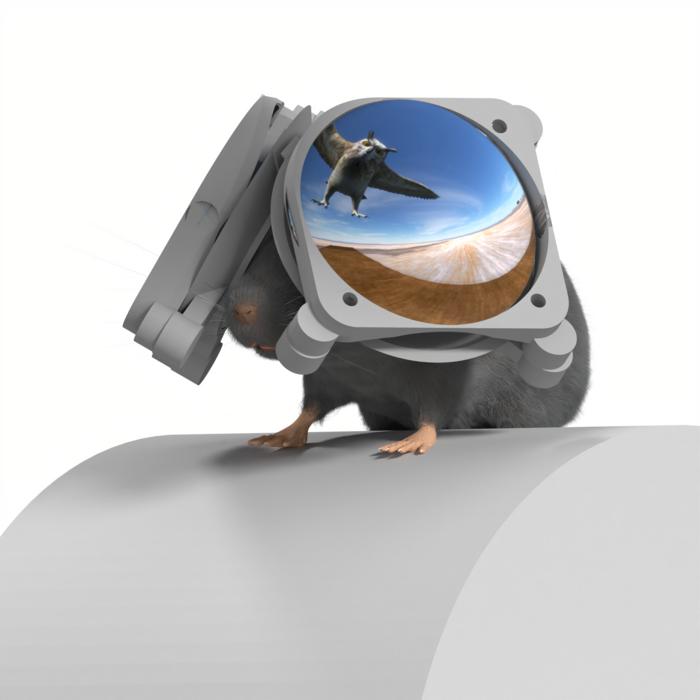
Northwestern University researchers have developed new virtual reality (VR) goggles for mice.
Besides just being cute, these miniature goggles provide more immersive experiences for mice living in laboratory settings. By more faithfully simulating natural environments, the researchers can more accurately and precisely study the neural circuitry that underlies behavior.
Compared to current state-of-the-art systems, which simply surround mice with computer or projection screens, the new goggles provide a leap in advancement. In current systems, mice can still see the lab environment peeking out from behind the screens, and the screens’ flat nature cannot convey three-dimensional (3D) depth. In another disadvantage, researchers have been unable to easily mount screens above mice’s heads to simulate overhead threats, such as looming birds of prey.
The new VR goggles bypass all those issues. And, as VR grows in popularity, the goggles also could help researchers glean new insights into how the human brain adapts and reacts to repeated VR exposure — an area that is currently little understood.

The research will be published on Friday (Dec. 8) in the journal Neuron. It marks the first time researchers have used a VR system to simulate an overhead threat.
“For the past 15 years, we have been using VR systems for mice,” said Northwestern’s Daniel Dombeck, the study’s senior author. “So far, labs have been using big computer or projection screens to surround an animal. For humans, this is like watching a TV in your living room. You still see your couch and your walls. There are cues around you, telling you that you aren’t inside the scene. Now think about putting on VR goggles, like Oculus Rift, that take up your full vision. You don’t see anything but the projected scene, and a different scene is projected into each eye to create depth information. That’s been missing for mice.”
Dombeck is a professor of neurobiology at Northwestern’s Weinberg College of Arts and Sciences. His laboratory is a leader in developing VR-based systems and high-resolution, laser-based imaging systems for animal research.
The value of VR
Although researchers can observe animals in nature, it is incredibly difficult to image patterns of real-time brain activity while animals engage with the real world. To overcome this challenge, researchers have integrated VR into laboratory settings. In these experimental setups, an animal uses a treadmill to navigate scenes, such as a virtual maze, projected onto surrounding screens.
By keeping the mouse in place on the treadmill — rather than allowing it to run through a natural environment or physical maze — neurobiologists can use tools to view and map the brain as the mouse traverses a virtual space. Ultimately, this helps researchers grasp general principles of how activated neural circuits encode information during various behaviors.
“VR basically reproduces real environments,” Dombeck said. “We’ve had a lot of success with this VR system, but it’s possible the animals aren’t as immersed as they would be in a real environment. It takes a lot of training just to get the mice to pay attention to the screens and ignore the lab around them.”
Introducing iMRSIV
With recent advances in hardware miniaturization, Dombeck and his team wondered if they could develop VR goggles to more faithfully replicate a real environment. Using custom-designed lenses and miniature organic light-emitting diode (OLED) displays, they created compact goggles.
Called Miniature Rodent Stereo Illumination VR (iMRSIV), the system comprises two lenses and two screens — one for each side of the head to separately illuminate each eye for 3D vision. This provides each eye with a 180-degree field-of-view that fully immerses the mouse and excludes the surrounding environment.
Unlike VR goggles for a human, the iMRSIV (pronounced “immersive”) system does not wrap around the mouse’s head. Instead, the goggles are attached to the experimental setup and closely perch directly in front of the mouse’s face. Because the mouse runs in place on a treadmill, the goggles still cover the mouse’s field of view.
“We designed and built a custom holder for the goggles,” said John Issa, a postdoctoral fellow in Dombeck’s laboratory and study co-first author. “The whole optical display — the screens and the lenses — go all the way around the mouse.”
Reduced training times
By mapping the mice’s brains, Dombeck and his team found that the brains of goggle-wearing mice were activated in very similar ways as in freely moving animals. And, in side-by-side comparisons, the researchers noticed that goggle-wearing mice engaged with the scene much more quickly than mice with traditional VR systems.
“We went through the same kind of training paradigms that we have done in the past, but mice with the goggles learned more quickly,” Dombeck said. “After the first session, they could already complete the task. They knew where to run and looked to the right places for rewards. We think they actually might not need as much training because they can engage with the environment in a more natural way.”
Simulating overhead threats for the first time
Next, the researchers used the goggles to simulate an overhead threat — something that had been previously impossible with current systems. Because hardware for imaging technology already sits above the mouse, there is nowhere to mount a computer screen. The sky above a mouse, however, is an area where animals often look for vital — sometimes life-or-death — information.
“The top of a mouse’s field of view is very sensitive to detect predators from above, like a bird,” said co-first author Dom Pinke, a research specialist in Dombeck’s lab. “It’s not a learned behavior; it’s an imprinted behavior. It’s wired inside the mouse’s brain.”
To create a looming threat, the researchers projected a dark, expanding disk into the top of the goggles — and the top of the mice’s fields of view. In experiments, mice — upon noticing the disk — either ran faster or froze. Both behaviors are common responses to overhead threats. Researchers were able to record neural activity to study these reactions in detail.
“In the future, we’d like to look at situations where the mouse isn’t prey but is the predator,” Issa said. “We could watch brain activity while it chases a fly, for example. That activity involves a lot of depth perception and estimating distances. Those are things that we can start to capture.”
Making neurobiology accessible
In addition to opening the door for more research, Dombeck hopes the goggles open the door to new researchers. Because the goggles are relatively inexpensive and require less intensive laboratory setups, he thinks they could make neurobiology research more accessible.
“Traditional VR systems are pretty complicated,” Dombeck said. “They’re expensive, and they’re big. They require a big lab with a lot of space. And, on top of that, if it takes a long time to train a mouse to do a task, that limits how many experiments you can do. We’re still working on improvements, but our goggles are small, relatively cheap and pretty user friendly as well. This could make VR technology more available to other labs.”
IMAGE CREDIT: Dom Pinke/Northwestern University.
Sign up for the Daily Dose Newsletter and get the morning’s best science news from around the web delivered straight to your inbox? It’s easy like Sunday morning.


Leave a Reply