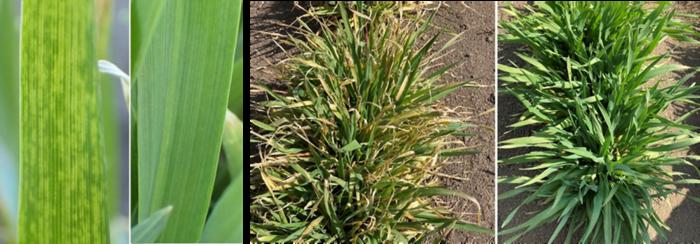
Barley is a staple crop with several applications, acting as a source of food, livestock feed, and an ingredient for malt brewing. Originally disseminated from China and the Korean Peninsula about 2,000 years ago, all Japanese barley cultivars were six-row for human food until the 1880s.
After the cultural enlightenment of the Meiji period, Japan needed to initiate its own domestic brewery. To supply raw materials for emerging beer industries, two-row beer barley cultivars were introduced from the West as genetic resources. Breeding of new beer barley cultivars was initiated to adapt to harsh climate and endemic diseases in Japan.
Lately, barley yellow mosaic virus (BaYMV) has devastated barley crops in Japan.

Most Japanese six-row barley cultivars are either resistant or moderately resistant to BaYMV. Unfortunately, the newly introduced Western two-row cultivars are highly susceptible to this disease.
Genes that confer resistance to BaYMV, such as resistance to yellow mosaic 5 (rym5) and rym3, have been routinely used to breed BaYMV-resistant barley cultivars. Such cultivars are also economically suitable for farming and have acceptable malting qualities. However, concerns arose that intensive breeding of BaYMV-resistant two-row malting barley cultivars may have reduced their genetic diversity.
To assess the diversity of two closely related modern Japanese malting barley cultivars, ‘Sukai Golden’ and ‘Sachiho Golden,’ Professor Shin Taketa from the Institute of Plant Science and Resources, Okayama University, and Dr. Keiichi Mochida from RIKEN Center for Sustainable Resource Science, along with Professor Shunsuke Yajima from the NODAI Genome Research Center, Tokyo University of Agriculture, Dr. Hidekazu Takahashi from the Food and Agricultural Sciences, Fukushima University, and Dr. Toshinori Sotome from the Tochigi Prefectural Agricultural Experiment Station, analyzed gene expression and single-nucleotide polymorphisms (SNPs) by sequencing RNAs from 20-day-old immature seeds. The results of their study were published online in Breeding Science on October 28, 2023.
RNA sequencing is an effective method to quickly obtain complete gene expression profiles and genome-wide data on SNPs, which are single-base variants in DNA that can sometimes be the reason for differences in disease susceptibility between populations.
Their analyses showed that these two Japanese cultivars possessed unique and contrasting features related to malting quality and BaYMV resistance gene(s). Notably, the researchers detected 2,419 Sukai Golden-specific and 3,058 Sachiho Golden-specific SNPs—a high SNP number compared to the genome sequences of two reference cultivars.
Discussing their findings, Prof. Taketa adds, “This study detected key traces of Japanese barley improvement inscribed in the genomes of two high-quality modern cultivars. Japanese beer barley breeding began around 150 years ago by introducing Western high-quality beer barley. The hot and humid Japanese climate and soil-transmitting virus diseases hampered the development of beer barley suited for Japan. Western beer barley cultivars inevitably required crossed with virus-disease-resistant East Asian barley, despite the latter having undesirable brewing quality characteristics. Balancing virus disease resistance and malting quality was extremely difficult. ”
Two SNP clusters were detected in ‘Sukai Golden’ showing the incorporation of the BaYMV resistance gene rym5 on the long arm of 3H and the anthocyanin-less ant2 gene on the long arm of 2H, respectively.
Similarly, the resistance gene rym3 from ‘Haganemugi’ was mapped to the proximal region of 5H. Haplotype analysis of progenitors of the two modern malting cultivars revealed that this particular rym3 gene received independent introduction into ‘Sukai Golden’ and ‘Sachiho Golden.’
This study of the immature seed transcriptomes of two elite Japanese malting barley cultivars could provide important insights into improving seed quality and resistance to BaYMV. Accordingly, Prof. Taketa concludes,
“We know that repeated crossing and rigorous selection of the barley cultivars allowed for adaptation to the harsh Japanese agricultural environment. In this way, high-quality modern Japanese beer barley cultivars were developed over the past 150 years and are still evolving for the future, thanks to the strenuous efforts of both public and private breeders.”
In summary, this study emphasizes the pivotal role of barley research in proposing long-term effective measures for preventing the barley resistance genes from becoming ineffective against variant virus strains. Plant geneticists should devise effective strategies for the durable use of limited virus resistance gene sources.
IMAGE CREDIT: Professor Shin Taketa from Okayama University
Sign up for the Daily Dose Newsletter and get the morning’s best science news from around the web delivered straight to your inbox? It’s easy like Sunday morning.


Leave a Reply