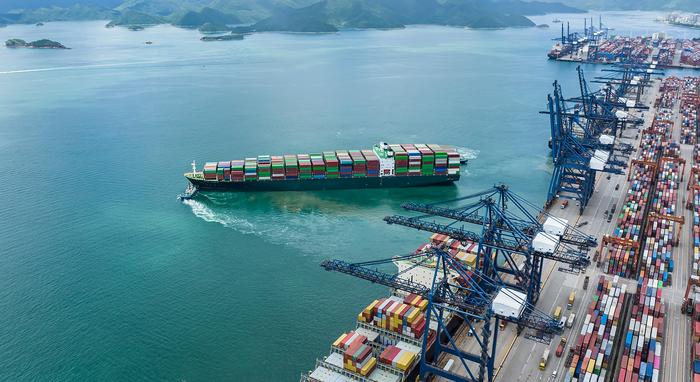
A study published today in IOP Publishing’s journal Environmental Research: Infrastructure and Sustainability has found that green ammonia could be used to fulfil the fuel demands of over 60% of global shipping by targeting just the top 10 regional fuel ports. Researchers at the University of Oxford looked at the production costs of ammonia which are similar to very low sulphur fuels, and concluded that the fuel could be a viable option to help decarbonise international shipping by 2050.
Around USD 2 trillion will be needed to transition to a green ammonia fuel supply chain by 2050, primarily to finance supply infrastructure. The study shows that the greatest investment need is in Australia, to supply the Asian markets, with large production clusters also predicted in Chile (to supply South America), California (to supply Western U.S.A.), North-West Africa (to meet European demand), and the southern Arabian Peninsula (to meet local demand and parts of south Asia).
90% of world’s physical goods trade is transported by ships which burn heavy fuel oil and emit toxic pollutants. This accounts for nearly 3% of the global greenhouse gas (GHG) emissions. As a result of this, the International Maritime Organization (IMO) committed to decarbonising international shipping in 2018, aiming to halve GHG emissions by 2050. These targets have been recently revised to net zero emissions by 2050.

After investigating the viability of diesel vessel exhaust scrubbers, green ammonia, made by electrolysing water with renewable electricity, was proposed as an alternative fuel source to quickly decarbonise the shipping industry. However, historically there has been great uncertainty as to how and where to invest to create the necessary infrastructure to deliver an efficient, viable fuel supply chain.
René Bañares-Alcántara, Professor of Chemical Engineering in the Department of Engineering Science at the University of Oxford, says: “Shipping is one of the most challenging sectors to decarbonize because of the need for fuel with high energy density and the difficulty of coordinating different groups to produce, utilize and finance alternative (green) fuel supplies.”
To guide investors, the team at the University of Oxford developed a modelling framework to create viable scenarios for how to establish a global green ammonia fuel supply chain. The framework combines a fuel demand model, future trade scenarios and a spatial optimisation model for green ammonia production, storage, and transport, to find the best locations to meet future demand for shipping fuel.
Professor Bañares-Alcántara continues: “The implications of this work are striking. Under the proposed model, current dependence upon oil-producing nations would be replaced by a more regionalised industry; green ammonia will be produced near the equator in countries with abundant land and high solar potential then transported to regional centres of shipping fuel demand.”
IMAGE CREDIT: IOP Publishing
Sign up for the Daily Dose Newsletter and get the morning’s best science news from around the web delivered straight to your inbox? It’s easy like Sunday morning.




Leave a Reply