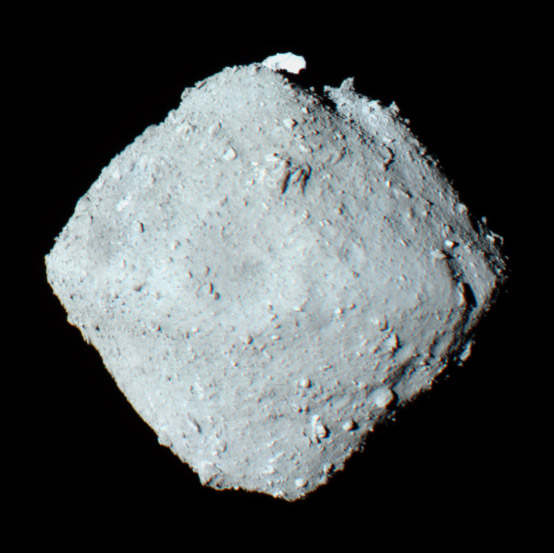
Analysis of organic compounds – called polycyclic aromatic hydrocarbons (PAHs) – extracted from the Ryugu asteroid and Murchison meteorite has found that certain PAHs likely formed in the cold areas of space between stars rather than in hot regions near stars as was previously thought. The findings open new possibilities for studying life beyond Earth and the chemistry of objects in space.
The only Australian members of an international research team, scientists from Curtin’s WA-Organic and Isotope Geochemistry Centre (WA-OIGC) carried out controlled burnings of plants to produce PAHs.
ARC Laureate Fellow John Curtin Distinguished Professor Kliti Grice, director of WA-OIGC, said PAHs are organic compounds made up of carbon and hydrogen that are common on Earth but are also found in celestial bodies like asteroids and meteorites.

“We performed controlled burn experiments on Australian plants, which were isotopically compared to PAHs from fragments of the Ryugu asteroid that were returned to Earth by a Japanese spacecraft in 2020, and the Murchison meteorite that landed in Australia in 1969. The bonds between light and heavy carbon isotopes in the PAHs were analysed to reveal the temperature at which they were formed,” Professor Grice said.
“Select PAHs from Ryugu and Murchison were found to have different characteristics: the smaller ones likely in cold outer space, while bigger ones probably formed in warmer environments, like near a star or inside a celestial body.”
Study co-author Dr Alex Holman, also from WA-OIGC, said understanding the isotopic composition of PAHs helps unravel the conditions and environments in which these molecules were created, offering insights into the history and chemistry of celestial bodies like asteroids and meteorites.
“This research gives us valuable insights into how organic compounds form beyond Earth and where they come from in space,” Dr Holman said.
“The use of high-tech methods and creative experiments has shown that select PAHs on asteroids can be formed in cold space.”
The full research paper, ‘Polycyclic aromatic hydrocarbons in samples of Ryugu formed in the interstellar medium’ will be published in the journal Science.
IMAGE CREDIT: Darts Archive
Sign up for the Daily Dose Newsletter and get the morning’s best science news from around the web delivered straight to your inbox? It’s easy like Sunday morning.



Leave a Reply