An international team of scientists has found early human migrants left Africa for Eurasia, across the Sinai peninsula and on through Jordan, over 80-thousand years ago.
Researchers from the University of Southampton (UK) and Shantou University (China), together with colleagues in Jordan, Australia and the Czech Republic(1), have proved there was a “well-watered corridor” which funnelled hunter-gatherers through The Levant towards western Asia and northern Arabia via Jordan.
Their findings, published in the journal Science Advances, support previous research conducted in Arabia suggesting this green, overland route, which is now desert, was favoured by travelling Homo sapiens heading north.

‘Modern’ humans evolved in Africa between 300 and 200 thousand years ago and dispersed out of the continent in several stages. It’s thought that over tens of thousands of years they went on to populate Asia and then Europe.
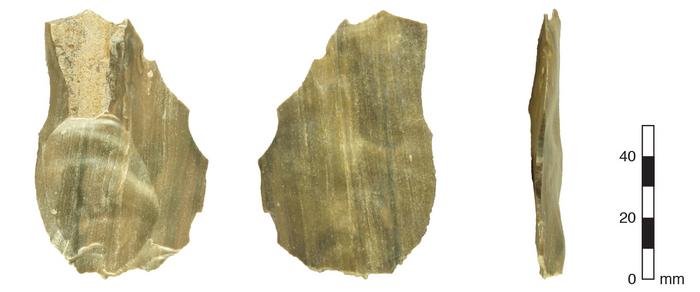
For this latest research, the team conducted fieldwork in the Jordan Rift Valley where they uncovered hand tools, known as ‘flakes’, on the edge of wadis – now dry river channels which, tens of thousands of years ago, were full of water. The scientists used luminescence dating techniques to help establish the age of the sediment the tools were buried in. This method estimates how long it has been since sediment was last exposed to light.
The results showed the tools were likely to have been used approximately 84 thousand years ago and then abandoned on the banks of the wadis and subsequently buried over time.
Paul Carling, Professor of Geomorphology at the University of Southampton, comments: “It’s long been thought that when the sea level was low, humans used a southern crossing, via the Red Sea from the horn of Africa, to get to southwestern Arabia. However, our study confirms there was a well-trodden passage to the north, across the only land-route from Africa to Eurasia.
“Our newly published evidence is a key piece of the puzzle that shows humans migrated using a northern route – using small wetland areas as bases whilst hunting abundant wildlife in the drier grasslands. Although previous studies have looked for large lakes as potential watering holes, in fact small wetlands were very important as staging posts during the migration.”
Dr Mahmoud Abbas, the study’s lead author from Shantou University, China, said: “The Levant acted as a well-watered corridor for modern humans to disperse out of Africa during the last interglacial, and we have now demonstrated this is the case in the Jordan Rift Valley zone.
“The paleohydrological evidence from the Jordan desert enhances our understanding of the environmental setting at that time. Rather than dry desert, savannah grasslands would have provided the much-needed resources for humans to survive during their journey out of Africa and into southwest Asia and beyond.”
The researchers say their study demonstrates the intimate relationship between climate change, human survival and migrations.
IMAGE CREDIT: University of Southampton.
Sign up for the Daily Dose Newsletter and get the morning’s best science news from around the web delivered straight to your inbox? It’s easy like Sunday morning.



Leave a Reply