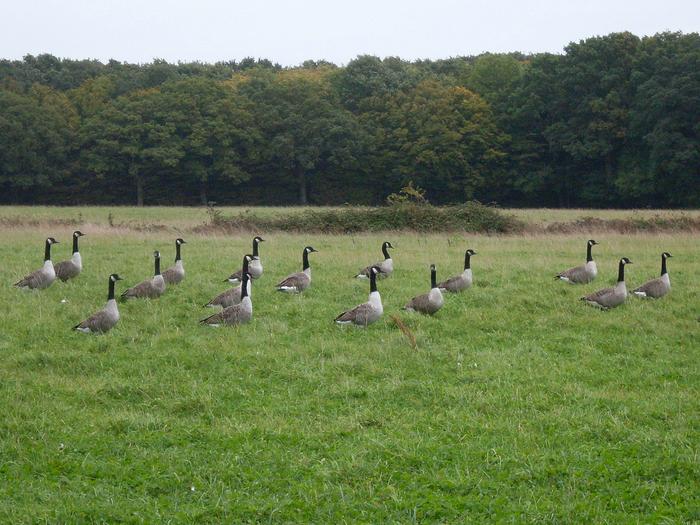
Canada geese strengthen existing friendships and forge a few new connections after losing close associates from their flock, new research shows.
University of Exeter scientists observed flocks of Canada geese before and after a population-management cull in which about 20% of the birds were killed.
In such a situation, some animals species increase “social connectivity” – mixing with many new individuals – which can increase the transmission of infectious diseases.

But the geese in the study responded by strengthening existing relationships, only adding enough new associations to replace those they had lost.
“Our findings shows that Canada geese are very robust to this level of social change,” said Dr Nick Royle, from the Centre for Ecology and Conservation on Exeter’s Penryn Campus in Cornwall.
“They are socially conservative – they keep calm and carry on, responding to losses in the flock by strengthen existing ties rather than greatly expanding their social network.
“This ability to deal with social disruption – this resilience – might contribute towards their success as an invasive species.”
As well as competing with native species, Canada geese can spread diseases including avian flu that could affect human and animal health.
They are culled in various parts of the UK, including at the Cotswold Water Park where this study took place.
Reducing the size of the population is a common method to reduce disease transmission. In some species this can backfire because individuals respond by forming multiple new social connections – which can increase the spread of disease.
In contrast, after short-term adjustments to restore their social network this population of Canada geese were robust to the effects of culling; predominantly strengthening existing ‘friendships’ rather than forming lots of new associations, reducing the potential for an increased risk of disease transmission.
The researchers say their findings highlight the importance of understanding the social behaviour of different species when planning management interventions such as culling.
The research was funded by the University of Exeter and the Animal and Plant Health Agency.
The paper, published in the Journal of Applied Ecology, is entitled: “Culling-induced perturbation of social networks of wild geese reinforces rather than disrupts associations among survivors.”
IMAGE CREDIT: Matthew Silk
Sign up for the Daily Dose Newsletter and get the morning’s best science news from around the web delivered straight to your inbox? It’s easy like Sunday morning.




Leave a Reply