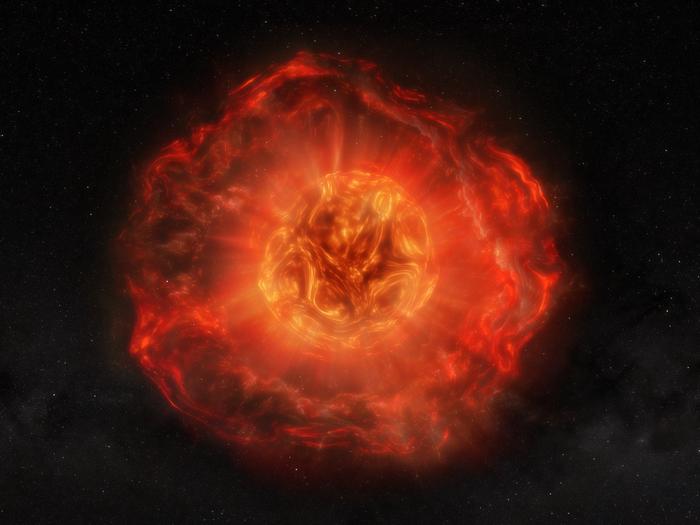
A newly discovered nearby supernova whose star ejected up to a full solar mass of material in the year prior to its explosion is challenging the standard theory of stellar evolution. The new observations are giving astronomers insight into what happens in the final year prior to a star’s death and explosion.
SN 2023ixf is a new Type II supernova discovered in May 2023 by amateur astronomer Kōichi Itagaki of Yamagata, Japan shortly after its progenitor, or origin star, exploded. Located about 20 million light-years away in the Pinwheel Galaxy, SN 2023ixf’s proximity to Earth, the supernova’s extreme brightness, and its young age make it a treasure trove of observable data for scientists studying the death of massive stars in supernova explosions.

Type II or core-collapse supernovae occur when red supergiant stars at least eight times, and up to about 25 times the mass of the Sun, collapse under their own weight and explode. While SN 2023ixf fit the Type II description, followup multi-wavelength observations led by astronomers at the Center for Astrophysics | Harvard & Smithsonian (CfA), and using a wide range of CfA’s telescopes, have revealed new and unexpected behavior.
Within hours of going supernova, core-collapse supernovae produce a flash of light that occurs when the shock wave from the explosion reaches the outer edge of the star. SN 2023ixf, however, produced a light curve that didn’t seem to fit this expected behavior. To better understand SN 2023ixf’s shock breakout, a team of scientists led by CfA postdoctoral fellow Daichi Hiramatsu analyzed data from the 1.5m Tillinghast Telescope, 1.2m telescope, and MMT at the Fred Lawrence Whipple Observatory, a CfA facility located in Arizona, as well as data from the Global Supernova Project— a key project of the Las Cumbres Observatory, NASA’s Neil Gehrels Swift Observatory, and many others. This multi-wavelength study, which was published this week in The Astrophysical Journal Letters, revealed that, in sharp contradiction to expectations and stellar evolution theory, SN 2023ixf’s shock breakout was delayed by several days.
Sign up for the Daily Dose Newsletter and get every morning’s best science news from around the web delivered straight to your inbox? It’s easy like Sunday morning.
“The delayed shock breakout is direct evidence for the presence of dense material from recent mass loss,” said Hiramatsu, adding that such extreme mass loss is atypical of Type II supernovae. “Our new observations revealed a significant and unexpected amount of mass loss— close to the mass of the Sun— in the final year prior to explosion.”
SN 2023ixf challenges astronomers’ understanding of the evolution of massive stars and the supernovae they become. Although scientists know that core-collapse supernovae are primary origin points for the cosmic formation and evolution of atoms, neutron stars, and black holes, very little is known about the years leading up to stellar explosions. The new observations point to potential instability in the final years of a star’s life, resulting in extreme mass loss. This could be related to the final stages of nuclear burn-off of high-mass elements, like silicon, in the star’s core.
In conjunction with multi-wavelength observations led by Hiramatsu, Edo Berger, professor of astronomy at Harvard and CfA, and Hiramatsu’s advisor, conducted millimeter-wave observations of the supernova using CfA’s Submillimeter Array (SMA) on the summit of Maunakea, Hawai’i. These data, which are published in The Astrophysical Journal Letters, directly tracked the collision between the supernova debris and the dense material lost before the explosion. “SN 2023ixf exploded exactly at the right time,” said Berger. “Only a few days earlier we commenced a new ambitious three-year program to study supernova explosions with the SMA, and this nearby exciting supernova was our first target.”
“The only way to understand how massive stars behave in the final years of their lives up to the point of explosion is to discover supernovae when they are very young, and preferably nearby, and then to study them across multiple wavelengths,” said Berger. ”Using both optical and millimeter telescopes we effectively turned SN 2023ixf into a time machine to reconstruct what its progenitor star was doing up to the moment of its death.”
The supernova discovery itself, and the immediate followup, have significant meaning to astronomers around the world, including those doing science in their own backyards. Itagaki discovered the supernova on May 19, 2023, from his private observatory in Okayama, Japan. Combined data from Itagaki and other amateur astronomers determined the time of the explosion to an accuracy of within two hours, giving professional astronomers at CfA and other observatories a head start in their investigations. CfA astronomers have continued to collaborate with Itagaki on on-going optical observations.
“The partnership between amateur and professional astronomers has a long-standing tradition of success in the supernova field,” said Hiramatsu. “In the case of SN 2023ixf, I received an urgent email from Kōichi Itagaki as soon as he discovered SN 2023ixf. Without this relationship, and Itagaki’s work and dedication, we would have missed the opportunity to gain critical understanding of the evolution of massive stars and their supernova explosions.”
IMAGE CREDIT: Melissa Weiss/CfA.
If you enjoy the content we create and would like to support us, please consider becoming a patron on Patreon! By joining our community, you’ll gain access to exclusive perks such as early access to our latest content, behind-the-scenes updates, and the ability to submit questions and suggest topics for us to cover. Your support will enable us to continue creating high-quality content and reach a wider audience.
Join us on Patreon today and let’s work together to create more amazing content! https://www.patreon.com/ScientificInquirer



Leave a Reply