HAVE YOUR SAY.
Join us in The Bullpen, where the members of the Scientific Inquirer community get to shape the site’s editorial decision making. We’ll be discussing people and companies to profile on the site. On Wednesday, April 26 at 5:30pm EST, join us on Discord and let’s build the best Scientific Inquirer possible.
The high seas have been colonized by a surprising number of coastal marine invertebrate species, which can now survive and reproduce in the open ocean, contributing strongly to the floating community composition. This finding was published today in Nature Ecology and Evolution by a team of researchers led by the Smithsonian Environmental Research Center (SERC) and the University of Hawai‘i (UH) at Mānoa.
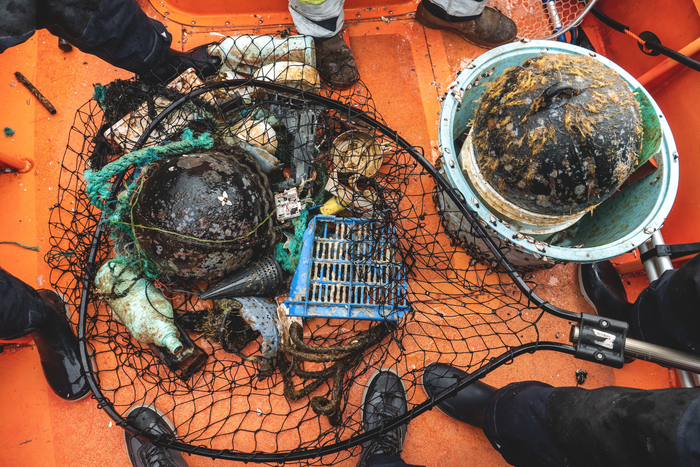
The researchers found coastal species, representing diverse taxonomic groups and life history traits, in the eastern North Pacific Subtropical Gyre on over 70 percent of the plastic debris they examined. Further, the debris carried more coastal species than open ocean species.
“This discovery suggests that past biogeographical boundaries among marine ecosystems — established for millions of years — are rapidly changing due to floating plastic pollution accumulating in the subtropical gyres,” said lead author Linsey Haram, research associate at SERC.

These researchers only recently discovered the existence of these “neopelagic communities,” or floating communities in deep ocean waters. To understand the ecological and physical processes that govern communities on floating marine debris, SERC and UH Mānoa formed a multi-disciplinary Floating Ocean Ecosystem (FloatEco) team. UH Mānoa led the assessment of physical oceanography and SERC evaluated biological and ecological dimensions of the study.
For this study, the FloatEco team analyzed 105 plastic samples collected by The Ocean Cleanup during their 2018 and 2019 expeditions in the North Pacific Subtropical Gyre, which occupies most of the northern Pacific Ocean. The field work relied on participation of both individual volunteers and non-governmental organizations.
“We were extremely surprised to find 37 different invertebrate species that normally live in coastal waters, over triple the number of species we found that live in open waters, not only surviving on the plastic but also reproducing,” said Haram. “We were also impressed by how easily coastal species colonized new floating items, including our own instruments — an observation we’re looking into further.”
“Our results suggest coastal organisms now are able to reproduce, grow, and persist in the open ocean — creating a novel community that did not previously exist, being sustained by the vast and expanding sea of plastic debris,” said co-author Gregory Ruiz, senior scientist at SERC. “This is a paradigm shift in what we consider to be barriers to the distribution and dispersal of coastal invertebrates.”
While scientists already knew organisms, including some coastal species, colonized marine plastic debris, scientists were unaware until now that established coastal communities could persist in the open ocean. These findings identify a new human-caused impact on the ocean, documenting the scale and potential consequences that were not previously understood.
“The Hawaiian Islands are neighbored in the northeast by the North Pacific garbage patch,” said Nikolai Maximenko, co-author and senior researcher at the UH Mānoa School of Ocean and Earth Science and Technology. “Debris that breaks off from this patch constitutes the majority of debris arriving on Hawaiian beaches and reefs. In the past, the fragile marine ecosystems of the islands were protected by the very long distances from coastal communities of Asia and North America. The presence of coastal species persisting in the North Pacific Subtropical Gyre near Hawai‘i is a game changer that indicates that the islands are at an increased risk of colonization by invasive species.”
“Our study underscores the large knowledge gap and still limited understanding of rapidly changing open ocean ecosystems,” said Ruiz. “This highlights the need for dramatic enhancement of the high-seas observing systems, including biological, physical and marine debris measurements.”
IMAGE CREDIT: The Ocean Cleanup
Leave a Reply