HAVE YOUR SAY.
Join us in The Bullpen, where the members of the Scientific Inquirer community get to shape the site’s editorial decision making. We’ll be discussing people and companies to profile on the site. On Wednesday, April 26 at 5:30pm EST, join us on Discord and let’s build the best Scientific Inquirer possible.
The field of plate tectonics is not that old, and scientists continue to learn the details of earthquake-producing geologic faults. The Cascadia Subduction Zone — the eerily quiet offshore fault that threatens to unleash a magnitude-9 earthquake in the Pacific Northwest — still holds many mysteries.
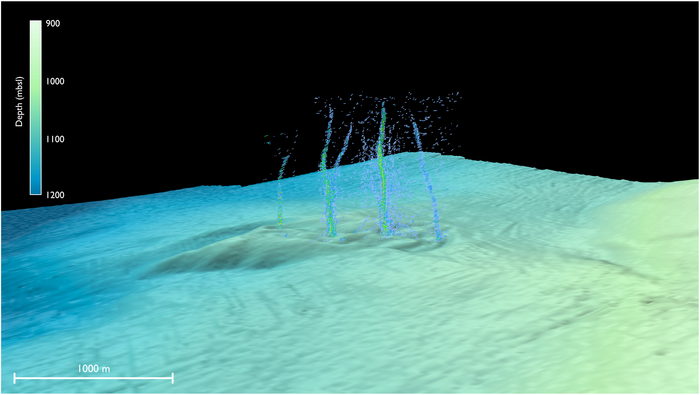
A study led by the University of Washington discovered seeps of warm, chemically distinct liquid shooting up from the seafloor about 50 miles off Newport, Oregon. The paper, published Jan. 25 in Science Advances, describes the unique underwater spring the researchers named Pythia’s Oasis. Observations suggest the spring is sourced from water 2.5 miles beneath the seafloor at the plate boundary, regulating stress on the offshore fault.
The team made the discovery during a weather-related delay for a cruise aboard the RV Thomas G. Thompson. The ship’s sonar showed unexpected plumes of bubbles about three-quarters of a mile beneath the ocean’s surface. Further exploration using an underwater robot revealed the bubbles were just a minor component of warm, chemically distinct fluid gushing from the seafloor sediment.

“They explored in that direction and what they saw was not just methane bubbles, but water coming out of the seafloor like a firehose. That’s something that I’ve never seen, and to my knowledge has not been observed before,” said co-author Evan Solomon, a UW associate professor of oceanography who studies seafloor geology.
The feature was discovered by first author Brendan Philip, who did the work as a UW graduate student and now works as a White House policy advisor.
Observations from later cruises show the fluid leaving the seafloor is 9 degrees Celsius (16 degrees Fahrenheit) warmer than the surrounding seawater. Calculations suggest the fluid is coming straight from the Cascadia megathrust, where temperatures are an estimated 150 to 250 degrees Celsius (300 to 500 degrees Fahrenheit).
The new seeps aren’t related to geologic activity at the nearby seafloor observatory that the cruise was heading toward, Solomon said. Instead, they occur near vertical faults that crosshatch the massive Cascadia Subduction Zone. These strike-slip faults, where sections of ocean crust and sediment slide past each other, exist because the ocean plate hits the continental plate at an angle, placing stress on the overlying continental plate.
Loss of fluid from the offshore megathrust interface through these strike-slip faults is important because it lowers the fluid pressure between the sediment particles and hence increases the friction between the oceanic and continental plates.
“The megathrust fault zone is like an air hockey table,” Solomon said. “If the fluid pressure is high, it’s like the air is turned on, meaning there’s less friction and the two plates can slip. If the fluid pressure is lower, the two plates will lock – that’s when stress can build up.”
Fluid released from the fault zone is like leaking lubricant, Solomon said. That’s bad news for earthquake hazards: Less lubricant means stress can build to create a damaging quake.
This is the first known site of its kind, Solomon said. Similar fluid seep sites may exist nearby, he added, though they are hard to detect from the ocean’s surface. A significant fluid leak off central Oregon could explain why the northern portion of the Cascadia Subduction Zone, off the coast of Washington, is believed to be more strongly locked, or coupled, than the southern section off the coast of Oregon.
“Pythias Oasis provides a rare window into processes acting deep in the seafloor, and its chemistry suggests this fluid comes from near the plate boundary,” said co-author Deborah Kelley, a UW professor of oceanography. “This suggests that the nearby faults regulate fluid pressure and megathrust slip behavior along the central Cascadia Subduction Zone.”
Solomon just returned from an expedition to monitor sub-seafloor fluids off the northeast coast of New Zealand. The Hikurangi Subduction Zone is similar to the Cascadia Subduction Zone but generates more frequent, smaller earthquakes that make it easier to study. But it has a different sub-seafloor structure meaning it’s unlikely to have fluid seeps like those discovered in the new study, Solomon said.
IMAGE CREDIT: Philip et al./Science Advances



Leave a Reply