HAVE YOUR SAY.
Join us in The Bullpen, where the members of the Scientific Inquirer community get to shape the site’s editorial decision making. We’ll be discussing people and companies to profile on the site. On Wednesday, April 26 at 5:30pm EST, join us on Discord and let’s build the best Scientific Inquirer possible.
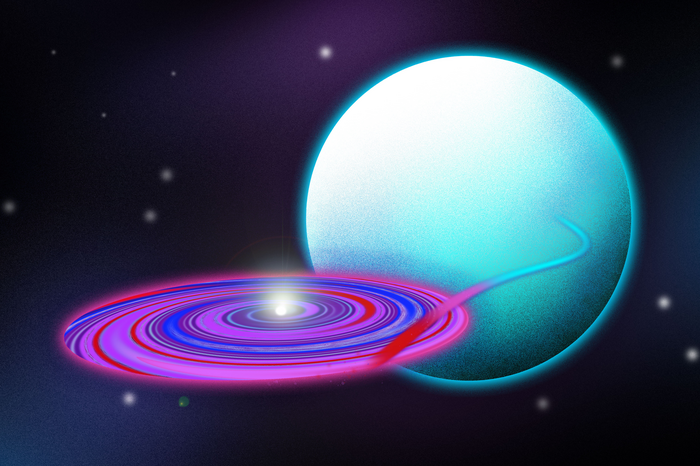
An accretion disk is a colossal whirlpool of gas and dust that gathers around a black hole or a neutron star like cotton candy as it pulls in material from a nearby star. As the disk spins, it whips up powerful winds that push and pull on the sprawling, rotating plasma. These massive outflows can affect the surroundings of black holes by heating and blowing away the gas and dust around them.
At immense scales, “disk winds” can offer clues to how supermassive black holes shape entire galaxies. Astronomers have observed signs of disk winds in many systems, including accreting black holes and neutron stars. But to date, they’ve only ever glimpsed a very narrow view of this phenomenon.
Now, MIT astronomers have observed a wider swath of winds, in Hercules X-1, a system in which a neutron star is drawing material away from a sun-like star. This neutron star’s accretion disk is unique in that it wobbles, or “precesses,” as it rotates. By taking advantage of this wobble, the astronomers have captured varying perspectives of the rotating disk and created a two-dimensional map of its winds, for the first time.

The new map reveals the wind’s vertical shape and structure, as well as its velocity — around hundreds of kilometers per second, or about a million miles per hour, which is on the milder end of what accretion disks can spin up.
If astronomers can spot more wobbling systems in the future, the team’s mapping technique could help determine how disk winds influence the formation and evolution of stellar systems, and even entire galaxies.
“In the future, we could map disk winds in a range of objects and determine how wind properties change, for instance, with the mass of a black hole, or with how much material it is accreting,” says Peter Kosec, a postdoc in MIT’s Kavli Institute for Astrophysics and Space Research. “That will help determine how black holes and neutron stars influence our universe.”
Kosec is the lead author of a study appearing in Nature Astronomy. His MIT co-authors include Erin Kara, Daniele Rogantini, and Claude Canizares, along with collaborators from multiple institutions, including the Institute of Astronomy in Cambridge, U.K.
Fixed sight
Disk winds have most often been observed in X-ray binaries — systems in which a black hole or a neutron star is pulling material from a less dense object and generating a white-hot disk of inspiraling matter, along with outflowing wind. Exactly how winds are launched from these systems is unclear. Some theories propose that magnetic fields could shred the disk and expel some of the material outward as wind. Others posit that the neutron star’s radiation could heat and evaporate the disk’s surface in white-hot gusts.
Clues to a wind’s origins may be deduced from its structure, but the shape and extent of disk winds has been difficult to resolve. Most binaries produce accretion disks that are relatively even in shape, like thin donuts of gas that spins in a single plane. Astronomers who study these disks from far-off satellites or telescopes can only observe the effects of disk winds within a fixed and narrow range, relative to their rotating disk. Any wind that astronomers manage to detect is therefore a small sliver of its larger structure.
“We can only probe the wind properties at a single point, and we’re completely blind to everything around that point,” Kosec notes.
In 2020, he and his colleagues realized that one binary system could offer a wider view of disk winds. Hercules X-1 has stood out from most known X-ray binaries for its warped accretion disk, which wobbles as it rotates around the system’s central neutron star.
“The disk is really wobbling over time every 35 days, and the winds are originating somewhere in the disk and crossing our line of sight at different heights above the disk with time,” Kosec explains. “That’s a very unique property of this system which allows us to better understand its vertical wind properties.”
A warped wobble
In the new study, the researchers observed Hercules X-1 using two X-ray telescopes — the European Space Agency’s XMM Newton and NASA’s Chandra Observatory.
“What we measure is an X-ray spectrum, which means the amount of X-ray photons that arrive at our detectors, versus their energy. We measure the absorption lines, or the lack of X-ray light at very specific energies,” Kosec says. “From the ratio of how strong the different lines are, we can determine the temperature, velocity, and the amount of plasma within the disk wind.”
With Hercules X-1’s warped disk, astronomers were able to see the line of the disk moving up and down as it wobbled and rotated, similar to the way a warped record appears to oscillate when seen from edge-on. The effect was such that the researchers could observe signs of disk winds at changing heights with respect to the disk, rather than at a single, fixed height above a uniformly rotating disk.
By measuring X-ray emissions and the absorption lines as the disk wobbled and rotated over time, the researchers could scan properties such as the temperature and density of winds at various heights with respect to its disk and construct a two-dimensional map of the wind’s vertical structure.
“What we see is that the wind rises from the disk, at an angle of about 12 degrees with respect to the disk as it expands in space,” Kosec says. “It’s also getting colder and more clumpy, and weaker at greater heights above the disk.”
The team plans to compare their observations with theoretical simulations of various wind-launching mechanisms, to see which could best explain the wind’s origins. Further out, they hope to discover more warped and wobbling systems, and map their disk wind structures. Then, scientists could have a broader view of disk winds, and how such outflows influence their surroundings — particularly at much larger scales.
“How do supermassive black holes affect the shape and structure of galaxies?” poses Erin Kara, the Class of 1958 Career Development Assistant Professor of Physics at MIT. “One of the leading hypotheses is that disk winds, launched from a black hole, can affect how galaxies look. Now we can get a more detailed picture of how these winds are launched, and what they look like.”
IMAGE CREDIT: Jose-Luis Olivares, MIT. Based on an image of Hercules X-1 by D. Klochkov, European Space Agency.




Leave a Reply