HAVE YOUR SAY.
Join us in The Bullpen, where the members of the Scientific Inquirer community get to shape the site’s editorial decision making. We’ll be discussing people and companies to profile on the site. On Wednesday, April 12 at 5:30pm EST, join us on Discord and let’s build the best Scientific Inquirer possible.
Ice sheets can retreat up to 600 metres a day during periods of climate warming, 20 times faster than the highest rate of retreat previously measured.
An international team of researchers, led by Dr Christine Batchelor of Newcastle University, UK, used high-resolution imagery of the seafloor to reveal just how quickly a former ice sheet that extended from Norway retreated at the end of the last Ice Age, about 20,000 years ago.
The team, which also included researchers from the universities of Cambridge and Loughborough in the UK and the Geological Survey of Norway, mapped more than 7,600 small-scale landforms called ‘corrugation ridges’ across the seafloor. The ridges are less than 2.5 m high and are spaced between about 25 and 300 metres apart.

These landforms are understood to have formed when the ice sheet’s retreating margin moved up and down with the tides, pushing seafloor sediments into a ridge every low tide. Given that two ridges would have been produced each day (under two tidal cycles per day), the researchers were able to calculate how quickly the ice sheet retreated.
Their results, reported in the journal Nature, show the former ice sheet underwent pulses of rapid retreat at a speed of 50 to 600 metres per day.
This is much faster than any ice sheet retreat rate that has been observed from satellites or inferred from similar landforms in Antarctica.
“Our research provides a warning from the past about the speeds that ice sheets are physically capable of retreating at,” said Dr Batchelor. “Our results show that pulses of rapid retreat can be far quicker than anything we’ve seen so far.”
Information about how ice sheets behaved during past periods of climate warming is important to inform computer simulations that predict future ice-sheet and sea-level change.
“This study shows the value of acquiring high-resolution imagery about the glaciated landscapes that are preserved on the seafloor,” said study co-author Dr. Dag Ottesen from the Geological Survey of Norway, who is involved in the MAREANO seafloor mapping programme that collected the data.
The new research suggests that periods of such rapid ice-sheet retreat may only last for short periods of time (days to months).
“This shows how rates of ice-sheet retreat averaged over several years or longer can conceal shorter episodes of more rapid retreat,” said study co-author Professor Julian Dowdeswell of the Scott Polar Research Institute, University of Cambridge. “It is important that computer simulations are able to reproduce this ‘pulsed’ ice-sheet behaviour.”
The seafloor landforms also shed light into the mechanism by which such rapid retreat can occur. Dr Batchelor and colleagues noted that the former ice sheet had retreated fastest across the flattest parts of its bed.
“An ice margin can unground from the seafloor and retreat near-instantly when it becomes buoyant”, explained co-author Dr Frazer Christie, also of the Scott Polar Research Institute. “This style of retreat only occurs across relatively flat beds, where less melting is required to thin the overlying ice to the point where it starts to float.”
The researchers conclude that pulses of similarly rapid retreat could soon be observed in parts of Antarctica. This includes at West Antarctica’s vast Thwaites Glacier, which is the subject of considerable international research due to its potential susceptibility to unstable retreat. The authors of this new study suggest that Thwaites Glacier could undergo a pulse of rapid retreat because it has recently retreated close to a flat area of its bed.
“Our findings suggest that present-day rates of melting are sufficient to cause short pulses of rapid retreat across flat-bedded areas of the Antarctic Ice Sheet, including at Thwaites”, said Dr. Batchelor. “Satellites may well detect this style of ice-sheet retreat in the near-future, especially if we continue our current trend of climate warming.”
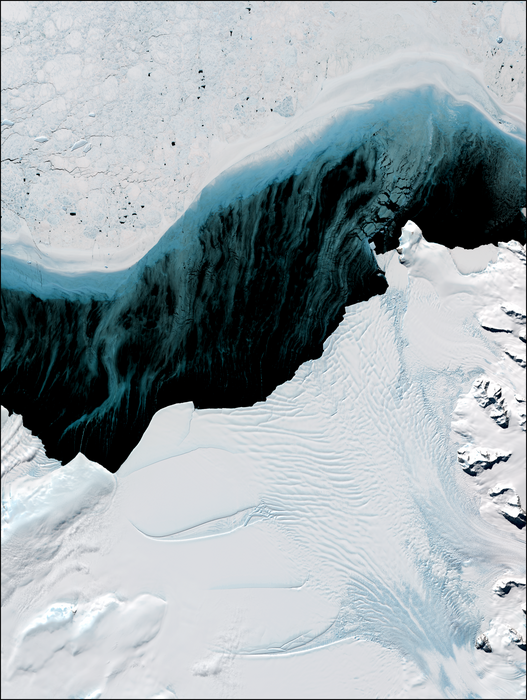
IMAGE CREDIT: NASA/USGS, processed by Dr. Frazer Christie, Scott Polar Research Institute, University of Cambridge




Leave a Reply