HAVE YOUR SAY.
Join us in The Bullpen, where the members of the Scientific Inquirer community get to shape the site’s editorial decision making. We’ll be discussing people and companies to profile on the site. On Wednesday, March 8 at 5:30pm EST, join us on Discord and let’s build the best Scientific Inquirer possible.
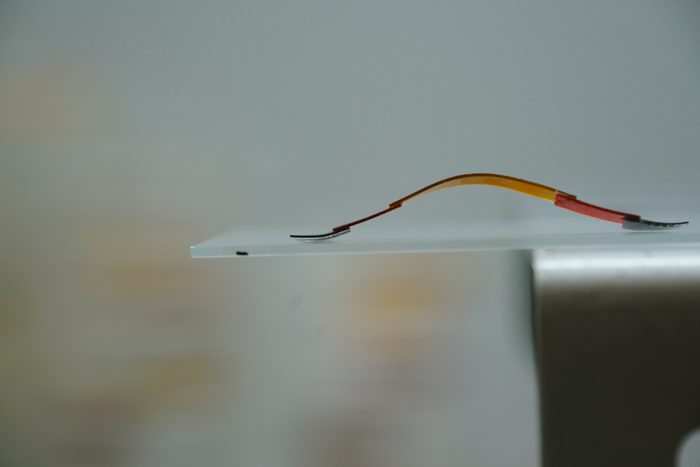
A tiny robot that could one day help doctors perform surgery was inspired by the incredible gripping ability of geckos and the efficient locomotion of inchworms.
The new robot, developed by engineers at the University of Waterloo, utilizes ultraviolet (UV) light and magnetic force to move on any surface, even up walls and across ceilings.
It is the first soft robot of its kind that doesn’t require connection to an external power supply, enabling remote operation and versatility for potential applications such as assisting surgeons and searching otherwise inaccessible places.

“This work is the first time a holistic soft robot has climbed on inverted surfaces, advancing state-of-the-art soft robotics innovation,” said Dr. Boxin Zhao, a professor of chemical engineering. “We are optimistic about its potential, with much more development, in several different fields.”
Constructed from a smart material, the robot – dubbed the GeiwBot by researchers because of the creatures that inspired it – can be altered at the molecular level to mimic how geckos stick and unstick powerful grippers on their feet.
That enables the robot – about four centimetres long, three millimetres wide and one millimetre thick – to climb on a vertical wall and across the ceiling without being tethered to a power source.
Zhao and his research team constructed the robot using liquid crystal elastomers and synthetic adhesive pads. A light-responsive polymer strip simulates the arching and stretching motion of an inchworm, while gecko-inspired magnet pads at either end do the gripping.
“Even though there are still limitations to overcome, this development represents a significant milestone for utilizing biomimicry and smart materials for soft robots,” said Zhao, the University of Waterloo Endowed Chair in Nanotechnology. “Nature is a great source of inspiration and nanotechnology is an exciting way to apply its lessons.”
An untethered soft robot paves the way for potential surgical applications via remote operation inside the human body and for sensing or searching in dangerous or hard-to-reach places during rescue operations.
The next step for researchers is to develop a solely light-driven climbing soft robot that doesn’t require a magnetic field and uses near-infrared radiation instead of UV light to improve biocompatibility.
IMAGE CREDIT: University of Waterloo


Leave a Reply