HAVE YOUR SAY.
Join us in The Bullpen, where the members of the Scientific Inquirer community get to shape the site’s editorial decision making. We’ll be discussing people and companies to profile on the site. On Wednesday, January 11 at 5:30pm EST, join us on Discord and let’s build the best Scientific Inquirer possible.
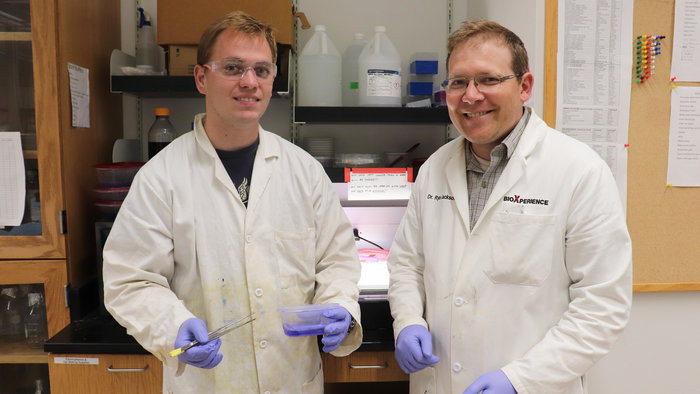
In a rare feat, Utah State University biochemists Thomson Hallmark and Ryan Jackson, along with collaborators, published not one, but two seminal papers in a top-tier, peer-reviewed journal this week. Their findings describe the structure and function of a newly discovered CRISPR immune system that – unlike better-known CRISPR systems that deactivate foreign genes to protect cells – shuts down infected cells to thwart infection.
“With this new system, known as Cas12a2, we’re seeing a structure and function unlike anything that’s been observed in CRISPR systems to date,” says Jackson, assistant professor in Utah State’s Department of Chemistry and Biochemistry.
In tandem papers, the USU researchers, along with colleagues from Germany’s Helmholtz Institute for RNA-based Infection Research, U.S.-based biotechnology company Benson Hill and the University of Texas at Austin, report findings in “Cas12a2 Elicits Abortive Infection via RNA-triggered Destruction of dsDNA,” and “RNA Targeting Unleashes Indiscriminate Nuclease Activity of CRISPR-Cas12a2” in the January 4, 2023 issue of Nature.The research is supported by the U.S. Department of Health & Human Services National Institutes of Health.

CRISPR, a manageable acronym for the mouthful “Clustered Regularly Interspaced Short Palindromic Repeats,” has captured the imaginations of scientists and lay people alike, with its gene-editing potential. Study of CRISPR DNA sequences and CRISPR-associated (Cas) proteins, which are actually bacterial immune systems, is still a young field, although it’s receiving widespread attention for its gene-editing applications and the recent Nobel Prize awarded to Jennifer Doudna and Emmanuel Charpentier. Jackson and Hallmark are among researchers around the globe deciphering the basic structure of these systems and what makes them tick.
“The findings reported in our two Nature papers were nearly six years in the making,” Jackson says.
Identified as a distinct immune system within the last five years, the Class 2, type V Cas12a2 is somewhat similar to the better-known CRISPR-Cas9, which binds to target DNA and cuts it – like molecular scissors – effectively shutting off a targeted gene. But CRISPR-Cas12a2 binds a different target than Cas9, and that binding has a very different effect.
“The Cas12a2 protein undergoes major conformational changes upon binding to RNA that opens an indiscriminate active site for DNA destruction,” Jackson says. “Cas12a2 destroys the DNA and RNA in target cells, causing them to go senescent.”
Using cryo-electron microscopy or “cryo-EM,” the USU team demonstrated this unique aspect of CRISPR-Cas12a2, including its RNA-triggered degradation of single-stranded RNA, single-stranded DNA and double-stranded DNA, resulting in a naturally occurring defensive strategy called abortive infection.
“Abortive infection is a natural phage resistance strategy used by bacteria and archaea to limit the spread of viruses and other pathogens,” says Hallmark, a third-year doctoral student. “For example, abortive infection prevents viral components that have infected a cell from replicating.”
Jackson says the team captured the structure of Cas12a2 in the act of cutting double-stranded DNA.
“Incredibly, Cas12a2 nucleases bend the usually straight piece of double-helical DNA 90 degrees, to force the backbone of the helix into the enzymatic active site, where it is cut,” he says. “It’s a change in structure that’s extraordinary to observe – a phenomenon that elicits audible gasps from fellow scientists.”
Jackson says the difference between a healthy cell and a malignant cell or infected cell, is genetic.
“If Cas12a2 could be harnessed to identify, target and destroy cells at the genetic level, the potential therapeutic applications are significant,” he says.
In addition, Cas12a2’s RNA diagnostic capabilities, described in the set of papers, could advance efforts to stem the effects of a number of genetic diseases.
“We’re just scratching the surface, but we believe Cas12a2 could lead to improved and additional CRISPR technologies that will greatly benefit society,” Jackson says.
IMAGE CREDIT: M. Muffoletto/USU



Leave a Reply