Unlike women, who are born with all the eggs they’ll ever have, men can continue to produce sperm throughout their adult lives. To do so, they require a constant renewal of spermatogonial stem cells, which give rise to sperm.
This reinvigoration of stem cells depends on a newly characterized stem cell self-renewal factor called DOT1L, according to research by Jeremy Wang of the University of Pennsylvania School of Veterinary Medicine and colleagues. When mice lack DOT1L, the team showed, they fail to maintain spermatogonial stem cells, and thus, lack the ability to continuously produce sperm.
Scientists have discovered only a handful of stem cell renewal factors, so the find, published in the journal Genes and Development, adds another entity to a rarified group.
HAVE YOUR SAY.
Join us in The Bullpen, where the members of the Scientific Inquirer community get to shape the site’s editorial decision making. We’ll be discussing people and companies to profile on the site. On Wednesday, July 20 at 5:30pm EST, join us on Discord and let’s build the best Scientific Inquirer possible.
“This novel factor was only able to be identified by finding this unusual phenotype: the fact that mice lacking DOT1L were not able to continue to produce sperm,” says Wang, the Ralph L. Brinster President’s Distinguished Professor at Penn Vet and a corresponding author on the paper. “Identifying this essential factor not only helps us understand the biology of adult germline stem cells but could also allow us to one day reprogram somatic cells, like a type of skin cell called fibroblasts, to become germline stem cells, essentially creating a gamete in a petri dish. That is the next frontier for fertility treatment.”
The researchers happened upon DOT1L’s role in stem cell self-renewal serendipitously. The gene is expressed widely; mice with a mutant version of DOT1L in all of their cells don’t survive past the embryonic stage of development. But based on DOT1L’s genetic expression patterns, Wang and colleagues believed that it could play a role in meiosis, the cell division process that gives rise to sperm and eggs. So, they decided to see what happened when they mutated the gene only in these germ cells.
“When we did this, the animals lived and appeared healthy,” Wang says. “When we looked closer, however, we found that the mice with the mutant DOT1L in their germ cells could complete an initial round of sperm production, but then the stem cells became exhausted and the mice lost all germ cells.”
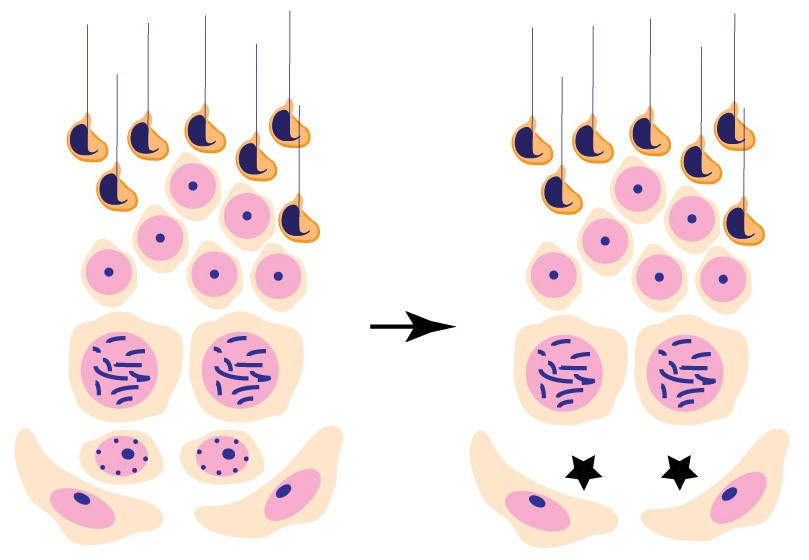
This drop-off in sperm production could arise due to other problems. But various lines of evidence supported the link between DOT1L and a failure of stem cell self-renewal. In particular, the researchers found that the mice experienced a sequential loss of the various stages of sperm development, first failing to make spermatogonia and then spermatocytes, followed by round spermatids, and then elongated spermatids.
In a further experiment, the researchers observed what happened when DOT1L was inactivated in germ cells not from birth, but during adulthood. As soon as Wang and colleagues triggered the DOT1L loss, they observed the same sequential loss of sperm development they had seen in the mice born without DOT1L in their germ cells.
Previously, other scientific groups have studied DOT1L in the context of leukemia. Overexpression of the gene in the progenitors of blood cells can lead to the malignancy. From that line of investigation, it was known that DOT1L acts as a histone methyltransferase, an enzyme that adds a methyl group to histones to influence gene expression.
To see whether the same mechanism was responsible for the results Wang and his team had observed in sperm development, the researchers treated spermatogonial stem cells with a chemical that blocks the methyltransferase activity of DOT1L. When they did so, the stem cells’ ability to give rise to spermatogonia was significantly reduced. The treatment also impaired the ability of stem cells to tag histones with a methyl group. And when these treated stem cells were transplanted into otherwise healthy mice, the animals’ spermatogonial stem cell activity was cut in half.
The team found that DOT1L appeared to be regulating a gene family known as Hoxc, transcription factors that play significant roles in regulating the expression of a host of other genes.
“We think that DOT1L promotes the expression of these Hoxc genes by methylating them,” says Wang. “These transcription factors probably contribute to the stem cell self-renewal process. Finding out the details of that is a future direction for our work.”
A longer-term goal is using factors like DOT1L and others involved in germline stem cell self-renewal to help people who have fertility challenges. The concept is to create germ cells from the ground up.
“That’s the future of this field: in vitro gametogenesis,” Wang says. “Reprogramming somatic cells to become spermatogonial stem cells is one of the steps. And then we’d have to figure out how to have those cells undergo meiosis. We’re in the early stages of envisioning how to accomplish this multi-step process, but identifying this self-renewal factor brings us one step closer.”
IMAGE CREDIT: Jeremy Wang

Leave a Reply