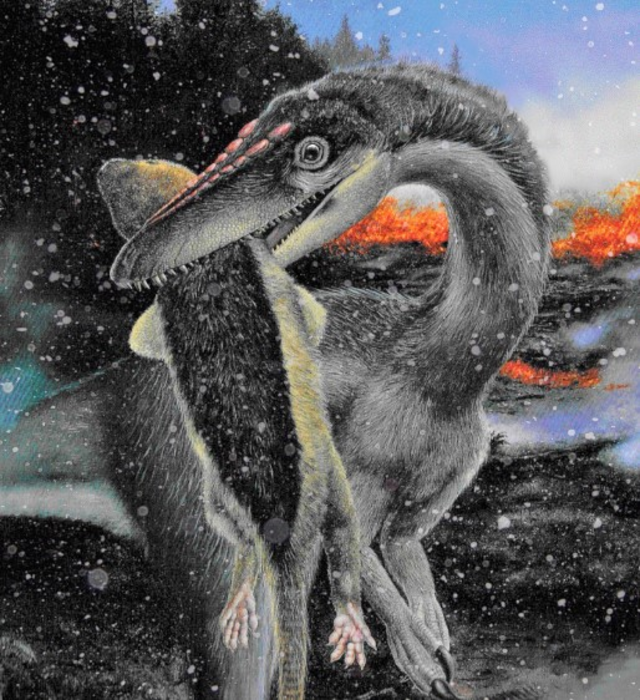
Many of us know the conventional theory of how the dinosaurs died 66 million years ago: in Earth’s fiery collision with a meteorite, and a following global winter as dust and debris choked the atmosphere. But there was a previous extinction, far more mysterious and less discussed: the one 202 million years ago, which killed off the big reptiles who up until then ruled the planet, and apparently cleared the way for dinosaurs to take over. What caused the so-called Triassic-Jurassic Extinction, and why did dinosaurs thrive when other creatures died?
We know that the world was generally hot and steamy during the Triassic Period, which preceded the extinction, and during the following Jurassic, which kicked off the age of dinosaurs. However, a new study turns the idea of heat-loving dinosaurs on its head: It presents the first physical evidence that Triassic dinosaur species—then a minor group largely relegated to the polar regions—regularly endured freezing conditions there. The telltale indicators: dinosaur footprints along with odd rock fragments that only could have been deposited by ice. The study’s authors say that during the extinction, cold snaps already happening at the poles spread to lower latitudes, killing off the coldblooded reptiles. Dinosaurs, already adapted, survived the evolutionary bottleneck and spread out. The rest is ancient history.
“Dinosaurs were there during the Triassic under the radar all the time,” said Paul Olsen, a geologist at Columbia University’s Lamont-Doherty Earth Observatory, and lead author of the study. “The key to their eventual dominance was very simple. They were fundamentally cold-adapted animals. When it got cold everywhere, they were ready, and other animals weren’t.”
HAVE YOUR SAY.
Join us in The Bullpen, where the members of the Scientific Inquirer community get to shape the site’s editorial decision making. We’ll be discussing people and companies to profile on the site. On Wednesday July 6 at 5:30pm EST, join us on Discord and let’s build the best Scientific Inquirer possible.
The study, based on recent excavations in the remote desert of northwest China’s Junggar Basin, was just published in the journal Science Advances.
Dinosaurs are thought to have first appeared during the Triassic Period in temperate southerly latitudes about 231 million years ago, when most of the planet’s land was joined together in one giant continent geologists call Pangaea. They made it to the far north by about 214 million years ago. Until the mass extinction at 202 million years, the more expansive tropical and subtropical regions in between were dominated by reptiles including relatives of crocodiles and other fearsome creatures.
During the Triassic, and for most of the Jurassic, atmospheric concentrations of carbon dioxide ranged at or above 2000 parts per million—five times today’s levels—so temperatures must have been intense. There is no evidence of polar ice caps then, and excavations have shown that deciduous forests grew in polar regions. However, some climate models suggest that the high latitudes were chilly some of the time; even with all that CO2, they would have received little sunlight much of the year, and temperatures would decline at least seasonally. But until now, no one has produced any physical evidence that they froze.
At the end of the Triassic, a geologically brief period of perhaps a million years saw the extinction of more than three quarters of all terrestrial and marine species on the planet, including shelled creatures, corals and all sizable reptiles. Some animals living in burrows, such as turtles, made it through, as did a few early mammals. It is unclear exactly what happened, but many scientists connect it to a series of massive volcanic eruptions that could have lasted hundreds of years at a stretch. At this time, Pangaea started to split apart, opening what is now the Atlantic Ocean, and separating what are now the Americas from Europe, Africa and Asia. Among other things, the eruptions would have caused atmospheric carbon dioxide to skyrocket beyond its already high levels, causing deadly temperatures spikes on land, and turning ocean waters too acid for many creatures to survive.
The authors of the new study cite a third factor: During the eruptions’ fiercest phases, they would have belched sulfur aerosols that deflected so much sunlight, they caused repeated global volcanic winters that overpowered high greenhouse-gas levels. These winters might have lasted a decade or more; even the tropics may have seen sustained freezing conditions. This killed uninsulated reptiles, but cold-adapted, insulated dinosaurs were able to hang on, say the scientists.
The researchers’ evidence: fine-grained sandstone and siltstone formations left by sediments in shallow ancient lake bottoms in the Junggar Basin. The sediments formed 206 million years ago during the late Triassic, through the mass extinction and beyond. At that time, before landmasses rearranged themselves, the basin lay at about 71 degrees north, well above the Arctic Circle. Footprints found by the authors and others show that dinosaurs were present along shorelines. Meanwhile, in the lakes themselves, the researchers found abundant pebbles up to about 1.5 centimeters across within the normally fine sediments. Far from any apparent shoreline, the pebbles had no business being there. The only plausible explanation for their presence: they were ice-rafted debris (IRD).
Briefly, IRD is created when ice forms against a coastal landmass and incorporates bits of underlying rock. At some point the ice becomes unmoored and drifts away into the adjoining water body. When it melts, the rocks drop to the bottom, mixing with normal fine sediments. Geologists have extensively studied ancient IRD in the oceans, where it is delivered by glacial icebergs, but rarely in lake beds; the Junggar Basin discovery adds to the scant record. The authors say the pebbles were likely picked up during winter, when lake waters froze along pebbly shorelines. When warm weather returned, chunks of that ice floated off with samples of the pebbles in tow, and later dropped them.
“This shows that these areas froze regularly, and the dinosaurs did just fine,” said study co-author Dennis Kent, a geologist at Lamont-Doherty.
How did they do it? Evidence has been building since the 1990s that many if not all non-avian dinosaurs including tyrannosaurs had primitive feathers. If not for flight, some coverings could have used for mating display purposes, but the researchers say their main purpose was insulation. There is also good evidence that, unlike the cold-blooded reptiles, many dinosaurs possessed warm-blooded, high-metabolism systems. Both qualities would have helped dinosaurs in chilly conditions.
“Severe wintery episodes during volcanic eruptions may have brought freezing temperatures to the tropics, which is where many of the extinctions of big, naked, unfeathered vertebrates seem to have occurred,” said Kent. “Whereas our fine feathered friends acclimated to colder temperatures in higher latitudes did OK.”
The findings defy the conventional imagery of dinosaurs, but some prominent specialists say they are convinced. “There is a stereotype that dinosaurs always lived in lush tropical jungles, but this new research shows that the higher latitudes would have been freezing and even covered in ice during parts of the year,” said Stephen Brusatte, a professor of paleontology and evolution at the University of Edinburgh. “Dinosaurs living at high latitudes just so happened to already have winter coats [while] many of their Triassic competitors died out.”
Randall Irmis, curator of paleontology at the Natural History Museum of Utah, and specialist in early dinosaurs, agrees. “This is the first detailed evidence from the high paleolatitudes, the first evidence for the last 10 million years of the Triassic Period, and the first evidence of truly icy conditions,” he said. “People are used to thinking of this as being a time when the entire globe was hot and humid, but that just wasn’t the case.”
Olsen says the next step to better understand this period is for more researchers to look for fossils in former polar areas like the Junggar Basin. “The fossil record is very bad, and no one is prospecting,” he said. “These rocks are gray and black, and it is much harder to prospect [for fossils] in these strata. Most paleontologists are attracted to the late Jurassic, where it’s known there are many big skeletons to be had. The paleo-Arctic is basically ignored.”
IMAGE CREDIT: Larry Felder




Leave a Reply