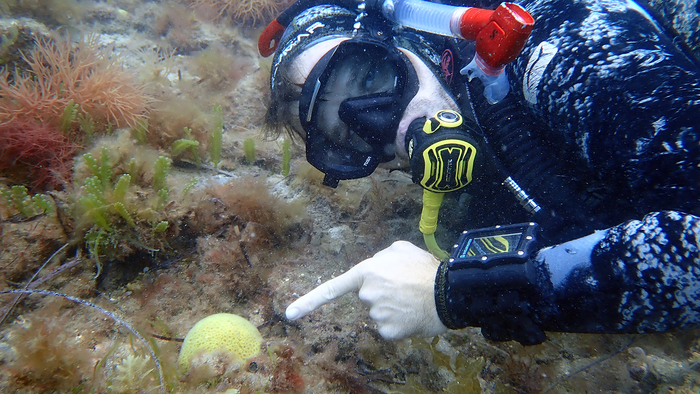
With about one-third of the world’s corals currently under threat of extinction due to climate change, Curtin researchers have made the encouraging discovery of a ‘lost’ species of coral that had been hidden for more than 50 years.
Lead author PhD student Mr David Juszkiewicz, from the Coral Conservation and Research Group within the Trace and Environmental DNA (TrEnD) Laboratory in Curtin’s School of Molecular and Life Sciences, said researchers found the coral Plesiastrea versipora, which is widespread in the Indo-Pacific Ocean, was actually hiding a second, cryptic species.
“The species Plesiastrea peroni was described some 200 years ago however as time went on taxonomists clumped it with Plesiastrea versipora but we have now resurrected the former species, which had been hidden for more half a century,” Mr Juszkiewicz said.
“We trawled through 200 years of historical and modern-day literature to firstly understand the larger morphological characteristics of Plesiastrea versipora, which was first described as a single species in 1816.
“By diving on various sites around Australia and the Indo-Pacific, we collected samples, which we used to study the micromorphology and microstructure of the coral skeleton to further identify its unique intricate features.
“After carrying out genetic sequencing, we found this species of coral actually contained a second, cryptic species, which we named Plesiastrea peroni – and this is found north of the Tropic of Capricorn in Australia and across the Indo-Pacific.
“Being able to accurately identify species is paramount to quality ecological research and conservation decision-making, so this study will allow coral ecologists and biologists to know which species of Plesiastrea they are working on.”
Mr Juszkiewicz said the discovery of a new species assisted in biodiversity conservation and helped to prevent the loss of species diversity.
“With the ever-worsening impact of climate change on the marine environment, it has never been more important to understand coral species and where they occur,” Mr Juszkiewicz said.
“We cannot protect species if we do not know about their existence or their present-day geographic range so this study is a step towards achieving this.
“With many species of both marine and terrestrial life under threat from human-driven climate change, this study bolsters our understanding of the tree of life and highlights the importance of taxonomy projects that help us understand the organisms that exist on our planet, how they are all related and how to better protect them.”
IMAGE CREDIT: Nicole Carey


Leave a Reply