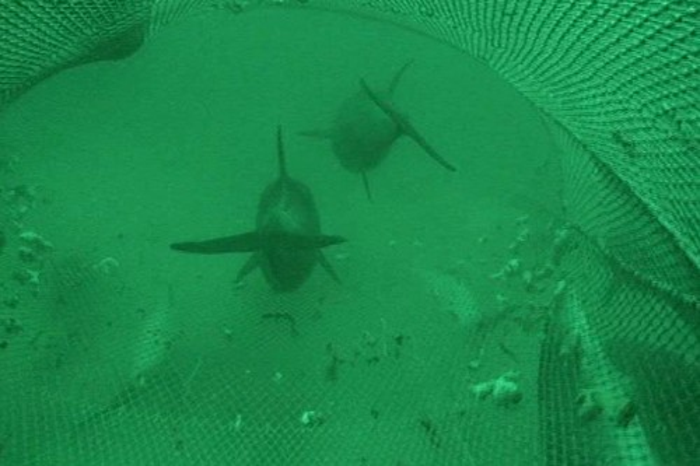
An international team of researchers have developed a method to assess sustainable levels of human-caused wildlife mortality, which when applied to a trawl fishery shows that dolphin capture is not sustainable.

The study, led by scientists at the University of Bristol and United Arab Emirates University was published today in Conservation Biology.
Human activities like commercial fishing can result in the accidental death of non-targeted wildlife, threatening protected and endangered species. “Bycatch and discarding of marine wildlife in commercial fisheries are major challenges for biodiversity conservation and fisheries management the world over”, said Dr. Simon Allen of Bristol’s School of Biological Sciences, who studies dolphin behaviour and interactions with fisheries.
Some fisheries are not selective and damage habitat, as well as capturing protected species, like dolphins, seals, turtles, sharks and rays. “Bycatch Reduction Devices were placed in Western Australian trawl nets in 2006, but no quantitative assessment of the impact was carried out. We set out to model different levels of dolphin capture, including those reported in skippers’ logbooks and those by independent observers. Unfortunately, our results show clearly that even the lowest reported annual dolphin capture rates are not sustainable”, Dr. Allen said.
The study’s lead author, Dr. Oliver Manlik, Assistant Professor at the United Arab Emirates University, said: “We introduce a novel approach to assessing human-caused mortality to wildlife that can be applied to fisheries bycatch, hunting, lethal control measures or wind turbine collisions. And when we incorporate stochastic factors, random events, we show that previous methods of assessing wildlife mortality were not conservative enough.” Dr. Manlik added “This raises concerns for the dolphin population and highlights a problem with other assessments that do not account for random events, like heatwaves, because these environmental fluctuations are becoming more frequent and intense with climate change.”
With only voluntary or low levels of fisheries monitoring and no quantitative conservation objectives, Dr. Allen notes that the UK and EU are also failing to address the bycatch problem. Greater transparency and the application of more rigorous methods would improve the scientific basis for decision-making around the impacts of fisheries on non-target species like dolphins, whales, seals and seabirds. The researchers include a co-author from the Species Conservation Toolkit Initiative and intend to make the new method of assessing human impacts, called ‘Sustainable Anthropogenic Mortality in Stochastic Environments’ or ‘SAMSE’, easily accessible to researchers and wildlife managers worldwide.
IMAGE CREDIT: Dr Simon Allen

Leave a Reply