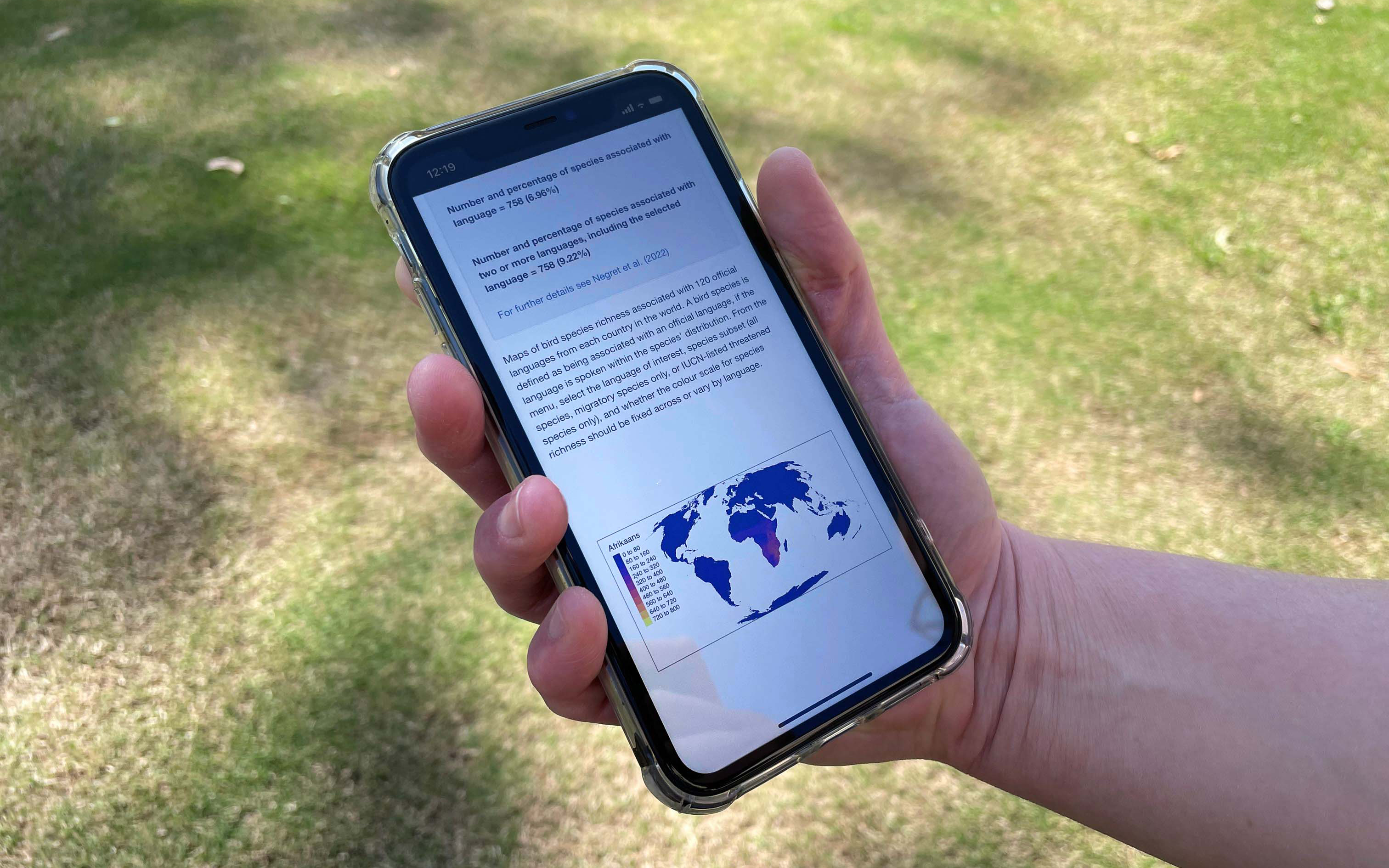
Researchers from The University of Queensland have helped design an app to protect birds at risk of extinction across the world by breaking down language barriers between scientists.
The Bird Language Diversity web app will help provide a “birds eye view”, ensuring vital information is shared to improve worldwide conservation.
UQ’s Dr Pablo Negret said the research team analyzed more than 10,000 bird species, and found that 1587 species have 10 languages or more spoken within their distributions.
“Scientific information on species can be scattered across different languages, and valuable information can go missing or get lost in translation,” Dr Negret said.
“Without adequate sharing of information, this can compromise the effectiveness of conservation measures.
“Take the common pochard bird for example; it is classified as vulnerable and spans 108 countries in Europe, Russia, Asia and north Africa, where a total of 75 official languages are spoken.
“The survival of the common pochard, and so many other species, depends on effective collaboration and policy agreements among people with diverse linguistic and cultural backgrounds.”
“This app reveals where threatened and migratory birds exist geographically, in relation to the language spoken in those regions,” Dr Negret said.
“Simply select a language to see the number of bird species that live within that language zone, or compare the impact of that language on bird species globally.
“We hope the app will incentivize researchers and conservation organizations to interact with their peers in other regions, especially if they speak different languages, and be a starting point to allow everyone to work together to protect threatened species.”
UQ researcher and co-author of paper, Dr Tatsuya Amano, said this work could extend further than bird species.
“Any species, whether it’s mammals, amphibians, or plants, with a range spanning multiple countries will be impacted by language barriers, as will species that migrate across different countries, such as marine species and butterflies,” Dr Amano said.
“The magnitude of the impact of poor communication on such an important issue is evident, and is the reason why we’re working hard to improve science communication across languages.”
Dr Amano said positive steps had been taken in recent years to lower the language barrier and facilitate improved science communication, but there was still room for improvement.
“The scientific community is certainly becoming better at overcoming these barriers, and many academic journals have recently changed their policies to become more language inclusive,” he said.
“But the issue is still largely overlooked, so we really hope our most recent work will shed more light on the importance of overcoming these barriers to better conserve life on Earth.”
IMAGE CREDIT: The University of Queensland



Leave a Reply